# Cells in a Range on an Excel Sheet
**Difficulty:** EASY
[External](https://leetcode.com/problems/cells-in-a-range-on-an-excel-sheet)
Canonical: https://scaleengineer.com/dsa/problems/cells-in-a-range-on-an-excel-sheet
**Data structures:** String
---
## Problem
A cell `(r, c)` of an excel sheet is represented as a string `""` where:
* `` denotes the column number `c` of the cell. It is represented by **alphabetical letters**.
* For example, the `1st` column is denoted by `'A'`, the `2nd` by `'B'`, the `3rd` by `'C'`, and so on.
* `` is the row number `r` of the cell. The `rth` row is represented by the **integer** `r`.
You are given a string `s` in the format `":"`, where `` represents the column `c1`, `` represents the row `r1`, `` represents the column `c2`, and `` represents the row `r2`, such that `r1 <= r2` and `c1 <= c2`.
Return _the **list of cells**_ `(x, y)` _such that_ `r1 <= x <= r2` _and_ `c1 <= y <= c2`. The cells should be represented as **strings** in the format mentioned above and be sorted in **non-decreasing** order first by columns and then by rows.
**Example 1:**
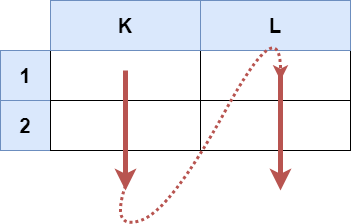
**Input:** s = "K1:L2"
**Output:** ["K1","K2","L1","L2"]
**Explanation:**
The above diagram shows the cells which should be present in the list.
The red arrows denote the order in which the cells should be presented.
**Example 2:**

**Input:** s = "A1:F1"
**Output:** ["A1","B1","C1","D1","E1","F1"]
**Explanation:**
The above diagram shows the cells which should be present in the list.
The red arrow denotes the order in which the cells should be presented.
**Constraints:**
* `s.length == 5`
* `'A' <= s[0] <= s[3] <= 'Z'`
* `'1' <= s[1] <= s[4] <= '9'`
* `s` consists of uppercase English letters, digits and `':'`.
# Approaches
## Parsing with Integer-based Row Iteration
This approach involves parsing the input string `s` to extract the start and end coordinates. We identify the column characters and row characters by their fixed positions in the string. The row characters are then converted to their integer equivalents. The core of the solution is a pair of nested loops. The outer loop iterates through the column characters from the start column to the end column. The inner loop iterates through the row numbers (as integers) from the start row to the end row. Inside the inner loop, we construct the cell identifier string by combining the current column character and row number, and add it to our result list.
**Time:** O(C * R), where C is the number of columns and R is the number of rows in the given range. We must visit each cell in the range once to generate its string representation. The total number of cells is C * R. · **Space:** O(C * R) to store the output list. The space required is proportional to the number of cells in the range, as each cell string is stored in the result list. An additional O(1) space is used for loop variables.
**Pros:** The logic is straightforward and easy to follow, directly translating the problem's requirements into code.; It correctly generates the cells in the specified order (column-first, then row-first).
**Cons:** It performs an unnecessary conversion of row characters to integers. While this is a minor operation, a more direct approach can avoid it.
### Explanation
This approach works by first parsing the necessary boundary information from the input string `s`. Given the fixed format `C1R1:C2R2`, we can reliably extract the start column `c1` at index 0, start row `r1` at index 1, end column `c2` at index 3, and end row `r2` at index 4.
While the columns `c1` and `c2` are characters and can be used directly in a loop, the row boundaries `r1` and `r2` are digit characters. This approach converts them into integers before looping. For example, `s.charAt(1) - '0'` converts the character '1' to the integer 1.
After parsing, two nested loops are used to generate the cell names. The outer loop iterates through each column character from `c1` to `c2`. For each column, the inner loop iterates through each row number from `r1` to `r2`. Inside the inner loop, the cell name is constructed by concatenating the current column character and row integer. This new string is then added to a list. The final list, containing all cell names in the desired order, is returned.
```java
import java.util.ArrayList;
import java.util.List;
class Solution {
public List cellsInRange(String s) {
List result = new ArrayList<>();
char c1 = s.charAt(0);
char c2 = s.charAt(3);
// Convert row characters to integers
int r1 = s.charAt(1) - '0';
int r2 = s.charAt(4) - '0';
for (char c = c1; c <= c2; c++) {
for (int r = r1; r <= r2; r++) {
result.add("" + c + r);
}
}
return result;
}
}
```
### Algorithm
- Initialize an empty `ArrayList` of strings, let's call it `result`.
- Get the starting column character `c1` from `s.charAt(0)`.
- Get the ending column character `c2` from `s.charAt(3)`.
- Get the starting row character from `s.charAt(1)` and convert it to an integer `r1`.
- Get the ending row character from `s.charAt(4)` and convert it to an integer `r2`.
- Start an outer `for` loop that iterates with a `char` variable `c` from `c1` to `c2`.
- Inside the outer loop, start an inner `for` loop that iterates with an `int` variable `r` from `r1` to `r2`.
- In the body of the inner loop, concatenate `c` and `r` to form the cell string.
- Add this new string to the `result` list.
- After both loops have completed, return the `result` list.
## Direct Character Iteration
This is a more streamlined and efficient approach that takes full advantage of the properties of character encoding. Since both the column letters ('A'-'Z') and row digits ('1'-'9') are contiguous in the ASCII table, we can iterate through them directly as characters. This method extracts the start and end characters for both columns and rows and uses two nested `char` loops to generate all combinations. This avoids the intermediate step of converting row characters to integers, making the code slightly cleaner and more performant.
**Time:** O(C * R), where C is the number of columns and R is the number of rows. This is the optimal time complexity because we need to generate C * R strings. The operations inside the loop are constant time. · **Space:** O(C * R) for storing the output list. This space is fundamentally required by the problem's output specification.
**Pros:** This is the most efficient implementation as it avoids any unnecessary data type conversions.; The code is very concise and elegant, leveraging the nature of character types.; It's robust due to its simplicity and directness.
**Cons:** There are no significant disadvantages to this approach; it is perfectly suited for this problem.
### Explanation
This approach is a refinement of the previous one and is considered more direct and efficient. It recognizes that since the row indicators ('1' through '9') are also characters with sequential ASCII values, there is no need to convert them to integers. We can iterate through the rows using a `char` loop, just like we do for the columns.
The implementation extracts all four boundary markers (`c1`, `r1`, `c2`, `r2`) as characters. It then employs two nested `for` loops, both using `char` as the loop variable type. The outer loop runs from `c1` to `c2`, and the inner loop runs from `r1` to `r2`. Inside the loops, the cell string is formed. Using a `StringBuilder` is a good practice for string construction in loops as it can be more efficient than repeated concatenation, although modern Java compilers often optimize simple concatenations. The final string is added to the result list. This method avoids the overhead of character-to-integer conversion, resulting in cleaner and slightly faster code.
```java
import java.util.ArrayList;
import java.util.List;
class Solution {
public List cellsInRange(String s) {
List result = new ArrayList<>();
char c1 = s.charAt(0);
char c2 = s.charAt(3);
char r1 = s.charAt(1);
char r2 = s.charAt(4);
for (char c = c1; c <= c2; c++) {
for (char r = r1; r <= r2; r++) {
StringBuilder sb = new StringBuilder();
sb.append(c);
sb.append(r);
result.add(sb.toString());
}
}
return result;
}
}
```
### Algorithm
- Initialize an empty `ArrayList` of strings, `result`.
- Extract the start column character `c1` from `s.charAt(0)`.
- Extract the end column character `c2` from `s.charAt(3)`.
- Extract the start row character `r1` from `s.charAt(1)`.
- Extract the end row character `r2` from `s.charAt(4)`.
- Start an outer `for` loop that iterates with a `char` variable `c` from `c1` to `c2`.
- Inside, start an inner `for` loop that iterates with a `char` variable `r` from `r1` to `r2`.
- In the inner loop, construct the cell string by appending the character `c` and the character `r`.
- Add the resulting string to the `result` list.
- After the loops complete, return the `result` list.
# Solutions
### Java
```java
class Solution {
public
List cellsInRange(String s) {
List ans = new ArrayList<>();
for (char i = s.charAt(0); i <= s.charAt(3); ++i) {
for (char j = s.charAt(1); j <= s.charAt(4); ++j) {
ans.add(i + "" + j);
}
}
return ans;
}
}
```
### CPP
```cpp
class Solution {
public:
vector cellsInRange(string s) {
vector ans;
for (char i = s[0]; i <= s[3]; ++i)
for (char j = s[1]; j <= s[4]; ++j)
ans.push_back({i, j});
return ans;
}
};
```
### Python
```python
class Solution:
def cellsInRange(self, s: str) -> List[str]: return [chr(i) + str(j) for i in range(
ord(s[0]), ord(s[- 2]) + 1) for j in range(int(s[1]), int(s[- 1]) + 1)]
```