
AI Can Write Code in Seconds. But Can It Stop Malware Too?
Replit integrates Socket Firewall to analyze AI-suggested packages in real time, blocking malicious dependencies before installation.
AI coding assistants have completely changed how developers build software.
Need a REST API? Ask AI. Need authentication? AI can generate it. Need a payment gateway? AI can stitch together the required code in seconds.
But AI doesn't just generate code. It also recommends and imports open-source packages from repositories like npm and PyPI to make that code work. That's where a new security challenge begins.
If an AI assistant like GitHub Copilot, Cursor or Claude unknowingly recommends a malicious dependency, installing it could execute harmful code before a developer even has the chance to review it. As AI-generated code becomes faster and more autonomous, traditional security checks that happen later in the development pipeline may no longer be enough.
To address this, Replit has integrated Socket Firewall directly into its cloud IDE. Instead of checking packages after they've been installed or committed, the firewall evaluates them during installation and blocks suspicious dependencies before they execute. The goal is simple: if AI can generate code instantly, security should be able to respond just as quickly.
Let's discover How Replit did it in this blog today.
Why AI is Changing Software Supply Chain Security
Modern AI coding assistants can generate entire features in seconds. As part of that process, they often recommend external libraries to avoid reinventing functionality. These packages are downloaded from public repositories such as npm and PyPI, which together host millions of open-source libraries.
While this dramatically speeds up development, it also creates a new challenge. AI models recommend packages based on the information available to them, but they don't independently verify whether a package is trustworthy or malicious. If a harmful package exists in a public registry, there's a risk that it could be suggested and installed during development.
Attackers actively exploit this. They publish malicious packages that appear legitimate, hoping developers or increasingly, AI coding assistants will install them.
For example, an AI assistant helping build a payment feature might recommend a package that looks genuine but contains hidden code designed to steal sensitive information. If the developer accepts the suggestion without noticing the issue, the malicious package gets installed immediately. By the time traditional security tools scan the project, the package may already have executed. This is exactly the kind of gap Replit is trying to close.
Why Traditional Security Checks are No Longer Enough
Most software teams already use security tools to scan their dependencies. However, many traditional Software Composition Analysis (SCA) tools work after code has been written and committed to a repository. In a conventional workflow, this delay is usually acceptable because developers manually choose and install packages.
AI-assisted development changes that workflow. Instead of carefully evaluating every dependency, developers often accept AI-generated suggestions to maintain their development speed. As AI agents become more autonomous, packages can be introduced into projects much faster than humans can review them. This means the security check may happen only after a potentially malicious dependency has already been downloaded and executed.
Rather than waiting until later in the software development lifecycle, Replit wanted security to happen at the exact moment a package is requested.
How Socket Firewall Works
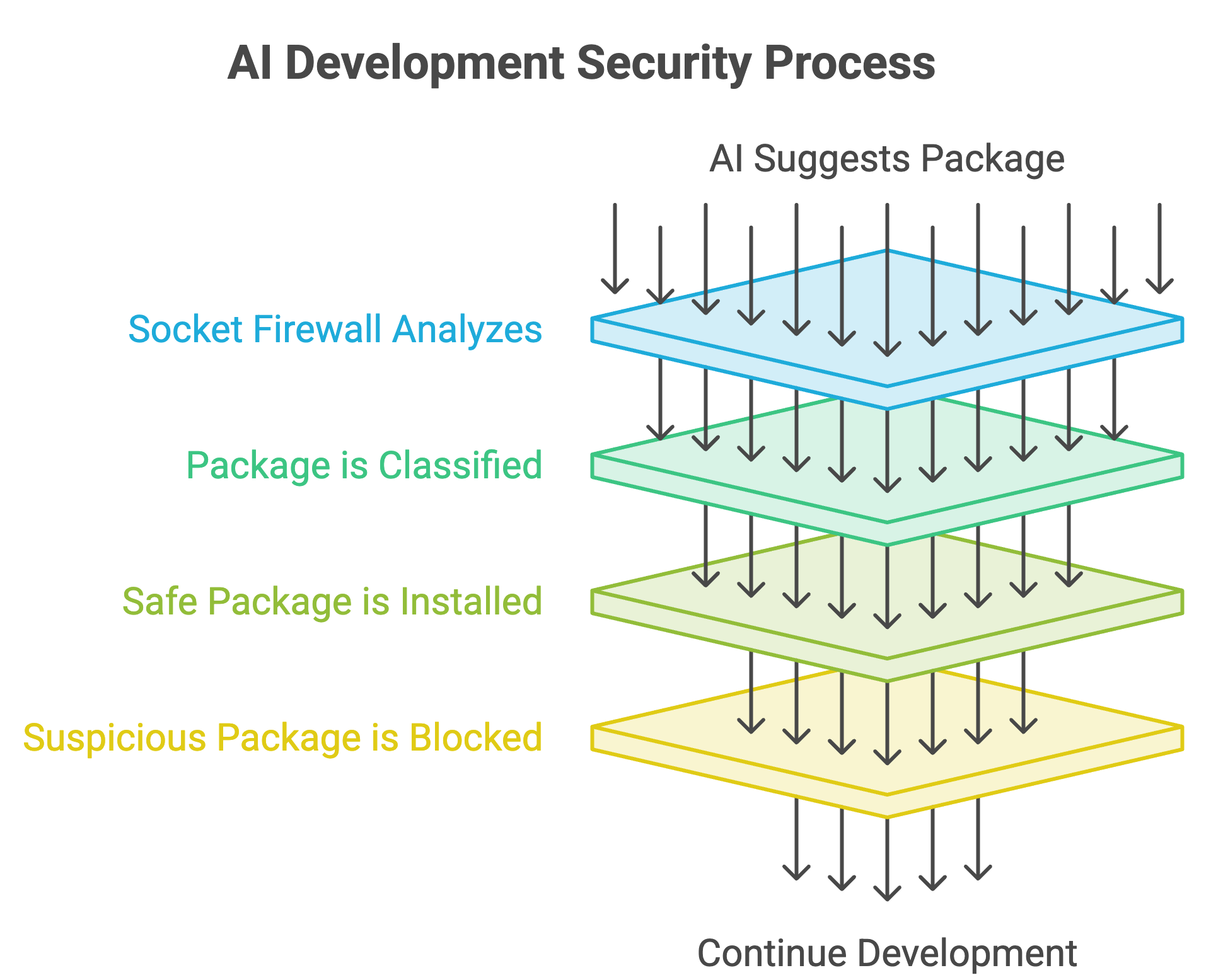
To reduce this risk, Replit integrated Socket Firewall directly into its development environment. Whenever a package manager requests a dependency, Socket Firewall intercepts that request before the package is downloaded.
Instead of relying only on package popularity or historical vulnerability databases, it analyzes the package itself. It examines the package's behavior and structure to identify activities that could indicate malicious intent.
For example, if a package attempts to access local environment variables or execute hidden installation scripts, Socket Firewall blocks the download before the package reaches the developer's environment. The dependency never gets installed.

This approach shifts security earlier in the development process. Instead of detecting problems after installation, the package is evaluated before it has an opportunity to execute.
Protecting Against Dependency Confusion
One of the predominant attacks is dependency confusion. Imagine a company has an internal package named payment-auth-internal. An attacker publishes a package with the same name in a public registry like npm, but assigns it a higher version number.
If an AI coding assistant or package manager resolves the public package instead of the internal one, the malicious dependency could be installed instead. According to Replit, Socket Firewall can detect these namespace collisions during package resolution and block the external package before it is downloaded, preventing the incorrect dependency from being used.
Another Common Threat: Typosquatting
Attackers also rely on something much simpler, spelling mistakes. A malicious package might use a name that's almost identical to a popular library.
For example, a legitimate package name is altered by removing a single character, making it look convincing enough that an AI assistant or developer could accidentally use it.
Because Socket Firewall analyzes the package before installation, it isn't limited to checking whether the package name looks familiar. It also evaluates the package's behavior. If the package contains actions that indicate malicious intent, such as executing unexpected commands during installation, the firewall blocks it before it reaches the developer's environment.
Why Looking Only at CVEs Isn't Enough
Most security tools rely on Common Vulnerabilities and Exposures (CVEs) to identify risky dependencies. These databases contain publicly disclosed vulnerabilities that have already been discovered and documented. The challenge is that newly published malicious packages often don't appear in these databases immediately.
An attacker can upload a poisoned package to a public registry, and it may remain available for days or even weeks before security researchers identify and report it. During that time, an AI coding assistant may still recommend the package because it appears legitimate or popular.
Instead of relying only on historical vulnerability records, Socket analyzes the package itself. It performs both static and dynamic analysis on the package's source code. It examines the package's Abstract Syntax Tree (AST) and traces how the code behaves during execution. If it detects suspicious behavior such as an obfuscated eval() call that attempts to trigger an external network request, the package is classified as malicious, even if no CVE has been published for it.
In other words, the decision isn't based on whether the package has been reported before. It's based on what the package is actually trying to do.
Keeping Security Inside the AI Development Loop
We all know at this point that AI-assisted development dramatically speeds up software creation. A single prompt can generate a feature along with multiple third-party dependencies. Reviewing every suggested package manually would quickly become a bottleneck, reducing many of the productivity gains that AI coding assistants provide.
Replit's approach is to move the security check directly into the development workflow. When the AI recommends a package, Socket evaluates it immediately. If the package is considered safe, installation continues. If suspicious behavior is detected, the package is blocked before it reaches the developer's environment.
This creates an automated feedback loop where package selection and security evaluation happen together, allowing developers to continue working without waiting for a later review stage.

Moving Towards Zero-Trust Dependency Management
As AI agents generate more code and recommend more dependencies, relying on manual package reviews becomes increasingly difficult. The external packages should no longer be trusted simply because they're widely used or have existed for a long time. Instead, every package should be evaluated before it is installed.
Replit applies this idea by embedding security directly into its cloud IDE. Rather than running heavy security processes on a developer's local machine, the inspection is performed by Replit's backend infrastructure. Socket completes these scans in milliseconds, allowing package installation to continue without introducing noticeable delays.
Keeping the security checks fast is important because developers are less likely to bypass or disable protections that don't interrupt their workflow.
Why This Matters for AI-Assisted Development
The way software is written is changing. Instead of writing every line of code manually, developers are increasingly collaborating with AI assistants that can generate code, recommend libraries, and automate repetitive tasks.
As this trend continues, software supply chain security also needs to evolve. Traditional security tools were designed for a workflow where developers manually selected dependencies and security checks happened later in the development pipeline.
AI-assisted development is much faster. Packages can be suggested, downloaded, and installed within seconds. If security only begins after the dependency has already been added to the project, malicious code may already have had an opportunity to execute.
Replit's integration of Socket Firewall reflects a shift toward inline security, where packages are evaluated at the moment they're requested rather than after they're installed. This approach will become increasingly important as AI-generated code becomes more common across software development.
Key Takeaways
AI coding assistants don't just generate code, they also recommend third-party packages that can introduce software supply chain risks.
Traditional security tools often scan dependencies after installation or commit, which may be too late for AI-assisted development.
Socket Firewall evaluates packages during installation, helping block suspicious dependencies before they execute.
Instead of relying only on known CVEs, Socket analyzes package behavior to detect previously unknown threats.
By embedding security directly into the IDE, Replit aims to protect developers without slowing down the AI-assisted development experience.
Official blog from Replit: Replit deploys Socket Firewall to secure AI development fullstack
By now, you must have had a clear idea of, AI Can Write Code in Seconds. But Can It Stop Malware Too? In a nutshell, AI coding assistants make software development faster, but they also increase the risk of introducing malicious dependencies. Replit addresses this by integrating Socket Firewall into its IDE, allowing packages to be analyzed and blocked before they are installed.
Congratulations! You've just advanced another step in your tech journey. Keep progressing!