
How Anthropic Built Claude's Multi-Agent Research System
Anthropic's Claude Research uses multiple AI agents that collaborate, reason, and coordinate to tackle complex research more effectively.
Have you ever given an AI a really complex task and noticed it either misses important details or gets stuck following one line of thought? That's because most AI assistants work like a single person doing all the research, they search, think, and answer one step at a time. While this works well for simple questions, it starts breaking down when a task requires exploring multiple ideas simultaneously.
For example, imagine asking: "Find the top AI startups in healthcare, compare their products, funding, founders, and recent acquisitions."
A single AI agent has to search for companies, verify information from different sources, compare products, track funding rounds, and adjust its approach as it discovers new information. Doing all of this within a single context window quickly becomes difficult.
Instead of making one agent do everything, Anthropic took a different approach while building Claude Research.
They built a multi-agent research system where one AI agent acts like a project manager and delegates different parts of the research to multiple AI agents working in parallel. Once each agent finishes its task, the results are combined into a single, well-structured answer. The results were impressive. According to Anthropic's internal evaluations, this architecture outperformed a single Claude Opus 4 agent by 90.2% on complex research tasks, showing the benefits of breaking large problems into smaller parallel tasks.
So, how does this system actually work? Let’s discover in this blog today.
Why a Single Agent Isn't Always Enough
Traditional AI systems work well when the path to the answer is predictable. A Retrieval-Augmented Generation (RAG) system, for example, retrieves relevant documents and uses them to generate a response.
Research, however, doesn't usually work that way.

As the AI discovers new information, it often needs to explore new directions before arriving at a final answer. For a single AI agent, all of this happens one step at a time. It searches, analyzes the results, decides what to do next, and repeats the process until it has enough information.
Since every step depends on the previous one, the agent can only explore one direction at a time.
Anthropic addressed this by breaking a large research task into multiple smaller tasks. Instead of relying on a single agent, the system creates multiple subagents, each responsible for investigating a different part of the problem. Once they finish, they return only their key findings to a Lead Researcher, which combines everything into the final response.
Another benefit of this approach is that each subagent gets its own context window. Rather than fitting all the research into a single context window, the workload is distributed across multiple agents, allowing the system to collectively process much more information than a single agent could handle.
The Multi-Agent Architecture
At the heart of Claude Research is an orchestrator-worker architecture.
Instead of every agent making independent decisions, the system has a clear hierarchy.
A Lead Researcher acts as the orchestrator. Its job isn't to search the web directly, it first understands the user's request, plans a research strategy, and decides how the work should be divided.
It then creates multiple subagents, each responsible for investigating a specific part of the problem.
For example, if the user asks for a comparison of AI companies, one subagent might research funding, another could analyze product offerings, while another explores recent announcements. Since these subagents work in parallel, the system can gather information much faster than a single sequential workflow.

Source: Anthropic’s blog
More Than Just Parallel Search
One interesting aspect of Anthropic's design is that the subagents aren't simply performing independent web searches.
Each subagent is itself an AI agent capable of reasoning, using tools, evaluating search results, and deciding what to do next.
As they work, they refine their searches based on the information they discover instead of following a predefined sequence of steps.
Once a subagent completes its investigation, it doesn't return every document it found. Instead, it summarizes the important findings and sends only the relevant information back to the lead agent.
This effectively turns each subagent into an intelligent filter, reducing a large amount of information into a concise summary that the lead agent can use to produce the final answer.
How the Entire Research Process Works
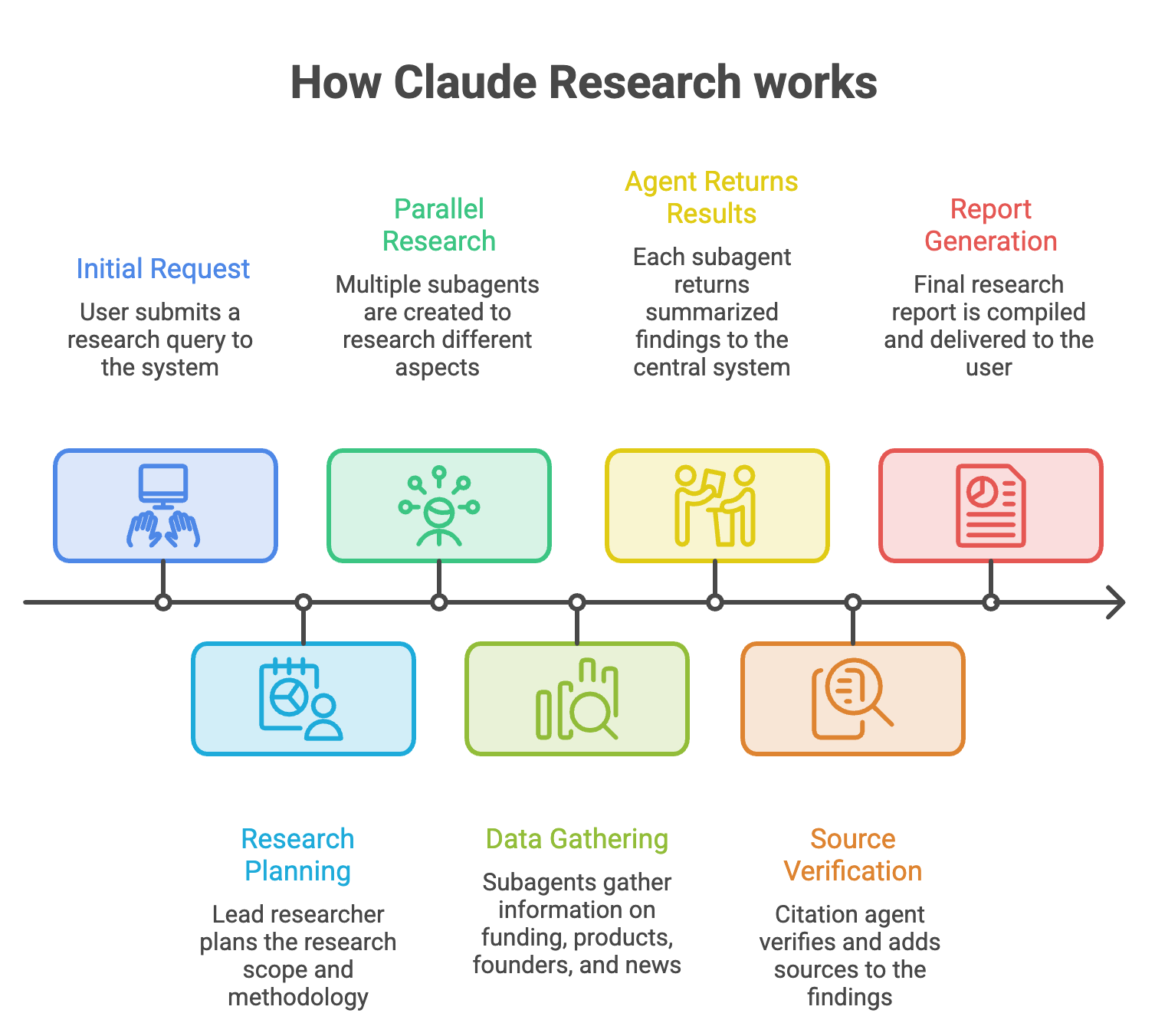
The workflow begins when a user submits a research query.
The Lead Researcher first thinks through the problem and creates a research plan. Since research sessions can become very long, the plan is also stored in memory so it isn't lost if the context window eventually exceeds its limit.
Next, the Lead Researcher creates one or more specialized subagents, each assigned a clearly defined research objective. These subagents independently search the web or other connected data sources, evaluate the information they find, and continuously refine their search strategy based on intermediate results.
Once they finish, their findings are returned to the Lead Researcher, which decides whether enough information has been gathered or whether additional subagents should be created to investigate unanswered questions.
Only after the research is complete does the workflow move to the final stage, a dedicated Citation Agent. Rather than relying on the research agents to produce citations, Anthropic separates this responsibility into its own agent, which reviews the completed report, identifies supporting evidence, and attaches citations to the appropriate claims before the final answer is returned to the user.

Source: Anthropic’s blog
Why This Architecture Works
The biggest advantage of this design isn't simply that it runs multiple agents.
It's that each agent focuses on a specific task while the lead agent focuses on coordination. This separation allows the system to explore multiple research directions simultaneously, process more information than a single context window would allow, and continuously adapt its strategy as new information becomes available.
But designing the architecture was only one part of the challenge.
Building a reliable multi-agent system also required Anthropic to rethink how agents are prompted, evaluated, and deployed in production, lessons that proved just as important as the architecture itself.
Building Smarter AI Agents
Designing the architecture was only the first step. The bigger challenge was making multiple AI agents work together efficiently.
During early experiments, Anthropic noticed several unexpected behaviors. Sometimes the lead agent created far too many subagents for a simple question. Other times, different subagents ended up performing the same searches, wasting both time and tokens. In some cases, agents kept searching even after they already had enough information.
Instead of solving these problems with hard-coded rules, Anthropic focused on improving the prompts given to the agents. Since every agent follows instructions through prompts, better prompts resulted in better coordination.
One of the biggest lessons was teaching the Lead Researcher how to delegate effectively.
Initially, the lead agent gave short instructions such as "Research the semiconductor shortage." These vague instructions often caused multiple subagents to explore the same topic or interpret the task differently.
To solve this, every subagent now receives much more detailed instructions. Along with its research objective, it is told what output is expected, which tools or sources to prefer, and where its responsibilities begin and end. This helps each subagent focus on its own task without duplicating work already assigned to others.
Another important improvement was teaching the system to scale its effort based on the complexity of the query.
Not every question requires ten AI agents.
A simple factual question might need only one agent and a handful of tool calls, while a broad research question could require several specialized subagents working in parallel. By defining these guidelines, Anthropic prevented the system from overusing resources on simple tasks while still allowing it to scale for more complex investigations.
Choosing the Right Tools Matters
Giving an AI access to tools doesn't automatically mean it knows which one to use.
Imagine asking someone to find an internal company document. Searching Google would never work because the information exists only inside the company's Slack workspace.
AI agents face the same challenge.
Claude Research can access many different tools, including web search and external integrations. If an agent chooses the wrong tool, it may spend a long time searching without ever finding the required information.
To improve this, Anthropic added simple heuristics to the prompts. Agents are encouraged to first understand what tools are available, choose the one that best matches the user's intent, and prefer specialized tools over generic ones whenever possible. Even the descriptions of these tools turned out to be important, because unclear descriptions often led agents down the wrong path.
Interestingly, Anthropic also used Claude itself to improve these tool descriptions.
They built an agent whose job was to repeatedly test a tool, identify where it failed, and rewrite its description to make future agents use it more effectively. This alone reduced task completion time by around 40%, simply because agents made fewer mistakes while selecting tools.
Teaching Agents to Think Like Researchers
Another lesson was that AI agents need guidance on how to approach research, not just what to research.
Human researchers usually start with broad searches to understand the overall landscape before diving into specific details.
Anthropic found that agents naturally tended to do the opposite. They often began with very long, highly specific search queries, which limited the amount of useful information they discovered.
To address this, the prompts encourage agents to start with broad searches, understand what's available, and gradually narrow their focus as they learn more about the topic. This mirrors how experienced researchers naturally explore unfamiliar subjects.
The team also made extensive use of extended thinking.
Before creating subagents, the Lead Researcher spends time planning the overall strategy, deciding how difficult the problem is, how many subagents are needed, and what each one should investigate.
Subagents use a similar process after every tool call. Rather than immediately performing another search, they pause to evaluate the results, identify missing information, and decide what to explore next. This iterative reasoning helps them adapt as the research evolves.
Why Parallelism Made Such a Difference
One of the biggest performance improvements came from allowing agents to work in parallel.
Initially, research tasks were performed one search after another, making complex investigations slow.
Anthropic introduced parallelism at two levels.
First, the Lead Researcher launches multiple subagents simultaneously instead of waiting for one to finish before creating the next. Second, each subagent can use multiple tools in parallel whenever appropriate.
Together, these optimizations reduced research time by up to 90% for complex queries while allowing the system to explore much more information than before.
Evaluating AI Agents Is Different
Building the system was only half the challenge.
Anthropic also needed a reliable way to measure whether the agents were actually improving.
Unlike traditional software, there isn't always one correct path to the answer. Two AI agents might take completely different approaches and still produce equally good results.
Because of this, Anthropic focused on evaluating outcomes rather than expecting every agent to follow the exact same sequence of steps.
They started with a small set of around twenty representative research queries instead of waiting to build a massive benchmark. Large improvements were easy to spot even with a relatively small evaluation set.
To score research reports, Anthropic relied heavily on an LLM-as-a-judge approach. Instead of checking only whether the final answer was correct, the evaluation also considered factual accuracy, citation quality, completeness, source quality, and whether the agents used tools efficiently.
At the same time, human evaluation remained essential. Human testers often discovered subtle issues that automated evaluations missed, such as agents preferring low-quality SEO articles over authoritative sources. These observations helped refine both prompts and tool selection strategies.
Running Multi-Agent Systems in Production
Building a prototype is one thing. Running it reliably for thousands of users is another.
Unlike traditional software, AI agents are stateful. A research session may involve dozens of tool calls over a long period of time. If something fails halfway through, restarting the entire process would waste both time and tokens.
Instead, Anthropic built systems that allow agents to resume from where they left off while also combining this with traditional engineering practices such as retries and checkpoints.
Debugging also required a different approach.
Because AI agents are non-deterministic, running the same prompt twice doesn't always produce identical behavior. To understand failures, Anthropic introduced production tracing that records high-level decision patterns without inspecting users' private conversations. This made it much easier to identify why agents failed and improve the system over time.
Deploying updates presented another challenge.
Since many research sessions remain active for long periods, replacing the entire system at once could interrupt running agents. Instead, Anthropic uses rainbow deployments, gradually shifting traffic from older versions to newer ones while allowing existing agents to finish their work uninterrupted.
Key Takeaways
Complex research isn't just a bigger version of question answering, it requires exploring multiple directions simultaneously.
Instead of relying on one AI agent, Claude Research breaks the work into specialized subagents coordinated by a Lead Researcher.
Prompt design, tool selection, and reasoning strategies are just as important as the underlying LLM.
Building production-ready AI systems requires much more than good models. Evaluation, reliability, debugging, and deployment all play a critical role.
As AI systems become more capable, we're moving from standalone AI assistants to collaborative teams of AI agents working together.
Official blog from Anthropic: How we built our multi-agent research system
By now, you must have had a clear idea of, How Anthropic Built Claude's Multi-Agent Research System? In a nutshell, Anthropic built Claude Research using multiple AI agents that collaborate like a research team instead of relying on a single AI agent. By combining parallel research, smarter prompting, and robust engineering practices, they created a system capable of handling complex research tasks more effectively.
Congratulations! You've just advanced another step in your tech journey. Keep progressing!