
Essay
How Meta Escaped the "Forking Trap" and Modernized WebRTC Across 50+ Products
Meta escaped the WebRTC forking trap using a dual-stack shim architecture, enabling safe A/B testing and continuous upstream upgrades.
If you've ever worked on an open-source library, you've probably been tempted to make a small change. Maybe you needed a quick bug fix. Maybe you wanted to optimize performance. Or perhaps you needed to add a feature that didn't exist upstream. At first, it seems harmless. You fork the project, make your changes, and move on.
But as the original project continues to evolve, your fork starts drifting away. New features, bug fixes, and security updates keep arriving upstream, while your internal version accumulates more and more custom changes. Eventually, upgrading becomes so difficult that many teams simply stop doing it. Meta calls this the "forking trap."
For years, Meta maintained its own highly optimized version of WebRTC, the open-source library that powers real-time audio and video communication. It was used across more than 50 different use cases, including Messenger and Instagram video calls, Cloud Gaming, and Meta Quest.
Over time, however, maintaining this heavily customized fork became increasingly difficult. Instead of continuing down that path, Meta spent several years redesigning its architecture so it could move back to the latest upstream WebRTC releases while still keeping its own proprietary optimizations.
So how do you replace years of custom engineering without breaking real-time communication for billions of users? Let's discover how Meta did it in this blog today.
Understanding the Forking Trap
Forking an open-source project is common. The real challenge comes later. Every time the upstream project releases a new version, your team has to merge those changes into your customized fork. As both versions continue evolving independently, the number of conflicts keeps increasing.
Eventually, upgrading the project becomes expensive, slow, and risky. Teams fall further behind upstream, missing out on new features, performance improvements, and security fixes. This was exactly the situation Meta found itself in with WebRTC.
For years, the company had built a specialized, high-performance version of the library to meet the demands of its large-scale real-time communication platform. While those optimizations were valuable, they also made it harder to stay synchronized with the open-source project.
Rather than performing another large one-time migration, Meta wanted a solution that would let it continuously upgrade to future WebRTC releases.
Why Upgrading WebRTC Was So Difficult
If this were a typical library upgrade, Meta could simply replace the old version with the new one. But WebRTC sits at the heart of real-time communication.
A regression in a new release could affect audio quality, video calls, or connection reliability across billions of users. Rolling back after a bad deployment would also be difficult because the new version would have completely replaced the old one. Meta wanted something safer.
Instead of replacing the old library immediately, engineers wanted to run both versions side by side so they could gradually compare them through A/B testing. But this presented another challenge. Both versions of WebRTC would have to exist inside the same application at the same time. Unfortunately, C++ doesn't make that easy.
Since both libraries expose many of the same classes, functions, and symbols, the linker treats them as duplicates, leading to thousands of symbol collisions during compilation. So before Meta could even think about migration, it first had to solve a much lower-level engineering problem:
How do you make two versions of the same C++ library coexist inside one application?
The Shim Layer: One Interface, Two Implementations
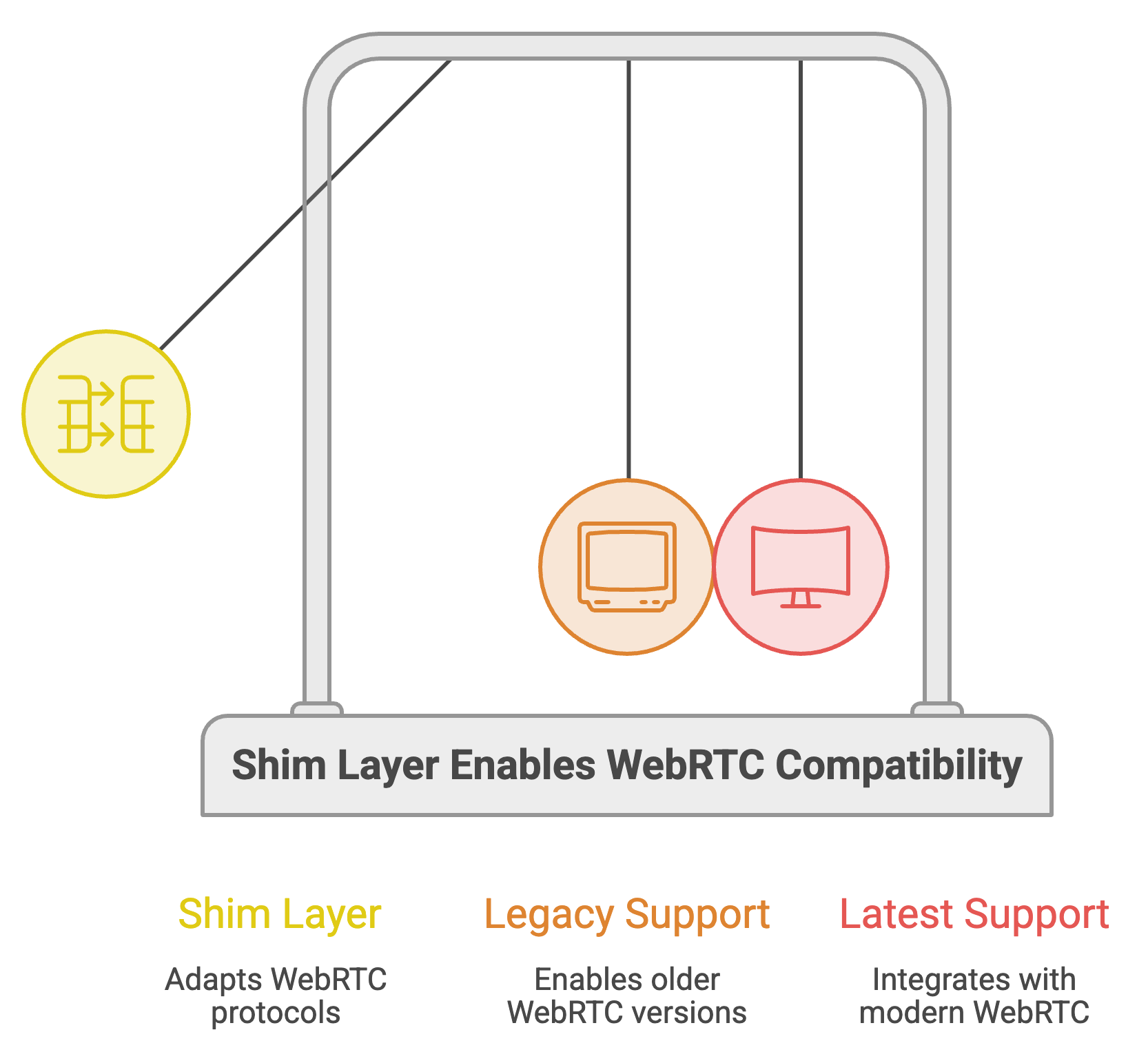
Meta's solution was to introduce a shim layer between its applications and WebRTC. Instead of applications communicating directly with WebRTC, they would communicate with the shim. The shim exposed a single, version-independent API.
Behind the scenes, it decided whether each request should be handled by the legacy WebRTC implementation or the latest upstream version.
You can think of it like this:
Application
      │
      ▼
   Shim Layer
      │
 ┌────┴────┐
 ▼         ▼
Legacy   Latest
WebRTC   WebRTC
This architecture gave Meta two major benefits.
First, both versions of WebRTC could run inside the same application, making gradual A/B testing possible.
Second, applications no longer needed to know which version they were using. They simply interacted with the shim, while the shim handled the routing internally.
Another important advantage was binary size. Meta considered duplicating a much larger orchestration layer above WebRTC, but that would have increased the application's uncompressed binary size by roughly 38 MB. By introducing the shim at the lowest possible layer instead, the increase was only about 5 MB, an 87% reduction.
Solving Thousands of Symbol Collisions
Even with the shim layer in place, another major problem remained. Both WebRTC versions still contained classes and functions with identical names.
When the linker encountered symbols like:
webrtc::PeerConnectionin both libraries, it had no way of knowing which one to use. Meta solved this by automatically renamespacing the entire library.
Instead of keeping both libraries under the same namespace, build scripts systematically rewrote every namespace during compilation.
For example:
The latest version became webrtc_latest::
The legacy version became webrtc_legacy::
This immediately removed thousands of naming conflicts. However, not everything in WebRTC lived inside a namespace. Some global C functions, variables, and classes still collided. For these, Meta either moved them into namespaces where possible or assigned flavor-specific identifiers to ensure every symbol remained unique.
The team also encountered conflicts caused by macros such as RTC_CHECK and RTC_LOG. Since these macros could appear outside WebRTC itself, including headers from both versions caused redefinition errors.
Meta resolved these issues by removing unnecessary includes, renaming rarely used macros, and sharing certain internal WebRTC modules between both versions whenever possible. Besides eliminating conflicts, this also reduced binary size and decreased the amount of code that required shimming.
At this point, Meta had successfully managed to compile two versions of WebRTC inside the same application. But the migration was far from complete. The next challenge was making sure existing applications could continue using WebRTC without changing thousands of lines of code, deciding how to switch between the two versions at runtime, and automating the creation of thousands of shim components.
Maintaining Backward Compatibility
Making two versions of WebRTC coexist was a huge milestone. But there was still another challenge.
Thousands of existing applications across Meta were already written against the original webrtc:: API. Asking every engineering team to immediately update their code wasn't practical. Meta needed a way to introduce the new architecture without disrupting existing applications.
Their first approach was to manually forward every symbol from the new namespace back to the familiar webrtc:: namespace. While this worked, it resulted in a massive header file that became difficult to maintain as WebRTC continued evolving.
The team eventually adopted a much cleaner solution. Instead of forwarding symbols one by one, they used C++ using declarations to import an entire flavor namespace into the familiar webrtc:: namespace.
This meant developers could continue writing code exactly as before. Behind the scenes, the shim layer handled all the routing to the appropriate WebRTC implementation. Since using declarations are purely compiler directives, this approach also avoided increasing the application's binary size.
Choosing the Right WebRTC Version at Runtime
Once both versions of WebRTC were available, Meta needed a way to decide which one should handle a particular application. Meta calls this process flavoring.
Every application starts with a global flavor configuration, which determines whether requests should be routed to the legacy WebRTC implementation or the latest upstream version. Instead of duplicating large amounts of code, Meta built a template-based helper library.
The common logic was written only once, while the small pieces that differed between the two WebRTC versions were implemented using C++ template specializations. This allowed the codebase to remain concise while supporting both versions during the migration.
The shim layer also relied on directional adapters and directional converters.
Adapters exposed the unified shim API while forwarding requests to the appropriate WebRTC implementation.
Converters translated objects such as structures and enums between the shim's type system and WebRTC's internal types.

This architecture made A/B testing straightforward. Different users could transparently use different WebRTC versions without requiring changes to application code.
Automating the Shim Layer
Although the shim architecture solved the compatibility problem, building the shim itself introduced another challenge.
Every WebRTC class, structure, enum, constant, adapter, converter, and unit test had to be created. Doing all of this manually would have taken an enormous amount of engineering effort. Instead, Meta automated the process.
Using Abstract Syntax Tree (AST) parsing, the team built a code generation system capable of producing the baseline shim code automatically. For simpler APIs where both WebRTC versions exposed nearly identical interfaces, the generated code required almost no manual changes.
For more complex APIs where method signatures, ownership rules, or object lifetimes differed, engineers refined the generated code before integrating it into production. The results were significant. The team's productivity increased from about one shim per day to three or four shims per day, while also reducing the likelihood of human error.
Rewiring Applications
With the shim layer generated, the next step was updating applications to use it. Instead of referencing WebRTC types directly, applications gradually switched to the corresponding shim types.
For example:
Before:
webrtc::Foo

After:
webrtc_shim::Foo
This migration introduced challenges around object ownership, null handling, and memory management.
To reduce the risk of subtle bugs, Meta relied heavily on unit tests that reproduced ownership transfer scenarios, along with end-to-end tests for particularly risky changes.
The migration happened incrementally. The team started with smaller applications before gradually moving to larger production systems. Each iteration uncovered new issues like missing shims, incorrectly configured objects, or additional symbol collisions which were resolved before expanding the rollout further.
By the end of the project, Meta had added more than 10,000 lines of shim code and modified hundreds of thousands of lines across thousands of files. Despite the scale of the migration, the careful testing process helped the team avoid major production issues.
Solving the Upgrade Problem for Good
Escaping the forking trap wasn't only about migrating to a newer WebRTC version. Meta also wanted to make future upgrades much easier.
Since the company develops software in a monorepo, maintaining long-lived feature branches inside the main repository wasn't practical. The team considered storing patches as individual patch files but instead chose to maintain feature branches in a separate Git repository.
For every upstream WebRTC release, Meta creates a new base branch. Each internal modification is maintained as its own feature branch on top of that base. When a new upstream version becomes available, every feature branch is merged forward individually before being combined into a new release candidate.
This approach offers several benefits.
Different feature branches can be updated in parallel.
Git history is preserved for every individual change.
Internal improvements can be submitted upstream more easily.
The workflow is well suited for future AI-assisted merge conflict resolution.
The Results
The migration fundamentally changed how Meta maintains WebRTC. Instead of remaining years behind the upstream project, Meta now continuously upgrades to newer stable Chromium releases while still supporting its internal optimizations.
The engineering benefits were measurable.
CPU usage decreased by up to 10%.
Crash rates improved by up to 3% across major applications.
Applications became 100–200 KB smaller (compressed), depending on the product.
Deprecated libraries such as usrsctp were removed, improving the security posture of the platform.
Meta also notes that these improvements translated into observable gains in user engagement while allowing the company to stay current with upstream WebRTC releases.
Key Takeaways
Long-lived forks become increasingly difficult to maintain as upstream projects continue evolving.
Meta escaped the "forking trap" by introducing a shim layer that allowed the legacy and latest WebRTC versions to coexist inside the same application.
Automated namespace rewriting solved thousands of C++ symbol collisions, making dual-stack builds possible.
Code generation using AST parsing significantly accelerated shim development while reducing manual effort.
Maintaining patches as feature branches instead of patch files created a scalable workflow for continuous upgrades.
The new architecture allows Meta to continuously adopt upstream WebRTC releases without repeating large migration projects.
Official blog from Meta: Escaping the Fork: How Meta Modernized WebRTC Across 50+ Use Cases
By now, you must have had a clear idea of, How Meta Escaped the "Forking Trap" and Modernized WebRTC Across 50+ Products? In a nutshell, Meta modernized WebRTC by building a dual-stack architecture that allowed both the legacy and latest versions to run together. This enabled safe A/B testing, continuous upgrades, and a long-term solution to the "forking trap."
Congratulations! You've just advanced another step in your tech journey. Keep progressing!