
What are SOLID Principles?
Learn solid principles in software engineering: explained with examples to write clean, maintainable, and scalable code. A practical guide for developers.

The SOLID principles are a set of five essential design guidelines for writing software that’s easy to understand, flexible enough to change, and simple to maintain. Championed by Robert C. Martin, they help developers fight complexity by encouraging decoupled components and clear responsibilities. The result? Future updates are far less likely to cause bugs.
Why SOLID Principles Are Your Blueprint for Better Code
Ever tried fixing a small bug only to disrupt unrelated features? This frustrating scenario often results from tightly coupled, tangled code—a software "junk drawer" where everything is interconnected and hard to manage.
The SOLID principles in software engineering address this issue. Think of them as a guide for constructing software that remains stable and organized, akin to a well-arranged toolbox with each tool having a clear function and place. This organization makes development faster, safer, and less stressful.
Benefits of Organized Code
Applying these principles allows you to focus on building impactful features by reducing time spent on complex dependencies.
With well-structured code:
Bugs are easier to find and fix as problems are isolated in small components.
Adding features becomes easier since you can expand the system without altering its core logic.
Onboarding new developers is quicker due to a logical and predictable codebase.
The infographic below illustrates how SOLID groups these ideas into responsibility, extensibility, and decoupling themes.
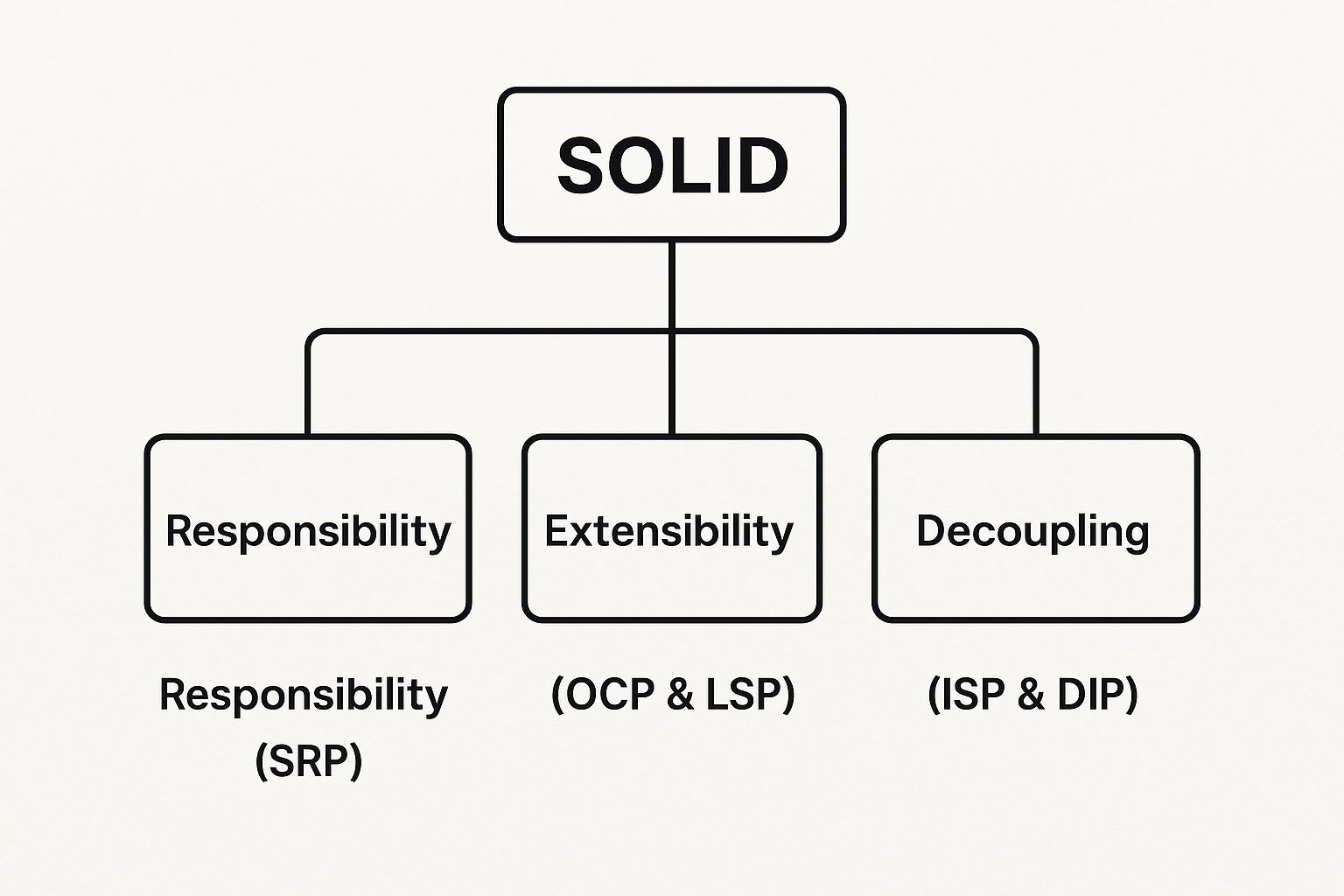
This visual shows how each principle contributes to the larger goal, from assigning single responsibilities at the component level to ensuring entire modules are loosely connected.
To give you a quick reference, here’s a simple breakdown of what each principle stands for and the problem it aims to fix.
SOLID Principles At a Glance
Principle | Acronym | Core Concept |
|---|---|---|
Single Responsibility Principle | S | A class should have only one reason to change, meaning it should have only one job. |
Open/Closed Principle | O | Software entities (classes, modules, functions) should be open for extension but closed for modification. |
Liskov Substitution Principle | L | Objects of a superclass should be replaceable with objects of a subclass without affecting the correctness of the program. |
Interface Segregation Principle | I | No client should be forced to depend on methods it does not use. Make fine-grained interfaces. |
Dependency Inversion Principle | D | High-level modules should not depend on low-level modules. Both should depend on abstractions. |
This table serves as a handy cheat sheet as we dive deeper into each concept.
Building for the Future
Robert C. Martin brought attention to the SOLID principles in the early 2000s, but they originate from 1980s object-oriented design concepts. The principles—Single Responsibility, Open/Closed, Liskov Substitution, Interface Segregation, and Dependency Inversion—are essential for creating adaptable software. They are vital for both large systems and small applications. Effectively managing changes in collaborative projects relies on understanding document version control best practices. Mastering SOLID ensures a codebase is ready for future growth.
Mastering the Single Responsibility Principle

As the first of the SOLID principles in software engineering, the Single Responsibility Principle (SRP) is probably the most famous—and the most misunderstood. Many developers hear "SRP" and think it just means "a class should only do one thing." While that's a decent starting point, the real definition is much sharper and more powerful.
A class should have only one reason to change.
What does that actually mean? It means a class should own just one piece of your application's functionality, typically tied to a single business "actor" or stakeholder. If your accounting department requests a change to tax calculation rules, the class responsible for that logic should change. If HR wants a new report format, a different class should change. If one business request forces you to change a class for multiple, unrelated reasons, you've likely got an SRP violation.
A Common SRP Violation Example
In a Human Resources app, an Employee class often contains various responsibilities like calculating payroll and taxes, saving employee data to a database, and generating performance reports. Although these tasks relate to employees, they introduce distinct reasons for the class to change, such as updates in tax laws, database migrations, or report format adjustments. This design is fragile, as modifying one aspect can inadvertently affect others, creating potential issues and making the class a risky dependency.
Refactoring Toward Single Responsibility
By applying SRP, we separate distinct responsibilities into dedicated classes, simplifying maintenance and enhancing system robustness.
Here's the refactored approach for the Employee class:
PayrollCalculator: Handles all financial calculations, so changes in tax rates or bonuses are only needed here.
EmployeeRepository: Manages data persistence with methods like save() or find(). Changes in database types will only affect this class.
ReportGenerator: Focuses on creating employee reports. Adjustments in format or style are confined to this class.
After refactoring, the Employee class becomes a simple data object, storing basic info like name and salary. This separation of concerns aids in building scalable systems. For more on this concept in larger architectures, visit https://hw.glich.co/p/what-are-microservices.
Actionable Insight: Use Your Commit History
A practical way to spot SRP violations is to look at your version control history (git log). If you see the same file being changed in commits with very different messages (e.g., "Fix tax calculation bug" and "Update report styling"), that's a strong signal the class is doing too much. Your commit history can be a powerful diagnostic tool for code quality.
Applying the Open/Closed Principle
The Open/Closed Principle (OCP) is the second of the SOLID principles in software engineering, and at first, it sounds like a complete contradiction. The rule states that software entities (like classes or modules) should be open for extension but closed for modification. How can something be both open and closed?
The trick is to design your components so you can add new functionality without tearing apart the code that already works. Think of it like your smartphone. You can install new apps to add features (extension) without having to crack open the phone and mess with its internal wiring (modification). This idea is fundamental to building systems that don't break every time you touch them.
A Common OCP Violation
To really get why this matters, let's look at a classic example: a payment processing system. A quick and dirty implementation might just use a big if-else or switch statement to handle different ways to pay.
Imagine a PaymentProcessor class with a single processPayment method:
public class PaymentProcessor {
    public void processPayment(String paymentType, double amount) {
        if (paymentType.equals("CreditCard")) {
            // Logic for credit card payment
            System.out.println("Processing credit card payment of $" + amount);
        } else if (paymentType.equals("PayPal")) {
            // Logic for PayPal payment
            System.out.println("Processing PayPal payment of $" + amount);
        } else if (paymentType.equals("Crypto")) {
            // Logic for crypto payment
            System.out.println("Processing crypto payment of $" + amount);
        }
    }
}
Currently, this approach works but poses risks. It violates the Open/Closed Principle. If a new payment method, like "Bank Transfer," is needed, we must modify the `PaymentProcessor` class by adding another `else if` block.
This is risky. The `PaymentProcessor` is a core, well-tested component. Each modification could introduce bugs, particularly affecting credit card or PayPal logic. This design is fragile, making feature additions daunting.Refactoring with the Strategy Pattern
We can fix this by refactoring the code to be open for new additions. A great way to do this is with the Strategy design pattern. The idea is to create a common interface that all our payment methods will follow.
First, we'll define a PaymentMethod interface:
public interface PaymentMethod {
    void process(double amount);
}
Next, we create a separate, concrete class for each payment type that implements this interface. Each class contains its own specific logic, keeping it totally isolated from the others.
CreditCardPayment.java
PayPalPayment.java
CryptoPayment.java
Now, our PaymentProcessor doesn't need to know the gritty details of any specific payment type. It just works with the PaymentMethod abstraction.
public class PaymentProcessor {
    public void processPayment(PaymentMethod method, double amount) {
        method.process(amount);
    }
}
With this new design in place, adding a "Bank Transfer" option is simple. We just create a new BankTransferPayment class. We don't have to touch the original, battle-tested PaymentProcessor at all. The system is now closed for modification but remains open for extension.
The Real-World Benefits of OCP
This plug-and-play architecture enhances long-term maintainability. The Open/Closed Principle allows new features to be added without affecting existing functionality, significantly reducing regression failures and costly downtime. Industries focused on software sustainability invest in SOLID principles to future-proof their systems. Learn why top engineering leaders support this approach here.
Embracing OCP creates a stable codebase, crucial for modern development and integration with automated pipelines. Our guide on CI/CD details how robust codebases enable faster and safer deployments.
OCP encourages strategic thinking about abstractions and dependencies, promoting the design of decoupled and adaptable components, a key trait of professional software engineering.
Understanding Liskov Substitution Principle
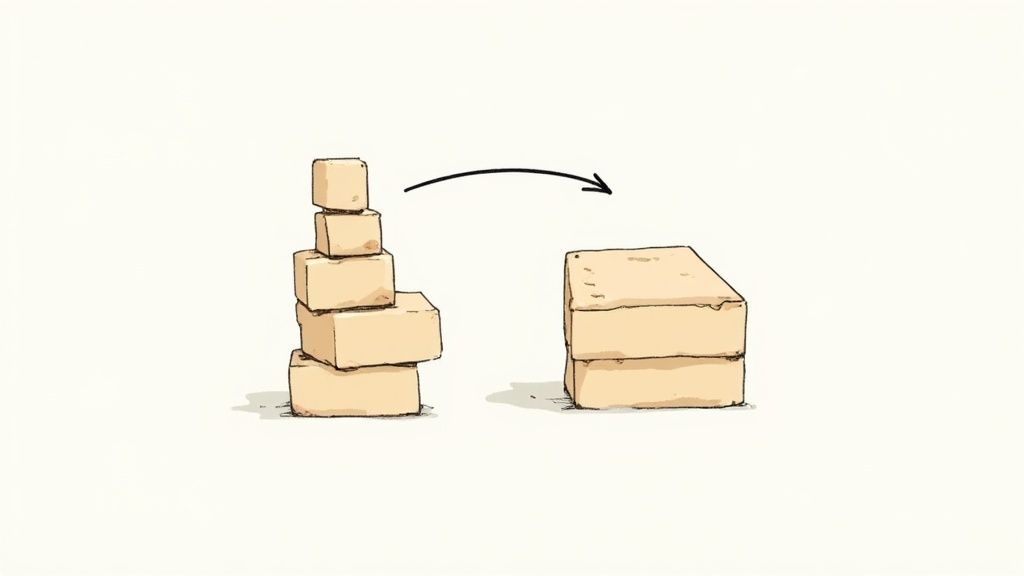
The Liskov Substitution Principle (LSP) ensures reliable inheritance within the SOLID principles of software engineering. It maintains integrity in class hierarchies, preventing hidden bugs. Essentially, LSP guarantees that if you write code for a base class (e.g., Bird), you can replace it with a derived class (e.g., Sparrow) without any issues or modifications. Formally, superclass objects should be replaceable by subclass objects without causing application errors. A subclass must adhere to its parent's "contract," allowing for new behaviors but not altering or removing expected ones. Breaking this promise causes unreliable abstractions and unpredictable bugs.
The Classic Rectangle and Square Violation
To see just how easy it is to get this wrong, let's walk through the most famous example of an LSP violation: the relationship between a Rectangle and a Square. On paper, a square is a rectangle, right? So it seems perfectly logical to have Square inherit from Rectangle.
Let’s start with a simple Rectangle class:
public class Rectangle {
    protected int width;
    protected int height;

    public void setWidth(int width) {
        this.width = width;
    }

    public void setHeight(int height) {
        this.height = height;
    }

    public int getArea() {
        return width * height;
    }
}
Now, let's create our Square class, which extends Rectangle. Because a square's width and height must always be the same, we'll override the setters to enforce this rule.
public class Square extends Rectangle {
    @Override
    public void setWidth(int width) {
        super.setWidth(width);
        super.setHeight(width);
    }

    @Override
    public void setHeight(int height) {
        super.setWidth(height);
        super.setHeight(height);
    }
}
This looks pretty clever, but it’s a trap. It subtly breaks the contract established by the Rectangle class, and any code expecting Rectangle's behavior is now in for a surprise.
Why This Inheritance Model Is Broken
Let's imagine some client code that uses our Rectangle class to perform a simple area check.
public class AreaCalculator {
    public static void checkArea(Rectangle r) {
        r.setWidth(5);
        r.setHeight(4);
        // We expect the area to be 5 * 4 = 20
        assert r.getArea() == 20 : "Area calculation is wrong!";
    }
}
Passing a Rectangle to checkArea functions as intended. However, when a Square is passed:
r.setWidth(5) sets both width and height to 5 due to the Square's override.
r.setHeight(4) again sets both width and height to 4.
r.getArea() returns 16 (4 * 4) instead of the expected 20, causing the assertion to fail.
This shows a Square cannot replace a Rectangle without causing unexpected behavior, violating the Liskov Substitution Principle by altering the assumption that width and height can be set independently.
Modeling the Relationship Correctly
The fix is to step back and realize that Square and Rectangle don't share a true "is-a" relationship from a behavioral standpoint, even if they do mathematically. A much better approach is to use a more generic abstraction.
We could create an interface, say Shape, that defines a contract common to all geometric figures.
public interface Shape {
    int getArea();
}
Then, both Rectangle and Square can implement this interface on their own terms, without any direct inheritance between them. This severs the broken behavioral link, making the system far more robust and predictable.
By respecting LSP, we build trust in our abstractions and stamp out a whole class of subtle, hard-to-find bugs. An actionable tip is to always ask: "If I replace a base class instance with a subclass instance, will my unit tests still pass without modification?" If the answer is no, you likely have an LSP violation.
Implementing the Interface Segregation Principle
Are your classes performing unnecessary tasks due to "fat" interfaces? This common issue arises from large, monolithic contracts that try to do too much. The Interface Segregation Principle (ISP), part of the SOLID principles in software engineering, addresses this by advocating for small, specific interfaces. This ensures clients only depend on methods they use, resulting in a cleaner, more decoupled design.
A Common ISP Violation: The Bloated Worker Interface
Let's say we're building a system to manage different kinds of workers. A quick-and-dirty approach might be to create a single IWorker interface that covers every possible action a worker could take.
// A "fat" interface that violates ISP
public interface IWorker {
    void work();
    void eat();
    void takeBreak();
}
This looks fine at first glance. We can easily create a HumanWorker class that implements all three methods, because, well, humans work, eat, and take breaks. No problem there.
public class HumanWorker implements IWorker {
    @Override
    public void work() {
        System.out.println("Human is working on the assembly line.");
    }

    @Override
    public void eat() {
        System.out.println("Human is eating lunch.");
    }

    @Override
    public void takeBreak() {
        System.out.println("Human is taking a coffee break.");
    }
}
The real trouble starts when we introduce a RobotWorker. Robots are great at working, but they don't eat or take coffee breaks. Yet, because our RobotWorker has to conform to the IWorker interface, it's forced to implement methods that are completely irrelevant to its function.
This is where things get ugly. You end up with awkward, empty implementations or, even worse, methods that throw an exception, adding nothing but clutter and confusion.
public class RobotWorker implements IWorker {
    @Override
    public void work() {
        System.out.println("Robot is assembling components.");
    }

    // Unnecessary methods the robot is forced to implement
    @Override
    public void eat() {
        // Robots don't eat. This method is useless.
        throw new UnsupportedOperationException("Robots do not eat!");
    }

    @Override
    public void takeBreak() {
        // Robots don't take breaks. This is also useless.
    }
}
This design creates a web of unnecessary dependencies. Any part of the system that interacts with workers now knows about eat() and takeBreak(), even if it only cares about robots that can work(). This tight coupling makes the whole system more rigid and a nightmare to maintain.
Refactoring with Role-Based Interfaces
The fix for this ISP violation is to break down our fat IWorker interface into smaller, more focused "role" interfaces. Each one should define a single, cohesive capability.
We can split the responsibilities into two distinct interfaces:
IWorkable: For any entity that can perform work.
IEatable: For any entity that needs to eat.
// Lean, focused interfaces that follow ISP
public interface IWorkable {
    void work();
}

public interface IFeedable {
    void eat();
    void takeBreak(); // Assuming breaks are related to eating/rest
}
Our classes now implement only necessary interfaces. The `HumanWorker` fulfills both roles, implementing `IWorkable` and `IFeedable`:
`public class HumanWorker implements IWorkable, IFeedable { ... }`
Meanwhile, the `RobotWorker` only needs `IWorkable`:
`public class RobotWorker implements IWorkable { ... }`
This design reduces unnecessary methods and decouples the system, allowing a task scheduler to focus on `IWorkable`.Embracing the Dependency Inversion Principle
Alright, we've made it to the fifth and final pillar of SOLID: the Dependency Inversion Principle (DIP). This one is a real game-changer for your architecture. It’s all about flipping traditional software dependencies upside down to build systems that are way more flexible, easier to test, and resilient to change.
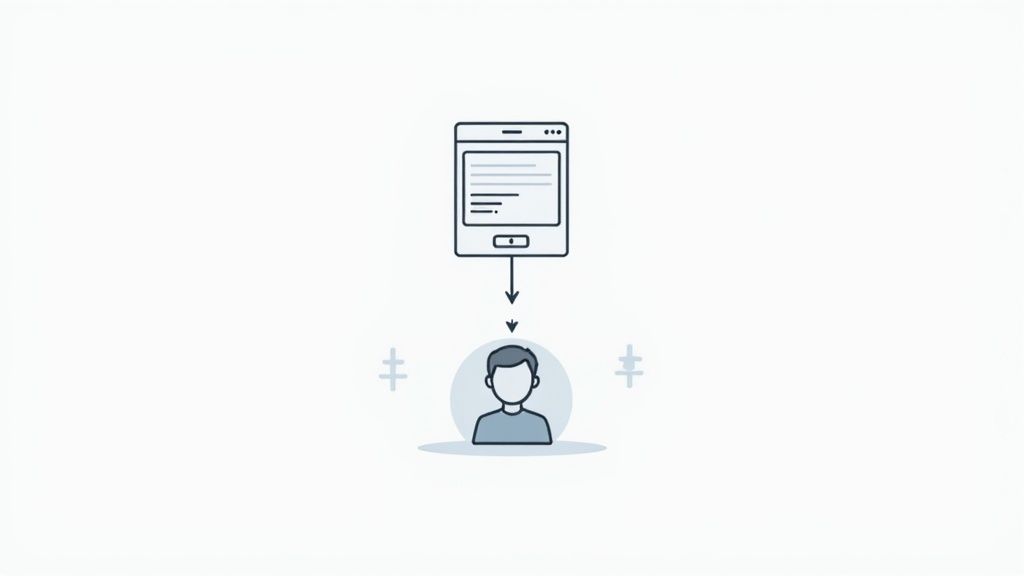
DIP focuses on decoupling by preventing high-level modules from directly depending on low-level ones, which often leads to a rigid system. Instead, both should depend on abstractions, with details relying on abstractions, not vice versa. This ensures that essential business logic remains independent of specific implementation details.
A Common DIP Violation
Let's look at a classic mistake to see why this matters. Imagine a ReportGenerator class. This is a high-level module because it contains the important business rules for creating a report. In a quick-and-dirty design, you might see it directly create and use a MySqlDatabase class, which is a low-level module handling the nitty-gritty of database access.
// Low-level detail
public class MySqlDatabase {
    public String[] queryData() {
        // Connect to MySQL and fetch some data...
        System.out.println("Fetching data from MySQL database...");
        return new String[]{"data1", "data2"};
    }
}

// High-level policy
public class ReportGenerator {
    private MySqlDatabase database;

    public ReportGenerator() {
        // Direct dependency on a concrete class! Yikes.
        this.database = new MySqlDatabase();
    }

    public void generateReport() {
        String[] data = database.queryData();
        // Logic to format and generate the report...
        System.out.println("Generating report with fetched data.");
    }
}
This code exemplifies tight coupling, leading to significant issues:
Testing challenges: Unit testing ReportGenerator requires a live MySQL database, resulting in slow and fragile tests dependent on an external system.
Difficulty in changes: Switching from MySQL to PostgreSQL involves altering the ReportGenerator class, violating the Open/Closed Principle.
Lack of reusability: ReportGenerator is tied to MySQL, making it unusable for projects with different data sources.
Inverting the Dependencies with Abstractions
So, how do we fix it? We "invert" the dependency by introducing an abstraction—in this case, an interface. We'll create a simple IDatabase interface that defines the contract our ReportGenerator actually needs.
// The abstraction
public interface IDatabase {
    String[] fetchData();
}
Next, we make our concrete database classes implement this new interface. The MySqlDatabase is no longer a dependency of our high-level logic; instead, it becomes a detail that depends on the abstraction.
// The detail now depends on the abstraction
public class MySqlDatabase implements IDatabase {
    @Override
    public String[] fetchData() {
        // ... MySQL-specific logic
        return new String[]{"mysql_data"};
    }
}

public class PostgreSqlDatabase implements IDatabase {
    @Override
    public String[] fetchData() {
        // ... PostgreSQL-specific logic
        return new String[]{"postgresql_data"};
    }
}
Finally, we refactor our high-level ReportGenerator. Instead of depending on a concrete class, it now only depends on the IDatabase interface. We'll pass the specific database implementation in from the outside, a technique called dependency injection.
// The high-level module now depends on the abstraction
public class ReportGenerator {
    private IDatabase database;

    // The dependency is "injected" through the constructor
    public ReportGenerator(IDatabase database) {
        this.database = database;
    }

    public void generateReport() {
        String[] data = database.fetchData();
        // ... report generation logic
    }
}
Just like that, we've completely decoupled our business logic from the implementation details. The ReportGenerator has no idea what kind of database it's using. It just knows it can call fetchData().
This simple change makes our system incredibly modular. We can easily swap out MySQL for PostgreSQL, test the ReportGenerator with a mock database object, and extend our system with new data sources in the future without touching a single line of existing code. That's the power of DIP.
Frequently Asked Questions About SOLID Principles
Are All Five Principles Always Necessary?
Do you need to apply every SOLID principle to every project? Not necessarily. SOLID serves as helpful guidelines, not strict laws. For small scripts or quick prototypes, enforcing every principle can be excessive. However, for systems you plan to maintain and expand, thoughtfully applying them enhances maintainability. The aim is to improve code, not just complete a checklist.
Do SOLID Principles Conflict With Agile?
What’s the relationship between SOLID and Agile development? The good news is they are incredibly complementary. Agile methodologies are all about embracing and expecting change, and SOLID principles help you build a codebase that’s way easier and safer to change.
By encouraging a decoupled and sturdy architecture, SOLID lets development teams refactor and add new features faster and with more confidence. This directly feeds into the iterative, adaptive nature of Agile, smoothing out the friction that often comes with rapid development cycles.