
What Is an Application Server?
Learn what is an application server, how it processes requests, and why it's essential for modern applications. Find out everything you need to know!

Ever wondered what happens behind the curtain when you log into an app, book a flight, or add something to your online shopping cart? That seamless, interactive experience is powered by an unseen engine: the application server.
Think of it as the brains of the operation. It's the critical middleman that sits between your browser and a database, handling all the complex business logic that makes modern web applications tick.
The Unseen Engine Behind Your Favorite Apps
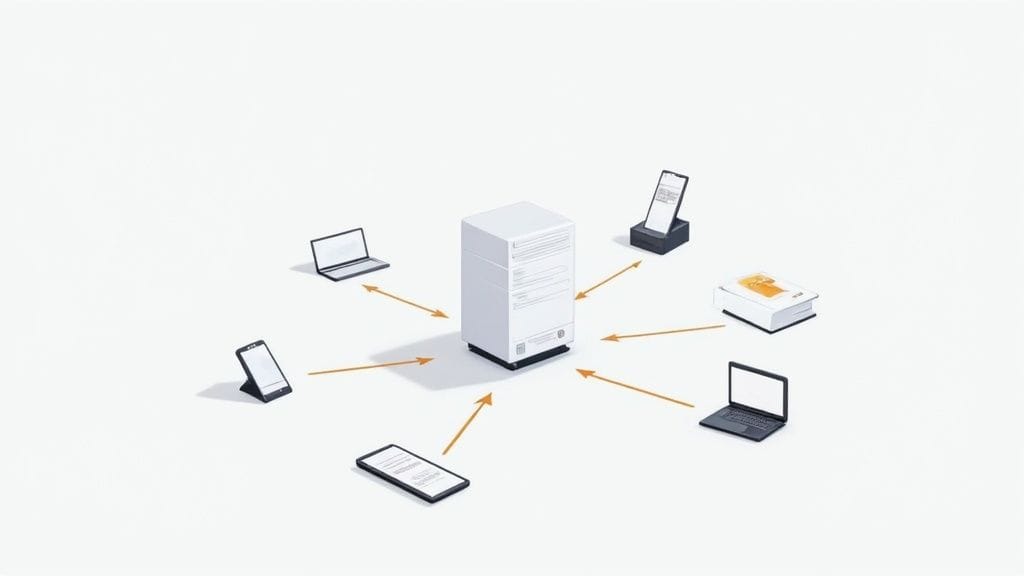
When you browse the web, you're usually interacting with two different kinds of servers working together.
First, there's the web server. Picture it as a friendly restaurant host. It greets you, takes your request for a web page, and quickly brings simple, pre-made items like a static HTML page (the menu) or an image (a glass of water). It's incredibly fast and efficient at serving this kind of static content.
But what happens when you ask for something custom? That's when the host passes your order to the kitchen crew. This is where the application server steps in. It's the entire kitchen, the chefs and prep cooks, ready to handle your complex, dynamic request.
The Kitchen Analogy Explained
When you order a medium-rare steak, the application server acts like kitchen staff, executing business logic:
It checks the database for steak availability.
It uses the application code to cook it perfectly.
It presents the dish to the web server for delivery.
Similarly, adding an item to an online cart involves checking inventory, updating totals, and creating a personalized page. The application server generates dynamic content based on user interaction.
An application server is a framework for creating and running web applications within a server-centric architecture.
To give you a clearer picture, here's a quick breakdown of an application server's responsibilities.
Application Server at a Glance
Core Function | What It Does | Real-World Analogy |
|---|---|---|
Business Logic Execution | Runs the core code that defines an application's rules and functionality. | The kitchen staff following a recipe to cook a specific dish. |
Database Connectivity | Manages connections to databases to read, write, and update data. | Checking the pantry for ingredients and updating inventory. |
Transaction Management | Ensures complex operations (like a financial transaction) complete successfully. | Making sure a customer's payment is processed before confirming an order. |
Security | Handles user authentication, authorization, and secure communications. | The bouncer at a club checking IDs and managing the guest list. |
This technology is the backbone of the modern internet. The global application server market, valued at USD 25.64 billion, is projected to more than double to USD 56.34 billion by 2030. These numbers show how essential these systems are. You can dive deeper into the application server market projections to see the full scope of its growth.
Tracing a Request From Click to Content
To really understand what an application server does, let’s follow a user request. Picture a standard three-tier architecture: your browser (the client), a web server, and the application server connected to a database.
This structure efficiently separates concerns. The application server is the crucial middle tier, acting as the go-between for the user interface and the backend database. A 2023 report on web application architecture highlights how central this model is.
The Three-Step Request Flow
Imagine you’re on an e-commerce site and you click "Add to Cart." The web server, which handles simple static things like loading images, sees this dynamic action and immediately forwards the request to the application server.
This is where the real work begins. The application server executes the specific business logic for adding an item to your cart.
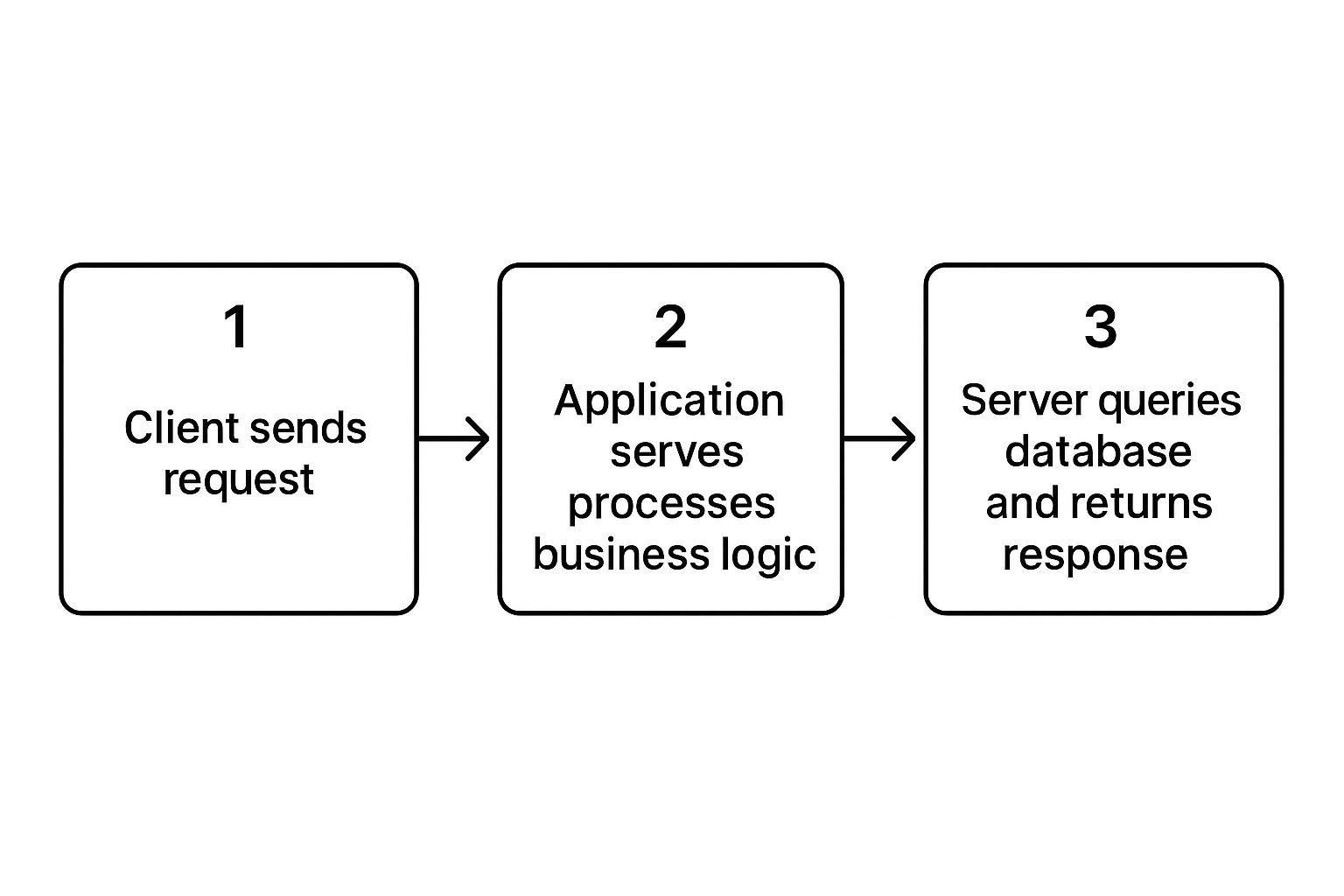
The application server is the central processing unit in this sequence. It's not just passing data; it's making decisions.
Here's what the server is doing behind the scenes:
Verifying Inventory: It checks the database to ensure the item is in stock.
Updating Your Session: It finds your unique shopping cart data and adds the new item.
Recalculating Totals: It instantly updates the cost, including any taxes or fees.
Finally, the application server generates a new, personalized HTML page showing your updated cart. It sends this dynamic content back through the web server to your browser, completing the loop. This entire process is built to handle the massive transaction volumes modern applications demand.
Handling this load efficiently often comes down to smart scaling. To learn more, check out our guide on vertical vs horizontal scaling.
Web Server vs Application Server Explained
In system architecture, understanding the distinction between a web server and an application server is crucial.
A web server acts like a fast librarian, retrieving static files such as images, CSS, or basic HTML pages, and handling straightforward HTTP requests.
An application server resembles a research assistant, tackling complex queries by consulting various sources like databases and generating dynamic content. It can also serve static files, but its main strength lies in executing complex business logic.
Their Distinct Roles and Responsibilities
A web server's main job is to serve content that already exists. When you ask for a company's homepage, the web server grabs the HTML file and sends it. It’s built for speed and efficiency in delivering static assets.
The application server’s work begins where the web server’s leaves off. It handles requests that need processing, like completing a payment, checking real-time inventory, or logging you in. These tasks require talking to databases and running custom code.
A web server primarily handles HTTP requests and serves static content. An application server executes server-side application code, generates dynamic content, and manages complex operations like transaction management.
Let's break down their capabilities side-by-side.
Key Differences Web Server vs Application Server
Feature | Web Server | Application Server |
|---|---|---|
Primary Function | Serves static content (HTML, CSS, images) over HTTP. | Executes business logic and generates dynamic content. |
Content Type | Static | Dynamic |
Protocols | Almost exclusively HTTP/HTTPS. | Supports multiple protocols (HTTP, RMI, RPC, etc.). |
Resource Usage | Low resource consumption; optimized for high-speed I/O. | Higher resource consumption due to running application code. |
Multi-threading | Typically uses a simpler multi-threaded model. | Manages complex multi-threading, connection pooling, and transactions. |
Common Examples | Nginx, Apache HTTP Server, Microsoft IIS. | Tomcat, WildFly (JBoss), WebLogic, GlassFish. |
They are designed for different roles: one specializes in delivery, the other in creation. In large systems, they operate together. The web server manages incoming traffic and simple tasks like serving static files, while the application server handles complex requests. This division optimizes performance, a key principle in load balancing, aimed at maximizing efficiency.
Exploring the Core Features and Components
An application server's strength lies in its built-in services that manage backend tasks, freeing developers to focus on unique features.
A key service is transaction management, which handles operations like bank transfers as all-or-nothing processes, ensuring safety if issues arise.
Another important service is connection pooling, which maintains ready-to-use database connections to enhance efficiency, similar to having taxis waiting at an airport, reducing wait times and streamlining operations.
Essential Built-in Services
Application servers provide essential tools for scalable software:
Security Services: Manage user authentication and access control.
Messaging Queues: Facilitate communication between application parts without direct connections.
Persistence: Simplify data storage and retrieval, often mapping code objects to database tables.
These components highlight the value of application servers, which continue to influence new architectures. For more on this evolution, see our guide on serverless architecture.
Application Servers You've Probably Used Today
Ever wondered what powers a global banking app or a large e-commerce site? It's often a strong application server working behind the scenes. The enterprise world has long relied on Java-based servers. Apache Tomcat excels at running Java Servlets and JavaServer Pages. Red Hat's WildFly is a staple in the Java ecosystem, noted for its reliability, making it essential in industries like finance and logistics where uptime is critical.
From Traditional Servers to Cloud Platforms
In the Windows environment, Microsoft's .NET framework with Internet Information Services (IIS) offers a robust application server setting for C# developers.
With the rise of cloud technology, application servers have integrated functionalities, concealing infrastructure complexities.
AWS Elastic Beanstalk allows developers to upload code, managing provisioning, load balancing, and scaling.
Google App Engine provides a fully managed platform, enabling a focus on application logic.
These platforms demonstrate the advancement of core principles. Application servers now handle complex logic across various technologies, such as server-side logic with Node.js SDKs. The U.S. application server market, valued at USD 7.4 billion, is projected to reach USD 22.4 billion by 2032, sparking discussions on building approaches like monolith vs microservices architecture.
Why Application Servers Aren't Going Anywhere
With the rise of microservices and serverless architectures, you may question the relevance of the classic application server. It remains essential. Despite changes in packaging, managing business logic, ensuring data consistency, and handling security are still vital tasks.
These challenges persist with new architectures, and the core principles of application servers are integrated into cloud-native platforms. Even when splitting a monolith, a layer to process logic is necessary. For more, see our guide on microservices.
The main point is that whether managing a single application or multiple distributed services, processing logic and managing state are crucial. Reliable digital experiences depend on it. The "server" may have evolved, but its role is as vital as ever.