
When Microservices Get Messy: How API Federation Brings Order
API Federation combines multiple services into one API using shared models and modular features, simplifying complex microservice architectures.
Microservices promise a lot of features like better scalability, faster development, independent teams and more flexibility. And honestly, in the beginning, they do deliver. But as systems grow, something strange starts happening. Instead of clarity, you get chaos. With microservices, now you have hundreds of APIs, different formats, inconsistent data, hidden services and broken integrations. What once felt like a clean architecture slowly turns into what people jokingly call a “microservices death star.”
So the real question becomes: How do you scale microservices without losing control? And that’s exactly where API Federation comes in.
The Problem with Scaling Microservices
When organizations grow, their API landscape grows with them. You start with a few services, then dozens, then hundreds. At that point, new challenges appear:
APIs become inconsistent
Discoverability becomes difficult
Observability becomes harder
Changes start breaking things
And the worst part? Every team is moving fast but in slightly different directions. Without a structured approach, your system becomes hard to understand, hard to evolve and even harder to maintain.
So, what is API Federation?
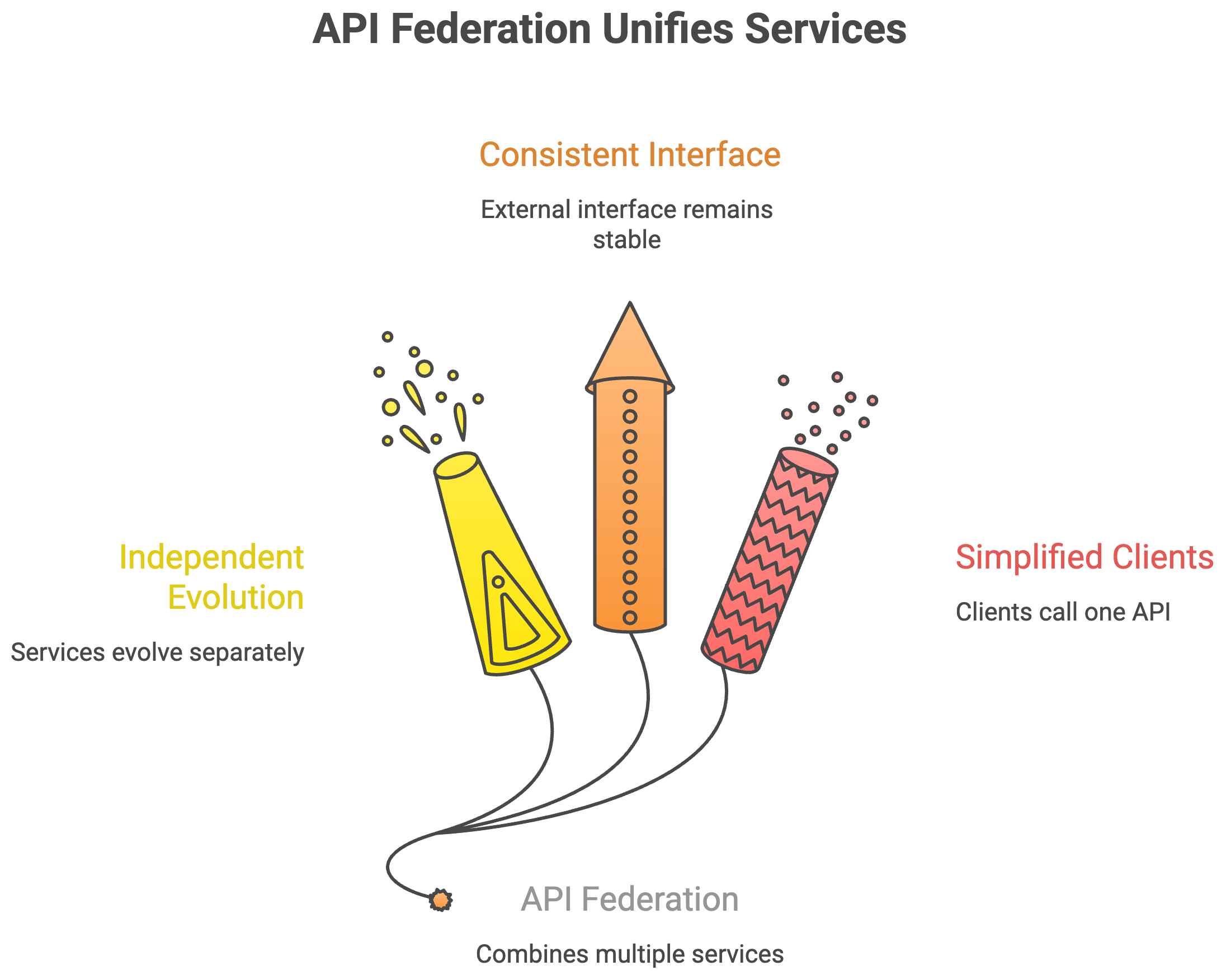
To solve this, we need a better way to manage APIs at scale. That’s where API Federation comes in! In simple terms: API Federation is a way to combine multiple services into one unified API without forcing teams to tightly couple their systems.
It allows:
Different services to evolve independently
While still exposing a consistent interface externally
You can think of it like this Instead of clients calling 10 different APIs, they call one federated API, and behind the scenes, it fetches data from multiple services.

What It’s NOT
Before going deeper, let’s clear some misconceptions:
1. It’s NOT a single “universal model”
Trying to create one global schema for the entire organization doesn’t work. Why?
Because:
Teams have different needs
Domains evolve differently
Central control slows everything down
This often leads to rigid systems that eventually break.
2. It’s NOT just GraphQL
GraphQL is commonly used for federation, but it’s not mandatory. API Federation is a design approach, not a specific technology.
It can work with:
REST APIs
Event-driven systems
Other architectures
Breaking Systems into Bounded Contexts
The first big idea behind API Federation comes from Domain-Driven Design (DDD). Instead of treating your system as one giant API, you divide it into bounded contexts.
What is a bounded context?
A group of services that:
Share the same domain concepts
Speak the same “language”
Represent data consistently
For example:
A “Customer” should mean the same thing across services in that context
Identifiers for entities should match everywhere
Data types should be consistent
It matters because federation works best when data meanings are aligned, IDs are consistent and schemas are compatible. Without this, combining APIs becomes messy.
How Federation Actually Works
Once you have a bounded context, federation combines services using a few key patterns:
1. Entity Extension
Different services may provide different fields for the same entity. Federation merges them into one unified view.
For example, one service might return customer details, while another returns their orders. Federation combines both into a single response.
Federated API → both combined
2. Entity Linking
Services can reference entities from other services using shared identifiers. Instead of directly linking services: They connect through common entity types and keys
This is powerful because if one service changes or disappears → system doesn’t break
3. Entity Composition
Sometimes entities don’t have identifiers (like value objects).
In such cases:
Federation combines available attributes dynamically
A Smarter Way to Design APIs
Traditionally, APIs are built as large, monolithic interfaces. But federation encourages something different: Build APIs as small reusable features
Instead of one big API doing everything, break it into smaller capabilities.
Examples of features:
CRUD operations
Pagination
Filtering
Search
Event streaming
Each feature:
Can be developed independently
Can be reused across services
Can evolve separately
This works better because now teams don’t depend on entire APIs, they depend only on specific features. And federation combines these features into one unified interface.
How Data is Fetched Across Services
To make federation work, services must support something called: Entity resolution
This means: Given an entity ID → return its data
Using this:
Federation can fetch data from multiple services
Join them using shared keys
Return a single response
For example: Fetch customer data, Fetch related orders and Combine everything. All in one query.
Balancing Flexibility and Control
Here’s a tricky part. You want teams to move independently. But also APIs to stay consistent This is where the idea of a federation protocol comes in.
What is a federation protocol?
A set of rules that:
Services must follow to be part of the federated API
Defines how conflicts are handled
Controls how schemas evolve
Example rules:
If two services define the same entity → they must agree on keys
If attributes conflict → resolve or rename
If a service can’t fully support federation → fallback mechanisms apply
It’s not fully centralized, and not completely decentralized either. It sits somewhere in between, giving teams freedom while still maintaining consistency.
Handling Changes Over Time
In real systems, APIs change all the time. Federation supports this by:
Automatically adapting to new attributes
Reflecting removed fields
Allowing gradual adoption of federation patterns
This means you don’t need a perfect system from day one, you can evolve into federation over time.
Keeping Things Stable in Production
Adding a federation layer shouldn’t break things. So it must work with:
Authentication systems
Caching
Rate limiting
Monitoring
SLAs
At the same time, federation introduces shared requirements like common authentication across services and shared entity identifiers.
Does Federation Affect Performance?
A common concern: “Won’t federation slow things down?”
Well, not necessarily. In fact:
It can improve efficiency by optimizing queries
It allows scaling specific services independently
The key is:
Efficient query planning
Leveraging capabilities of underlying services
Making it Work at Scale
Federation isn’t just an architectural idea, it also impacts your development lifecycle.
You need:
CI/CD pipelines
Metadata management
API contract validation
Automated deployments
Every time a service changes:
Federation layer must update
Consistency checks must run
Tools That Help (Like DataGraph)
Tools like MuleSoft’s DataGraph help automate this entire process.
They:
Use API metadata (like OAS/RAML)
Generate federated schemas
Handle query execution
Provide monitoring and logging
And importantly, they simplify federation into a manageable workflow.
Key Takeaways
API Federation is not just a technical solution, it’s a way of thinking. It helps solve one of the biggest problems in modern systems: How do you scale without losing control?
By:
Structuring APIs into bounded contexts
Designing modular features
Combining services intelligently
Balancing autonomy with governance
In the end, it gives you the best of both worlds i.e., Independent teams and Unified experience. And that’s what makes it powerful.
Official blog from Salesforce: API Federation: growing scalable API landscapes
By now, you must have had a clear idea of, When Microservices Get Messy: How API Federation Brings Order. In a nutshell, API Federation unifies multiple microservices into a single API using bounded contexts, shared models, and feature-based design. It balances team autonomy with consistency while simplifying complex API ecosystems.
Congratulations! You've just advanced another step in your tech journey. Keep progressing!