
Check If All 1's Are at Least Length K Places Away
EasyPrompt
Given an binary array nums and an integer k, return true if all 1's are at least k places away from each other, otherwise return false.
Example 1:
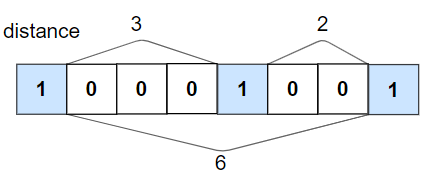
Input: nums = [1,0,0,0,1,0,0,1], k = 2
Output: true
Explanation: Each of the 1s are at least 2 places away from each other.
Example 2:
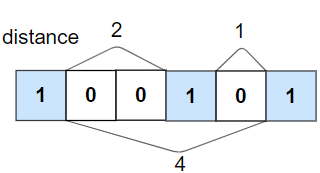
Input: nums = [1,0,0,1,0,1], k = 2
Output: false
Explanation: The second 1 and third 1 are only one apart from each other.
Constraints:
1 <= nums.length <= 1050 <= k <= nums.lengthnums[i]is0or1
Approaches
2 approaches with complexity analysis and trade-offs.
This approach involves two main steps. First, we iterate through the entire array to find and store the indices of all occurrences of 1. Then, we iterate through this list of indices to check if the distance between every pair of consecutive 1s meets the requirement.
Algorithm
- Create an empty list,
oneIndices, to store the indices of all1s. - Iterate through the input array
numsfrom left to right. For each element at indexi:- If
nums[i]is equal to1, add the indexito theoneIndiceslist.
- If
- After populating the list, check its size. If
oneIndicescontains fewer than two elements (i.e., zero or one1s in the array), the condition is trivially satisfied, so returntrue. - Iterate through the
oneIndiceslist starting from the second element (indexp = 1tooneIndices.size() - 1). - In each iteration, calculate the number of zeros between the current
1and the previous1. The gap isoneIndices.get(p) - oneIndices.get(p - 1) - 1. - If this calculated
gapis less thank, it means two1s are too close. Returnfalseimmediately. - If the loop completes without finding any violations, it means all consecutive
1s are at leastkplaces away. Returntrue.
Walkthrough
The core idea is to first identify the locations of all the 1s. By storing their indices in a separate list, we can easily calculate the distance between any two consecutive 1s. The distance between two 1s at indices i and j (with i < j) is the number of 0s between them, which is j - i - 1.
Once we have the list of indices, say [idx_1, idx_2, idx_3, ...], we just need to check if idx_2 - idx_1 - 1 >= k, idx_3 - idx_2 - 1 >= k, and so on. If we find any pair that violates this condition, we can immediately conclude the result is false. If we check all consecutive pairs and find no violations, the result is true. If there are fewer than two 1s, there are no pairs to check, so the condition is automatically met.
import java.util.ArrayList;import java.util.List; class Solution { public boolean kLengthApart(int[] nums, int k) { List<Integer> oneIndices = new ArrayList<>(); for (int i = 0; i < nums.length; i++) { if (nums[i] == 1) { oneIndices.add(i); } } if (oneIndices.size() <= 1) { return true; } for (int i = 1; i < oneIndices.size(); i++) { int prevIndex = oneIndices.get(i - 1); int currentIndex = oneIndices.get(i); int distance = currentIndex - prevIndex - 1; if (distance < k) { return false; } } return true; }}Complexity
Time
O(N), where N is the length of the `nums` array. The first pass to find all `1`s takes O(N) time. The second pass over the list of indices takes O(M) time, where M is the number of `1`s. Since M ≤ N, the total time complexity is dominated by the first pass, resulting in O(N).
Space
O(M), where M is the number of `1`s in the array. This is because we store the index of every `1` in a list. In the worst case, where the array consists of many `1`s, the space complexity can be O(N), where N is the length of the array.
Trade-offs
Pros
The logic is straightforward and easy to reason about.
It cleanly separates the task of finding the
1s from the task of checking their distances.
Cons
Requires extra space proportional to the number of
1s in the array.In the worst-case scenario (an array with many
1s), this can lead to high memory usage, potentially O(N).Involves two separate passes over the data (one over the original array, one over the list of indices).
A more optimal solution is to iterate through the array just once, using constant extra space. We can achieve this by keeping a running count of the zeros we've seen since the last 1. When we encounter a new 1, we check if this count is sufficient.
Algorithm
- Initialize an integer variable,
zeroCount, tok. This is a key step that elegantly handles the first1encountered in the array, as we can imaginekzeros preceding the start of the array. - Iterate through the
numsarray from left to right. - For each number
numin the array:- If
numis1:- Check if
zeroCountis less thank. If it is, this means we have encountered a1before seeing at leastkzeros since the last1. This violates the condition, so returnfalse. - If
zeroCount >= k, the condition is met for this1. ResetzeroCountto0to begin counting the zeros for the next interval.
- Check if
- If
numis0:- Simply increment
zeroCount.
- Simply increment
- If
- If the loop completes without returning
false, it means all1s in the array are separated by at leastkzeros. Returntrue.
Walkthrough
This approach avoids storing all indices by processing the array in a single pass. We use a counter to track the number of zeros between consecutive 1s.
A clever trick is to initialize this counter to k. This ensures that the very first 1 we find in the array will always pass the check, as if it were preceded by an infinite number of zeros. For any subsequent 1, we check if the number of zeros counted since the previous 1 is at least k. If it's not, we return false. If it is, we reset the counter to 0 and continue scanning.
For example, with nums = [1,0,0,1], k = 2:
- Initialize
zeroCount = 2. nums[0]is1:zeroCount(2) is not less thank(2). OK. ResetzeroCount = 0.nums[1]is0:zeroCountbecomes 1.nums[2]is0:zeroCountbecomes 2.nums[3]is1:zeroCount(2) is not less thank(2). OK. ResetzeroCount = 0.- Loop ends. Return
true.
This method is highly efficient as it only requires one pass and a single variable for storage.
class Solution { public boolean kLengthApart(int[] nums, int k) { // Initialize count to k to handle the first '1'. // This pretends there are k zeros before the array starts. int zeroCount = k; for (int num : nums) { if (num == 1) { if (zeroCount < k) { return false; } // Reset the counter after finding a '1'. zeroCount = 0; } else { // Increment the counter for each '0'. zeroCount++; } } return true; }}Complexity
Time
O(N), where N is the length of the `nums` array. We perform a single pass through the array, making the time complexity linear with respect to the input size.
Space
O(1). We only use a single integer variable (`zeroCount`) to keep track of the state, regardless of the size of the input array.
Trade-offs
Pros
Extremely efficient, with optimal O(N) time and O(1) space complexity.
Processes the array in a single pass, making it suitable for very large inputs or streaming data.
Simple implementation once the core logic is understood.
Cons
The logic of initializing the counter to
kmight be slightly less intuitive at first glance compared to tracking the last seen index.
Solutions
Solution
class Solution {public boolean kLengthApart(int[] nums, int k) { int j = -(k + 1); for (int i = 0; i < nums.length; ++i) { if (nums[i] == 1) { if (i - j - 1 < k) { return false; } j = i; } } return true; }}class Solution: def kLengthApart(self, nums: List[int], k: int) -> bool: j = - inf for i, x in enumerate(nums): if x: if i - j - 1 < k: return False j = i return Trueclass Solution {public: bool kLengthApart(vector<int> &nums, int k) { int j = -(k + 1); for (int i = 0; i < nums.size(); ++i) { if (nums[i] == 1) { if (i - j - 1 < k) { return false; } j = i; } } return true; }};Video walkthrough
Newsletter
One sharp idea, every week
System design and interview prep — short enough to finish.
No spam. Unsubscribe anytime.
Practice
Same difficulty — related problems to reinforce the pattern.