
Convert Binary Number in a Linked List to Integer
EasyPrompt
Given head which is a reference node to a singly-linked list. The value of each node in the linked list is either 0 or 1. The linked list holds the binary representation of a number.
Return the decimal value of the number in the linked list.
The most significant bit is at the head of the linked list.
Example 1:
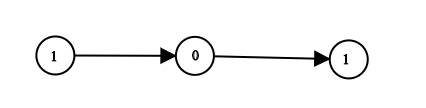
Input: head = [1,0,1]
Output: 5
Explanation: (101) in base 2 = (5) in base 10
Example 2:
Input: head = [0]
Output: 0
Constraints:
- The Linked List is not empty.
- Number of nodes will not exceed
30. - Each node's value is either
0or1.
Approaches
3 approaches with complexity analysis and trade-offs.
This approach involves two main steps. First, we traverse the linked list to build a string representation of the binary number. Second, we use a built-in function to parse this binary string into its decimal integer equivalent.
Algorithm
- Initialize a
StringBuildernamedsb. - Create a pointer
currentand set it tohead. - Loop while
currentis notnull:- Append
current.valtosb. - Move
currenttocurrent.next.
- Append
- Convert the
StringBuilderto a string. - Use
Integer.parseInt(string, 2)to get the decimal value and return it.
Walkthrough
We initialize a StringBuilder to accumulate the digits. We iterate through the linked list from the head node to the end. In each step, we append the node's value (either '0' or '1') to the StringBuilder. After the traversal is complete, we will have a string like "101". Finally, we use Java's Integer.parseInt(binaryString, 2) method to convert this binary string into an integer. This method handles the conversion from base 2 to base 10 for us.
/** * Definition for singly-linked list. * public class ListNode { * int val; * ListNode next; * ListNode() {} * ListNode(int val) { this.val = val; } * ListNode(int val, ListNode next) { this.val = val; this.next = next; } * } */class Solution { public int getDecimalValue(ListNode head) { StringBuilder sb = new StringBuilder(); ListNode current = head; while (current != null) { sb.append(current.val); current = current.next; } return Integer.parseInt(sb.toString(), 2); }}Complexity
Time
O(N), where N is the number of nodes in the linked list. The traversal takes O(N) time, and parsing the string of length N also takes O(N) time.
Space
O(N), for the `StringBuilder` which stores the N digits of the binary number.
Trade-offs
Pros
Simple to understand and implement, especially if you are familiar with string manipulation and built-in parsing functions.
Cons
Less efficient in terms of space, as it requires extra O(N) space to store the binary string.
The process of building a string and then parsing it can be slower than direct mathematical calculation due to overhead.
Solutions
Solution
/** * Definition for singly-linked list. * public class ListNode { * int val; * ListNode next; * ListNode() {} * ListNode(int val) { this.val = val; } * ListNode(int val, ListNode next) { this.val = val; this.next = next; } * } */ class Solution { public int getDecimalValue ( ListNode head ) { int ans = 0 ; for (; head != null ; head = head . next ) { ans = ans << 1 | head . val ; } return ans ; } }Video walkthrough
Newsletter
One sharp idea, every week
System design and interview prep — short enough to finish.
No spam. Unsubscribe anytime.
Practice
Same difficulty — related problems to reinforce the pattern.