
Determine Whether Matrix Can Be Obtained By Rotation
EasyPrompt
Given two n x n binary matrices mat and target, return true if it is possible to make mat equal to target by rotating mat in 90-degree increments, or false otherwise.
Example 1:
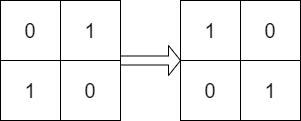
Input: mat = [[0,1],[1,0]], target = [[1,0],[0,1]]
Output: true
Explanation: We can rotate mat 90 degrees clockwise to make mat equal target.
Example 2:
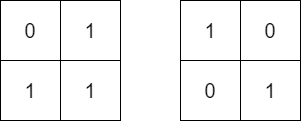
Input: mat = [[0,1],[1,1]], target = [[1,0],[0,1]]
Output: false
Explanation: It is impossible to make mat equal to target by rotating mat.
Example 3:
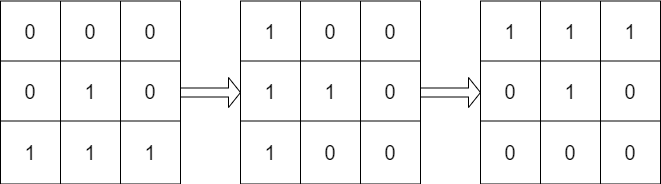
Input: mat = [[0,0,0],[0,1,0],[1,1,1]], target = [[1,1,1],[0,1,0],[0,0,0]]
Output: true
Explanation: We can rotate mat 90 degrees clockwise two times to make mat equal target.
Constraints:
n == mat.length == target.lengthn == mat[i].length == target[i].length1 <= n <= 10mat[i][j]andtarget[i][j]are either0or1.
Approaches
3 approaches with complexity analysis and trade-offs.
This approach directly simulates the process of rotating the matrix. We generate each of the four possible rotations (0, 90, 180, and 270 degrees) one by one and compare each result with the target matrix. For each rotation, a new auxiliary matrix is created to store the result.
Algorithm
- Create a helper function
areEqual(mat1, mat2)to compare two matrices element by element. It takesO(N^2)time. - Create a helper function
rotate(matrix)that takes a matrix and returns a newN x Nmatrix, which is the 90-degree clockwise rotation of the input. This also takesO(N^2)time and space. - In the main function, start with the original matrix
mat. - In a loop that runs 4 times (for 0, 90, 180, and 270-degree rotations):
- Call
areEqualto compare the current state ofmatwithtarget. If they are equal, returntrue. - If not equal, call
rotateto get the next rotated version of the matrix.
- Call
- If the loop completes without finding a match, return
false.
Walkthrough
The fundamental idea is to check every possible orientation of the mat matrix against the target matrix. A matrix can be rotated 90 degrees clockwise three times before returning to its original state on the fourth rotation. This gives us four states to check.
We can implement this by:
- First, checking if the original
matis equal totarget. - If not, we create a new matrix,
rotated90, by applying the 90-degree rotation formula:rotated[j][n-1-i] = original[i][j]. We then comparerotated90withtarget. - If there's still no match, we rotate
rotated90to getrotated180and compare that withtarget. - Finally, we rotate
rotated180to getrotated270and perform the last comparison.
If any of these comparisons return true, the function returns true. If all four checks fail, it returns false.
class Solution { public boolean findRotation(int[][] mat, int[][] target) { // Check 0 degree rotation if (areEqual(mat, target)) return true; // Check 90, 180, 270 degree rotations int[][] rotatedMat = mat; for (int i = 0; i < 3; i++) { rotatedMat = rotate(rotatedMat); if (areEqual(rotatedMat, target)) { return true; } } return false; } private int[][] rotate(int[][] matrix) { int n = matrix.length; int[][] newMatrix = new int[n][n]; for (int i = 0; i < n; i++) { for (int j = 0; j < n; j++) { newMatrix[j][n - 1 - i] = matrix[i][j]; } } return newMatrix; } private boolean areEqual(int[][] mat1, int[][] mat2) { int n = mat1.length; for (int i = 0; i < n; i++) { for (int j = 0; j < n; j++) { if (mat1[i][j] != mat2[i][j]) { return false; } } } return true; }}Complexity
Time
O(N^2). We perform a constant number of rotations (up to 3) and comparisons (up to 4). Each of these operations takes O(N^2) time to iterate through all the elements of the matrix.
Space
O(N^2), where N is the dimension of the matrix. This is because we create a new N x N matrix to store the result of each rotation.
Trade-offs
Pros
The logic is straightforward and easy to understand as it directly models the physical rotation.
It does not modify the original input matrix.
Cons
Requires extra space proportional to the size of the matrix, which can be inefficient for large matrices.
Solutions
Solution
class Solution {public boolean findRotation(int[][] mat, int[][] target) { int times = 4; while (times-- > 0) { if (equals(mat, target)) { return true; } rotate(mat); } return false; }private void rotate(int[][] matrix) { int n = matrix.length; for (int i = 0; i < n / 2; ++i) { for (int j = i; j < n - 1 - i; ++j) { int t = matrix[i][j]; matrix[i][j] = matrix[n - j - 1][i]; matrix[n - j - 1][i] = matrix[n - i - 1][n - j - 1]; matrix[n - i - 1][n - j - 1] = matrix[j][n - i - 1]; matrix[j][n - i - 1] = t; } } }private boolean equals(int[][] nums1, int[][] nums2) { int n = nums1.length; for (int i = 0; i < n; ++i) { for (int j = 0; j < n; ++j) { if (nums1[i][j] != nums2[i][j]) { return false; } } } return true; }}Video walkthrough
Newsletter
One sharp idea, every week
System design and interview prep — short enough to finish.
No spam. Unsubscribe anytime.
Practice
Same difficulty — related problems to reinforce the pattern.