
Find Center of Star Graph
EasyPrompt
There is an undirected star graph consisting of n nodes labeled from 1 to n. A star graph is a graph where there is one center node and exactly n - 1 edges that connect the center node with every other node.
You are given a 2D integer array edges where each edges[i] = [ui, vi] indicates that there is an edge between the nodes ui and vi. Return the center of the given star graph.
Example 1:
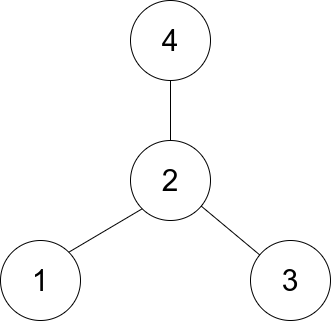
Input: edges = [[1,2],[2,3],[4,2]]
Output: 2
Explanation: As shown in the figure above, node 2 is connected to every other node, so 2 is the center.
Example 2:
Input: edges = [[1,2],[5,1],[1,3],[1,4]]
Output: 1
Constraints:
3 <= n <= 105edges.length == n - 1edges[i].length == 21 <= ui, vi <= nui != vi- The given
edgesrepresent a valid star graph.
Approaches
2 approaches with complexity analysis and trade-offs.
This approach is based on the property that the center node of a star graph has a degree of n-1, while all other nodes have a degree of 1. We can count the degree of each node by iterating through all the edges. The node with the highest degree is the center.
Algorithm
-
- Determine the number of nodes,
n, which isedges.length + 1.
- Determine the number of nodes,
-
- Create an integer array
degreeof sizen + 1to store the degree of each node, initialized to zeros.
- Create an integer array
-
- Iterate through each
edgein theedgesarray.
- Iterate through each
-
- For each
edge = [u, v], incrementdegree[u]anddegree[v].
- For each
-
- After iterating through all edges, loop from
i = 1ton.
- After iterating through all edges, loop from
-
- If
degree[i]is equal ton - 1, theniis the center node. Returni.
- If
Walkthrough
In a star graph with n nodes, the center node is connected to all other n-1 nodes. This means its degree (the number of edges connected to it) is n-1. All other nodes (the 'spokes' of the star) are only connected to the center, so their degree is 1.
We can use this property to find the center. The algorithm involves two main steps:
- Count Degrees: We iterate through the
edgesarray. For each edge[u, v], we increment the degree count for both nodeuand nodev. A hash map or an array can be used to store these counts. Since node labels are from 1 ton, an array of sizen+1is a simple choice. - Find Center: After counting, we iterate through our degree counts. The node whose degree is
n-1(or simply the maximum degree) is the center of the star graph.
For example, given edges = [[1,2],[2,3],[4,2]], there are n = 4 nodes. The center must have a degree of 3.
After processing all edges, the degrees would be: degree(1)=1, degree(2)=3, degree(3)=1, degree(4)=1.
Clearly, node 2 has a degree of 3, making it the center.
import java.util.HashMap;import java.util.Map; class Solution { public int findCenter(int[][] edges) { int n = edges.length + 1; int[] degree = new int[n + 1]; for (int[] edge : edges) { degree[edge[0]]++; degree[edge[1]]++; } for (int i = 1; i <= n; i++) { if (degree[i] == n - 1) { return i; } } return -1; // Should not be reached }}Complexity
Time
O(N), where N is the number of nodes. We iterate through N-1 edges to populate the degree counts, and then iterate through up to N nodes to find the center. This results in a linear time complexity.
Space
O(N), where N is the number of nodes. We use an auxiliary array of size N+1 to store the degree of each node.
Trade-offs
Pros
It's a general approach that can find the node with the highest degree in any graph.
The logic is straightforward and easy to understand.
Cons
It's not the most efficient solution for this specific problem, as it requires O(N) time and space.
It processes the entire input, which is unnecessary given the problem's guarantees.
This highly efficient approach leverages the core property of a star graph: the center node must be a part of every edge. Therefore, the center node must be the common node present in any two edges. By simply inspecting the first two edges, we can identify the center in constant time.
Algorithm
-
- Consider the first edge,
edges[0], which contains two nodes, let's call themcandidate1andcandidate2.
- Consider the first edge,
-
- Consider the second edge,
edges[1].
- Consider the second edge,
-
- Check if
candidate1is present inedges[1].
- Check if
-
- If it is,
candidate1is the center. Returncandidate1.
- If it is,
-
- If not,
candidate2must be the center (due to the star graph property). Returncandidate2.
- If not,
Walkthrough
The problem guarantees that the input graph is a valid star graph. In a star graph, there is a central node connected to all other n-1 nodes. This implies that the center node must appear in every single one of the n-1 edges.
Based on this insight, we don't need to examine all the edges. We only need to look at any two distinct edges to find the node they have in common. The simplest choice is to use the first two edges: edges[0] and edges[1].
Let edges[0] = [u, v] and edges[1] = [x, y]. The center node must be one of the nodes in the first edge, i.e., either u or v. We can check which of these two also appears in the second edge.
- If
uis equal toxory, thenuis the center. - Otherwise,
vmust be the center (since a center is guaranteed to exist and be common to both edges).
This check involves a maximum of two comparisons and is independent of the number of nodes n.
class Solution { public int findCenter(int[][] edges) { // The center node must be in the first edge. int node1 = edges[0][0]; int node2 = edges[0][1]; // The center node must also be in the second edge. // So we check which of node1 or node2 is in the second edge. if (node1 == edges[1][0] || node1 == edges[1][1]) { return node1; } else { return node2; } }}Complexity
Time
O(1). The solution only accesses the first two elements of the `edges` array and performs a constant number of comparisons, regardless of the size of the input.
Space
O(1). No extra space is used that scales with the input size.
Trade-offs
Pros
Extremely fast and memory-efficient.
Very simple and concise implementation.
Cons
This solution is highly specialized and only works because the input is guaranteed to be a valid star graph.
It would fail on a general graph or if the input did not represent a star graph.
Solutions
Solution
class Solution {public int findCenter(int[][] edges) { int a = edges[0][0], b = edges[0][1]; int c = edges[1][0], d = edges[1][1]; return a == c || a == d ? a : b; }}/** * @param {number[][]} edges * @return {number} */ var findCenter = function (edges) { const [a, b] = edges[0]; const [c, d] = edges[1]; return a == c || a == d ? a : b; };class Solution {public: int findCenter(vector<vector<int>> &edges) { int a = edges[0][0], b = edges[0][1]; int c = edges[1][0], d = edges[1][1]; return a == c || a == d ? a : b; }};class Solution: def findCenter( self, edges: List[List[int]]) -> int: return edges[0][0] if edges[0][0] in edges[1] else edges[0][1]Video walkthrough
Newsletter
One sharp idea, every week
System design and interview prep — short enough to finish.
No spam. Unsubscribe anytime.
Practice
Same difficulty — related problems to reinforce the pattern.