
Invert Binary Tree
EasyPrompt
Given the root of a binary tree, invert the tree, and return its root.
Example 1:
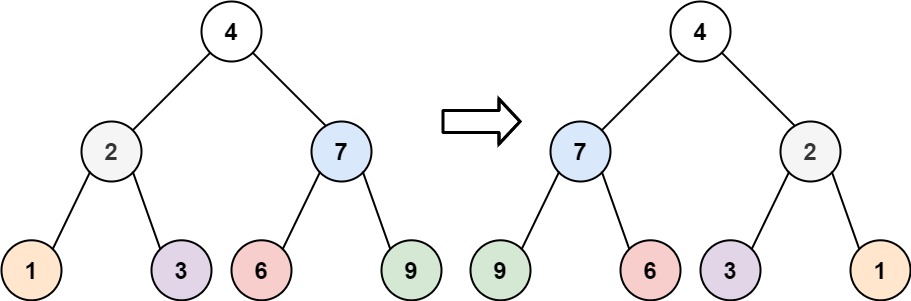
Input: root = [4,2,7,1,3,6,9]
Output: [4,7,2,9,6,3,1]
Example 2:
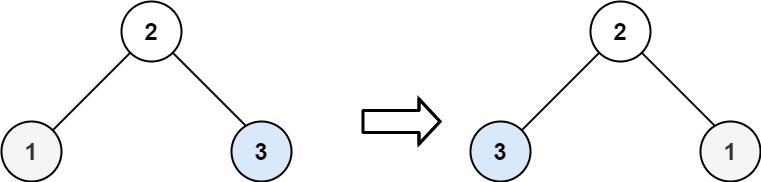
Input: root = [2,1,3]
Output: [2,3,1]
Example 3:
Input: root = []
Output: []
Constraints:
- The number of nodes in the tree is in the range
[0, 100]. -100 <= Node.val <= 100
Approaches
2 approaches with complexity analysis and trade-offs.
We can solve this problem using a recursive approach where we swap the left and right children of each node recursively.
Algorithm
- Check if root is null, return null if true
- Store left child in temporary variable
- Assign right child to left child
- Assign temporary variable (original left child) to right child
- Recursively call invertTree on left child
- Recursively call invertTree on right child
- Return root
Walkthrough
The recursive approach works by traversing the binary tree and swapping the left and right children of each node. For each node:
- First check if the root is null, if yes return null
- Swap the left and right children of the current node
- Recursively invert the left subtree
- Recursively invert the right subtree
- Return the root node
Here's the implementation:
public class TreeNode { int val; TreeNode left; TreeNode right; TreeNode() {} TreeNode(int val) { this.val = val; } TreeNode(int val, TreeNode left, TreeNode right) { this.val = val; this.left = left; this.right = right; }} class Solution { public TreeNode invertTree(TreeNode root) { // Base case: if root is null, return null if (root == null) { return null; } // Swap the left and right children TreeNode temp = root.left; root.left = root.right; root.right = temp; // Recursively invert left and right subtrees invertTree(root.left); invertTree(root.right); return root; }}Complexity
Time
O(n) where n is the number of nodes in the tree as we need to visit each node once
Space
O(h) where h is the height of the tree due to the recursive call stack. In worst case (skewed tree) it can be O(n)
Trade-offs
Pros
Simple and easy to understand
Clean and concise code
Uses less space compared to iterative approach
Cons
Can cause stack overflow for very deep trees
Recursive calls may have overhead
Solutions
Solution
/** * Definition for a binary tree node. * public class TreeNode { * public int val; * public TreeNode left; * public TreeNode right; * public TreeNode(int val=0, TreeNode left=null, TreeNode right=null) { * this.val = val; * this.left = left; * this.right = right; * } * } */ public class Solution { public TreeNode InvertTree ( TreeNode root ) { if ( root == null ) { return null ; } TreeNode l = InvertTree ( root . left ); TreeNode r = InvertTree ( root . right ); root . left = r ; root . right = l ; return root ; } }Video walkthrough
Newsletter
One sharp idea, every week
System design and interview prep — short enough to finish.
No spam. Unsubscribe anytime.
Practice
Same difficulty — related problems to reinforce the pattern.