
Largest Local Values in a Matrix
EasyPrompt
You are given an n x n integer matrix grid.
Generate an integer matrix maxLocal of size (n - 2) x (n - 2) such that:
maxLocal[i][j]is equal to the largest value of the3 x 3matrix ingridcentered around rowi + 1and columnj + 1.
In other words, we want to find the largest value in every contiguous 3 x 3 matrix in grid.
Return the generated matrix.
Example 1:
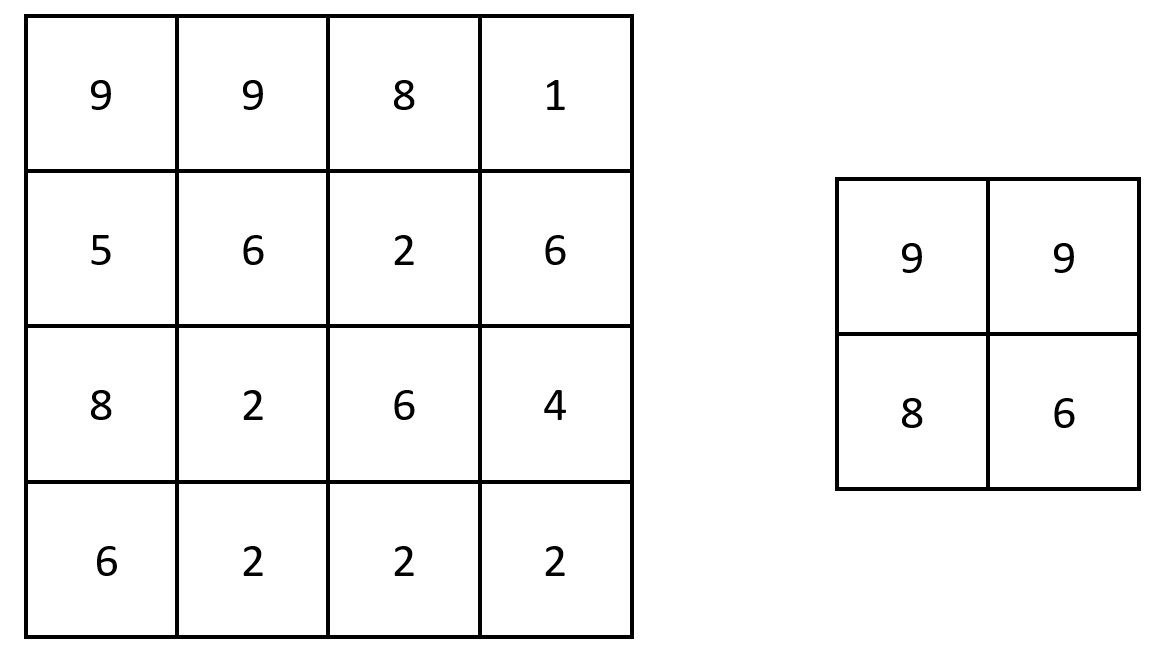
Input: grid = [[9,9,8,1],[5,6,2,6],[8,2,6,4],[6,2,2,2]]
Output: [[9,9],[8,6]]
Explanation: The diagram above shows the original matrix and the generated matrix.
Notice that each value in the generated matrix corresponds to the largest value of a contiguous 3 x 3 matrix in grid.
Example 2:
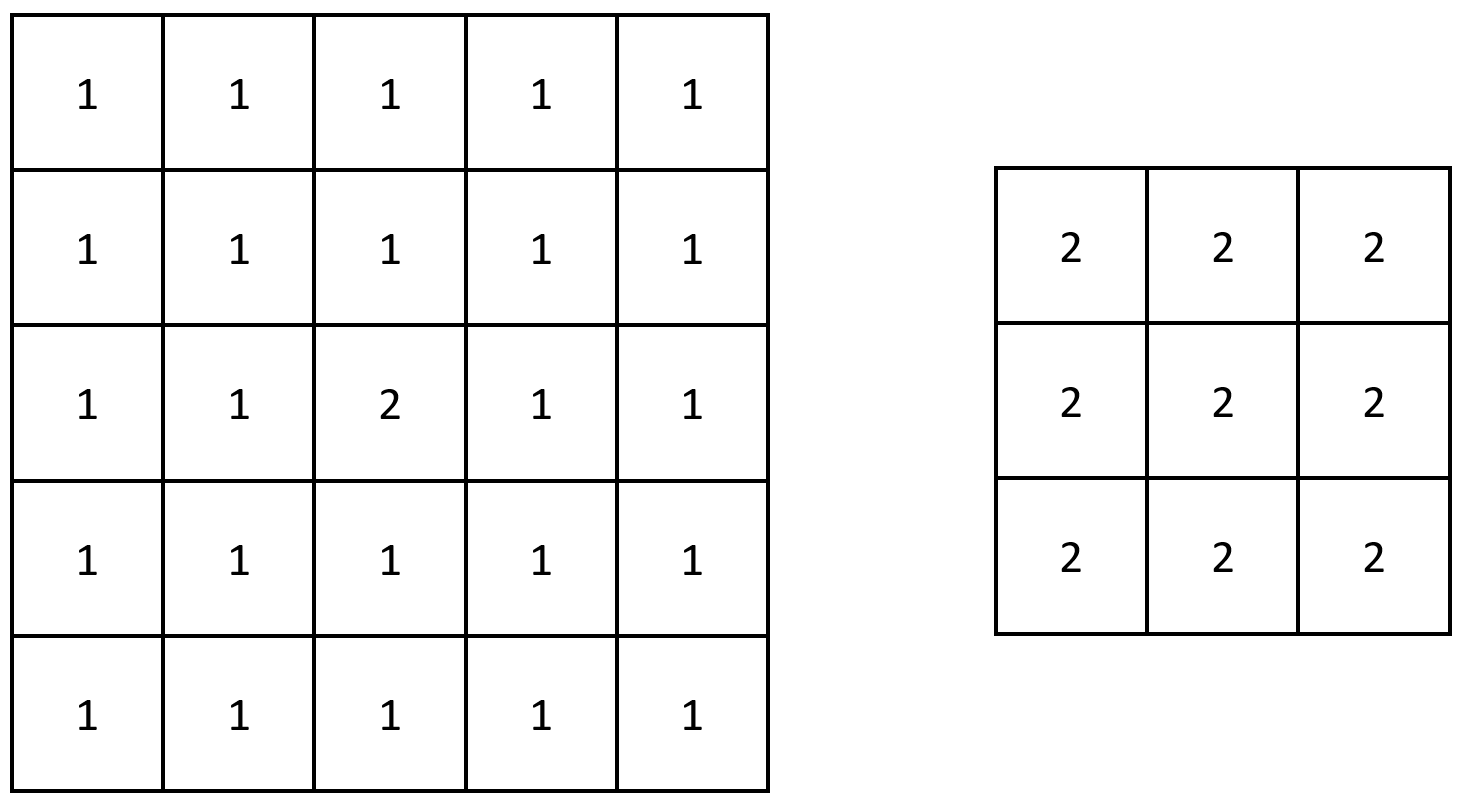
Input: grid = [[1,1,1,1,1],[1,1,1,1,1],[1,1,2,1,1],[1,1,1,1,1],[1,1,1,1,1]]
Output: [[2,2,2],[2,2,2],[2,2,2]]
Explanation: Notice that the 2 is contained within every contiguous 3 x 3 matrix in grid.
Constraints:
n == grid.length == grid[i].length3 <= n <= 1001 <= grid[i][j] <= 100
Approaches
2 approaches with complexity analysis and trade-offs.
This approach directly implements the logic described in the problem statement. We iterate through each possible top-left corner of a 3 x 3 subgrid in the input grid. For each of these subgrids, we find the maximum value and store it in the corresponding cell of the resulting maxLocal matrix.
Algorithm
- Get the size
nof the inputgrid. - Create a new result matrix
maxLocalof size(n - 2) x (n - 2). - Loop for
ifrom0ton - 3:- Loop for
jfrom0ton - 3:- Initialize a variable
currentMaxto0(since grid values are positive). - Loop for
kfromitoi + 2:- Loop for
lfromjtoj + 2:- Update
currentMax = max(currentMax, grid[k][l]).
- Update
- Loop for
- Set
maxLocal[i][j] = currentMax.
- Initialize a variable
- Loop for
- Return
maxLocal.
Walkthrough
The core idea is to simulate the process of finding the largest local value for every possible 3x3 subgrid. The center of these subgrids will form the new (n-2)x(n-2) matrix.
- We first determine the dimensions of the output matrix, which will be
(n - 2) x (n - 2)since the3 x 3windows cannot be centered on the border elements of thegrid. - We create a new matrix
maxLocalof this size. - We use a pair of nested loops to iterate from
i = 0ton - 3andj = 0ton - 3. These(i, j)coordinates represent the top-left corner of a3 x 3subgrid in the originalgridand also correspond to the indices of themaxLocalmatrix. - For each
(i, j), we perform another nested loop to traverse the3 x 3subgrid. This inner loop iterates from rowk = itoi + 2and columnl = jtoj + 2. - Inside the innermost loop, we keep track of the maximum element found within the current
3 x 3window. We initialize a variablecurrentMaxand update it withgrid[k][l]ifgrid[k][l]is larger. - After scanning the entire
3 x 3window, the value ofcurrentMaxis assigned tomaxLocal[i][j]. - Once the outer loops are complete, the
maxLocalmatrix is fully populated and can be returned.
class Solution { public int[][] largestLocal(int[][] grid) { int n = grid.length; int[][] maxLocal = new int[n - 2][n - 2]; for (int i = 0; i < n - 2; i++) { for (int j = 0; j < n - 2; j++) { maxLocal[i][j] = findMax(grid, i, j); } } return maxLocal; } // Helper function to find the maximum in a 3x3 subgrid private int findMax(int[][] grid, int r, int c) { int maxVal = 0; for (int i = r; i < r + 3; i++) { for (int j = c; j < c + 3; j++) { if (grid[i][j] > maxVal) { maxVal = grid[i][j]; } } } return maxVal; }}Complexity
Time
`O(n^2)`. The algorithm iterates through `(n-2) * (n-2)` possible top-left corners. For each corner, it scans a `3x3` grid, which is a constant time operation (9 lookups). Thus, the total time is proportional to `(n-2)^2 * 9`, which simplifies to `O(n^2)`.
Space
`O((n-2)^2)` or `O(n^2)`. This space is required for the output matrix `maxLocal`. If the output space is not considered, the auxiliary space complexity is `O(1)`.
Trade-offs
Pros
Simple to understand and implement as it directly follows the problem definition.
It is optimal in terms of auxiliary space (if the output array is not counted).
Cons
Performs redundant computations. When sliding the
3x3window, it re-evaluates the maximum over shared elements instead of reusing previous calculations.
Solutions
Solution
class Solution {public int[][] largestLocal(int[][] grid) { int n = grid.length; int[][] ans = new int[n - 2][n - 2]; for (int i = 0; i < n - 2; ++i) { for (int j = 0; j < n - 2; ++j) { for (int x = i; x <= i + 2; ++x) { for (int y = j; y <= j + 2; ++y) { ans[i][j] = Math.max(ans[i][j], grid[x][y]); } } } } return ans; }}Video walkthrough
Newsletter
One sharp idea, every week
System design and interview prep — short enough to finish.
No spam. Unsubscribe anytime.
Practice
Same difficulty — related problems to reinforce the pattern.