
Matrix Diagonal Sum
EasyPrompt
Given a square matrix mat, return the sum of the matrix diagonals.
Only include the sum of all the elements on the primary diagonal and all the elements on the secondary diagonal that are not part of the primary diagonal.
Example 1:
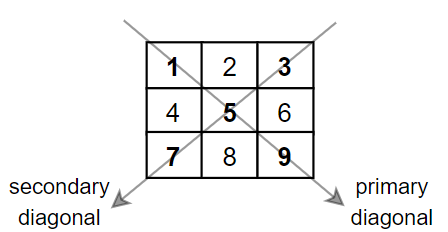
Input: mat = [[1,2,3],
              [4,5,6],
              [7,8,9]]
Output: 25
Explanation: Diagonals sum: 1 + 5 + 9 + 3 + 7 = 25
Notice that element mat[1][1] = 5 is counted only once.
Example 2:
Input: mat = [[1,1,1,1],
              [1,1,1,1],
              [1,1,1,1],
              [1,1,1,1]]
Output: 8
Example 3:
Input: mat = [[5]]
Output: 5
Constraints:
n == mat.length == mat[i].length1 <= n <= 1001 <= mat[i][j] <= 100
Approaches
3 approaches with complexity analysis and trade-offs.
This approach involves iterating through every element of the n x n matrix. For each element, we check if it lies on the primary or secondary diagonal. If it does, we add its value to a running total.
Algorithm
- Initialize a variable
sumto 0. - Get the dimension of the square matrix,
n. - Use nested loops to iterate from
i = 0ton-1andj = 0ton-1. - Inside the inner loop, check if
i == j(primary diagonal) ori + j == n - 1(secondary diagonal). - If the condition is true, add
mat[i][j]tosum. - Return
sum.
Walkthrough
The algorithm uses two nested loops to traverse each cell (i, j) of the matrix. Inside the loops, a condition checks if the cell is part of a diagonal. A cell mat[i][j] is on the primary diagonal if its row index i is equal to its column index j (i == j). A cell is on the secondary diagonal if the sum of its indices equals n - 1 (i + j == n - 1). If either of these conditions is true, the element's value is added to the sum. The OR condition (||) naturally handles the case of the central element (in odd-sized matrices) by ensuring it's added only once. After iterating through all elements, the final sum is returned.
class Solution { public int diagonalSum(int[][] mat) { int n = mat.length; int sum = 0; for (int i = 0; i < n; i++) { for (int j = 0; j < n; j++) { // Check for primary diagonal or secondary diagonal if (i == j || i + j == n - 1) { sum += mat[i][j]; } } } return sum; }}Complexity
Time
O(n^2), where `n` is the number of rows (or columns) in the matrix. We visit every element in the matrix.
Space
O(1), as we only use a constant amount of extra space for the `sum` variable and loop counters.
Trade-offs
Pros
Simple to understand and implement.
Cons
Inefficient for large matrices as it checks every single element, even those not on any diagonal.
Solutions
Solution
class Solution { public int diagonalSum ( int [][] mat ) { int ans = 0 ; int n = mat . length ; for ( int i = 0 ; i < n ; ++ i ) { int j = n - i - 1 ; ans += mat [ i ][ i ] + ( i == j ? 0 : mat [ i ][ j ]); } return ans ; } }Video walkthrough
Newsletter
One sharp idea, every week
System design and interview prep — short enough to finish.
No spam. Unsubscribe anytime.
Practice
Same difficulty — related problems to reinforce the pattern.