
Matrix Similarity After Cyclic Shifts
EasyPrompt
You are given an m x n integer matrix mat and an integer k. The matrix rows are 0-indexed.
The following proccess happens k times:
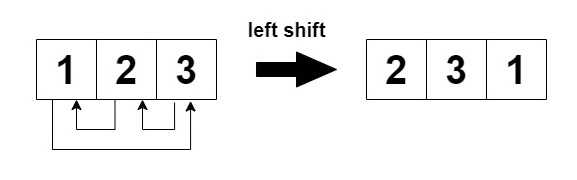
- Even-indexed rows (0, 2, 4, ...) are cyclically shifted to the left.
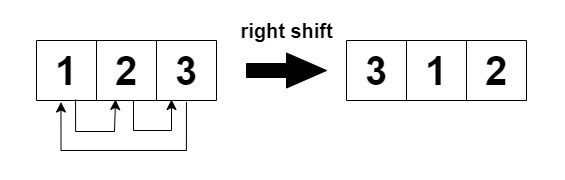
- Odd-indexed rows (1, 3, 5, ...) are cyclically shifted to the right.
Return true if the final modified matrix after k steps is identical to the original matrix, and false otherwise.
Example 1:
Input: mat = [[1,2,3],[4,5,6],[7,8,9]], k = 4
Output: false
Explanation:
In each step left shift is applied to rows 0 and 2 (even indices), and right shift to row 1 (odd index).

Example 2:
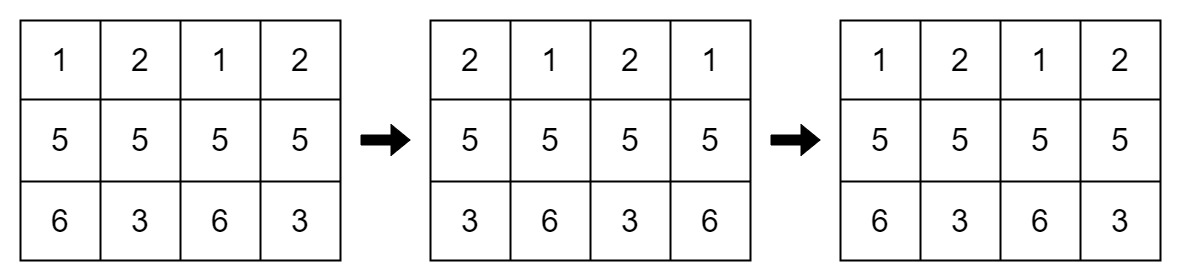
Input: mat = [[1,2,1,2],[5,5,5,5],[6,3,6,3]], k = 2
Output: true
Explanation:
Example 3:
Input: mat = [[2,2],[2,2]], k = 3
Output: true
Explanation:
As all the values are equal in the matrix, even after performing cyclic shifts the matrix will remain the same.
Constraints:
1 <= mat.length <= 251 <= mat[i].length <= 251 <= mat[i][j] <= 251 <= k <= 50
Approaches
3 approaches with complexity analysis and trade-offs.
This approach directly simulates the process described in the problem. It performs the cyclic shifts one by one for k steps and then compares the final matrix with the original one.
Algorithm
- Create a copy of the input matrix,
mat, calledcurrentMat. - Get the number of columns,
n. - Loop
ktimes. In each iteration, representing one step of the shift:- Create a new
m x nmatrix callednextMat. - Iterate through each row
iand columnjofcurrentMat. - If
iis an even index, perform a single left shift:nextMat[i][j] = currentMat[i][(j + 1) % n]. - If
iis an odd index, perform a single right shift:nextMat[i][j] = currentMat[i][(j - 1 + n) % n]. - After filling
nextMat, updatecurrentMatto benextMat.
- Create a new
- After the
kiterations are complete, compare the finalcurrentMatwith the originalmatelement by element. - If all elements match, return
true. Otherwise, returnfalse.
Walkthrough
We start by creating a copy of the original matrix to modify, let's call it currentMat. We then loop k times. In each iteration, we simulate one step of the cyclic shift process. For each step, we create a new temporary matrix, nextMat, to store the result of the shift. We iterate through each row of currentMat. If the row index is even, we perform a single left cyclic shift. If the row index is odd, we perform a single right cyclic shift. After processing all rows, we update currentMat with the contents of nextMat. After k iterations, we compare the final currentMat with the original mat. If they are identical, we return true; otherwise, false.
class Solution { public boolean areSimilar(int[][] mat, int k) { int m = mat.length; int n = mat[0].length; int[][] currentMat = new int[m][n]; for (int i = 0; i < m; i++) { System.arraycopy(mat[i], 0, currentMat[i], 0, n); } for (int step = 0; step < k; step++) { int[][] nextMat = new int[m][n]; for (int i = 0; i < m; i++) { if (i % 2 == 0) { // Even row: left shift for (int j = 0; j < n; j++) { nextMat[i][j] = currentMat[i][(j + 1) % n]; } } else { // Odd row: right shift for (int j = 0; j < n; j++) { nextMat[i][j] = currentMat[i][(j - 1 + n) % n]; } } } currentMat = nextMat; } for (int i = 0; i < m; i++) { for (int j = 0; j < n; j++) { if (mat[i][j] != currentMat[i][j]) { return false; } } } return true; }}Complexity
Time
O(k * m * n). The outer loop runs `k` times, and inside it, we iterate through the `m x n` matrix to perform the shifts.
Space
O(m * n). We use an extra matrix `currentMat` and `nextMat` to store the state of the matrix at each step.
Trade-offs
Pros
Simple to understand and implement as it directly follows the problem description.
Cons
Highly inefficient, especially for large values of
k.Time complexity is proportional to
k, which can lead to Time Limit Exceeded errors.Requires significant extra space to store intermediate matrices.
Solutions
Solution
class Solution {public boolean areSimilar(int[][] mat, int k) { int m = mat.length, n = mat[0].length; k %= n; for (int i = 0; i < m; ++i) { for (int j = 0; j < n; ++j) { if (i % 2 == 1 && mat[i][j] != mat[i][(j + k) % n]) { return false; } if (i % 2 == 0 && mat[i][j] != mat[i][(j - k + n) % n]) { return false; } } } return true; }}Video walkthrough
Newsletter
One sharp idea, every week
System design and interview prep — short enough to finish.
No spam. Unsubscribe anytime.
Practice
Same difficulty — related problems to reinforce the pattern.