
Maximum Height of a Triangle
EasyPrompt
You are given two integers red and blue representing the count of red and blue colored balls. You have to arrange these balls to form a triangle such that the 1st row will have 1 ball, the 2nd row will have 2 balls, the 3rd row will have 3 balls, and so on.
All the balls in a particular row should be the same color, and adjacent rows should have different colors.
Return the maximum height of the triangle that can be achieved.
Example 1:
Input: red = 2, blue = 4
Output: 3
Explanation:
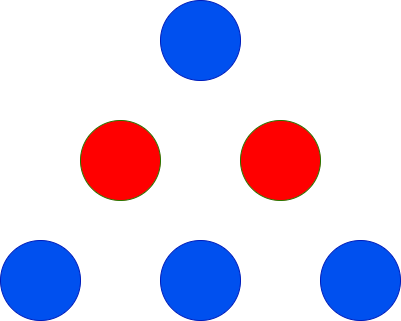
The only possible arrangement is shown above.
Example 2:
Input: red = 2, blue = 1
Output: 2
Explanation:
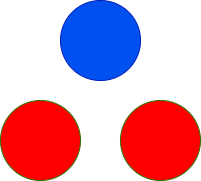
The only possible arrangement is shown above.
Example 3:
Input: red = 1, blue = 1
Output: 1
Example 4:
Input: red = 10, blue = 1
Output: 2
Explanation:
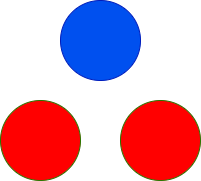
The only possible arrangement is shown above.
Constraints:
1 <= red, blue <= 100
Approaches
2 approaches with complexity analysis and trade-offs.
This approach directly simulates the process of building the triangle. Since there are two possible ways to start (with a red ball row or a blue ball row), we simulate both scenarios and take the maximum height achieved. We greedily add rows one by one as long as we have enough balls of the required color.
Algorithm
- Simulate the triangle construction for two separate scenarios: one starting with a red row and another starting with a blue row.
- For each scenario, iterate row by row, starting from row 1.
- In each iteration
i, check if there are enough balls (iballs) of the required color for that row. - If yes, subtract the balls, increment the height, and continue to the next row.
- If no, the construction for that scenario stops, and the current height is the maximum for that scenario.
- The final answer is the maximum height obtained from the two scenarios.
Walkthrough
We can model the construction of the triangle row by row. The key constraints are that row i requires i balls, all balls in a row must be the same color, and adjacent rows must have different colors. This leads to two possible coloring patterns:
- Pattern 1: Odd-numbered rows are red, and even-numbered rows are blue.
- Pattern 2: Odd-numbered rows are blue, and even-numbered rows are red.
We can write a helper function that takes the counts of balls for odd and even rows and calculates the maximum height possible. We then call this function for both patterns and return the greater of the two heights.
The simulation proceeds iteratively. For a given pattern, we start with height = 0 and row = 1. In a loop, we check if we can build the current row. If row is odd, we check the ball count for odd rows. If row is even, we check the ball count for even rows. If we have enough balls, we subtract the required number, increment the height, and move to the next row. If not, we stop and the current height is the maximum for that pattern.
class Solution { public int maxHeightOfTriangle(int red, int blue) { // Scenario 1: Odd rows are red, even are blue int height1 = calculateHeight(red, blue); // Scenario 2: Odd rows are blue, even are red int height2 = calculateHeight(blue, red); return Math.max(height1, height2); } private int calculateHeight(int oddColorBalls, int evenColorBalls) { int height = 0; int row = 1; while (true) { if (row % 2 != 0) { // Odd row if (oddColorBalls >= row) { oddColorBalls -= row; } else { break; } } else { // Even row if (evenColorBalls >= row) { evenColorBalls -= row; } else { break; } } height++; row++; } return height; }}Complexity
Time
O(sqrt(red + blue)) - The total number of balls used for a triangle of height `h` is `1 + 2 + ... + h = h*(h+1)/2`. If the total balls are `N = red + blue`, then `h^2` is roughly `2N`, so the maximum height `h` is `O(sqrt(N))`. The loop runs `h` times.
Space
O(1) - We only use a few variables to store the current state (ball counts, height, row number).
Trade-offs
Pros
Simple to understand and implement.
Very efficient for the given constraints, as the maximum height is small.
Cons
Asymptotically slower than the binary search approach, although the difference is negligible given the problem's constraints.
A more optimized approach uses binary search on the height of the triangle. The core idea is that the possibility of forming a triangle of a certain height is a monotonic function. If we can build a triangle of height h, we can definitely build one of height h-1. This allows us to efficiently search for the maximum possible height.
Algorithm
- The problem has a monotonic property: if a triangle of height
his possible, any triangle of height less thanhis also possible. - This allows us to use binary search on the answer (the height
h). - We define a search space for
h, for example, from0to200. - For each
midvalue in the binary search, we check if a triangle of heightmidis feasible using a helper functionisPossible(h). - The
isPossible(h)function calculates the total balls needed for each color for a heighthand checks against the availableredandblueballs for both starting color scenarios. - If
isPossible(mid)is true, we storemidas a potential answer and search for a larger height (low = mid + 1). - If false, we search for a smaller height (
high = mid - 1).
Walkthrough
We can binary search for the maximum height h. For a given h, we need an O(1) way to check if it's possible to construct such a triangle. A triangle of height h is possible if we have enough red and blue balls for one of the two coloring patterns.
Let's analyze the ball requirements for a height h:
- Number of odd rows:
(h + 1) / 2 - Number of even rows:
h / 2 - Balls for odd rows (sum of first
kodd numbers1, 3, ...):k^2, wherek = (h+1)/2. - Balls for even rows (sum of first
keven numbers2, 4, ...):k*(k+1), wherek = h/2.
Our isPossible(h) function will calculate these required ball counts and check against the available red and blue balls:
- Case 1 (Start Red): Check if
red >= balls_for_odd_rowsandblue >= balls_for_even_rows. - Case 2 (Start Blue): Check if
blue >= balls_for_odd_rowsandred >= balls_for_even_rows.
If either case is true, a triangle of height h is possible. The binary search algorithm will use this check to narrow down the search space and find the maximum h.
class Solution { public int maxHeightOfTriangle(int red, int blue) { int low = 0, high = 200; // A safe upper bound for height int ans = 0; while (low <= high) { int h = low + (high - low) / 2; if (isPossible(h, red, blue)) { ans = h; low = h + 1; // Try for a larger height } else { high = h - 1; // Height is too large } } return ans; } private boolean isPossible(int h, int red, int blue) { if (h == 0) { return true; } long oddRows = (h + 1) / 2; long evenRows = h / 2; long ballsForOddRows = oddRows * oddRows; long ballsForEvenRows = evenRows * (evenRows + 1); // Case 1: Odd rows are red, even rows are blue if (red >= ballsForOddRows && blue >= ballsForEvenRows) { return true; } // Case 2: Odd rows are blue, even rows are red if (blue >= ballsForOddRows && red >= ballsForEvenRows) { return true; } return false; }}Complexity
Time
O(log(max_height)) - The search space for the height is up to `red + blue`. The binary search takes logarithmic time relative to the size of this search space. Since `max_height` is `O(sqrt(red+blue))`, the complexity is `O(log(sqrt(red+blue)))`, which simplifies to `O(log(red+blue))`. The `isPossible` check is O(1).
Space
O(1) - The binary search and helper function use a constant amount of extra space.
Trade-offs
Pros
Asymptotically the most efficient approach.
Scales well even if the constraints on
redandbluewere much larger.
Cons
Slightly more complex to reason about and implement compared to the direct simulation.
Requires careful handling of formulas and potential integer overflows for ball counts.
Solutions
Solution
class Solution {public int maxHeightOfTriangle(int red, int blue) { int ans = 0; for (int k = 0; k < 2; ++k) { int[] c = {red, blue}; for (int i = 1, j = k; i <= c[j]; j ^= 1, ++i) { c[j] -= i; ans = Math.max(ans, i); } } return ans; }}class Solution {public: int maxHeightOfTriangle(int red, int blue) { int ans = 0; for (int k = 0; k < 2; ++k) { int c[2] = {red, blue}; for (int i = 1, j = k; i <= c[j]; j ^= 1, ++i) { c[j] -= i; ans = max(ans, i); } } return ans; }};class Solution: def maxHeightOfTriangle(self, red: int, blue: int) -> int: ans = 0 for k in range(2): c = [red, blue] i, j = 1, k while i <= c[j]: c[j] -= i j ^= 1 ans = max(ans, i) i += 1 return ansVideo walkthrough
Newsletter
One sharp idea, every week
System design and interview prep — short enough to finish.
No spam. Unsubscribe anytime.
Practice
Same difficulty — related problems to reinforce the pattern.