
Merge Two Binary Trees
EasyPrompt
You are given two binary trees root1 and root2.
Imagine that when you put one of them to cover the other, some nodes of the two trees are overlapped while the others are not. You need to merge the two trees into a new binary tree. The merge rule is that if two nodes overlap, then sum node values up as the new value of the merged node. Otherwise, the NOT null node will be used as the node of the new tree.
Return the merged tree.
Note: The merging process must start from the root nodes of both trees.
Example 1:
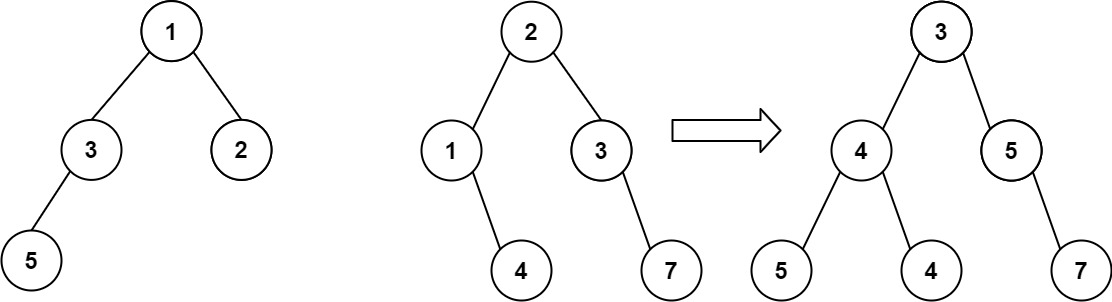
Input: root1 = [1,3,2,5], root2 = [2,1,3,null,4,null,7]
Output: [3,4,5,5,4,null,7]
Example 2:
Input: root1 = [1], root2 = [1,2]
Output: [2,2]
Constraints:
- The number of nodes in both trees is in the range
[0, 2000]. -104 <= Node.val <= 104
Approaches
3 approaches with complexity analysis and trade-offs.
This approach avoids recursion by using a stack to perform a pre-order traversal of the trees. It modifies one of the trees (e.g., tree1) in-place to store the merged result, which saves space compared to creating a new tree. This is useful for avoiding stack overflow on extremely deep trees.
Algorithm
- If
root1is null, returnroot2. - Create a
Stackand push aTreeNode[]pair containing[root1, root2]. - Loop while the stack is not empty:
- Pop the pair
[t1, t2]. - If
t2is null, continue to the next iteration. - Add
t2.valtot1.val. - For the left children: If
t1.leftis null, sett1.left = t2.left. Otherwise, push[t1.left, t2.left]to the stack. - For the right children: If
t1.rightis null, sett1.right = t2.right. Otherwise, push[t1.right, t2.right]to the stack.
- Pop the pair
- Return
root1.
Walkthrough
The core idea is to use a stack to keep track of pairs of nodes from tree1 and tree2 that need to be processed. We will merge tree2 into tree1.
- First, handle the edge case where one of the root nodes is null. If
root1is null, we can simply returnroot2. - Push the root pair
[root1, root2]onto the stack. - While the stack is not empty, pop a pair
[t1, t2]. - If
t2is null, there's nothing to merge for this pair, so we continue. - Sum the values:
t1.val += t2.val. - Now, consider the left children. If
t1has a left child, we need to checkt2's left child. Ift2also has a left child, we push the pair[t1.left, t2.left]to the stack for future processing. Ift1does not have a left child butt2does, we can directly attacht2's left subtree tot1by settingt1.left = t2.left. - The same logic is applied to the right children.
- After the loop finishes,
root1will be the root of the merged tree.
import java.util.Stack; class Solution { public TreeNode mergeTrees(TreeNode root1, TreeNode root2) { if (root1 == null) { return root2; } // We will merge root2 into root1 Stack<TreeNode[]> stack = new Stack<>(); stack.push(new TreeNode[]{root1, root2}); while (!stack.isEmpty()) { TreeNode[] t = stack.pop(); // No need to merge if t[1] is null, as t[0] remains as is. if (t[0] == null || t[1] == null) { continue; } // Add t[1]'s value to t[0]'s t[0].val += t[1].val; // Process left children if (t[0].left == null) { t[0].left = t[1].left; } else { stack.push(new TreeNode[]{t[0].left, t[1].left}); } // Process right children if (t[0].right == null) { t[0].right = t[1].right; } else { stack.push(new TreeNode[]{t[0].right, t[1].right}); } } return root1; }}Complexity
Time
O(M), where M is the number of overlapping nodes in the two trees. We only push pairs to the stack where both nodes exist, so we only iterate over the overlapping parts.
Space
O(W), where W is the maximum width of the trees. In the worst case of a complete binary tree, the width can be O(N), where N is the number of nodes. In the best case of a skewed tree, the space is O(1).
Trade-offs
Pros
Avoids recursion, preventing potential stack overflow errors for very deep trees.
More space-efficient than creating a new tree since it modifies one in-place.
Cons
Modifies one of the original input trees.
The code can be slightly more complex to write and understand compared to the recursive version.
Worst-case space complexity for the stack can be O(N) for wide, bushy trees.
Solutions
Solution
/** * Definition for a binary tree node. * public class TreeNode { * int val; * TreeNode left; * TreeNode right; * TreeNode() {} * TreeNode(int val) { this.val = val; } * TreeNode(int val, TreeNode left, TreeNode right) { * this.val = val; * this.left = left; * this.right = right; * } * } */ class Solution { public TreeNode mergeTrees ( TreeNode root1 , TreeNode root2 ) { if ( root1 == null ) { return root2 ; } if ( root2 == null ) { return root1 ; } TreeNode node = new TreeNode ( root1 . val + root2 . val ); node . left = mergeTrees ( root1 . left , root2 . left ); node . right = mergeTrees ( root1 . right , root2 . right ); return node ; } }Video walkthrough
Newsletter
One sharp idea, every week
System design and interview prep — short enough to finish.
No spam. Unsubscribe anytime.
Practice
Same difficulty — related problems to reinforce the pattern.