
Pascal's Triangle
EasyPrompt
Given an integer numRows, return the first numRows of Pascal's triangle.
In Pascal's triangle, each number is the sum of the two numbers directly above it as shown:
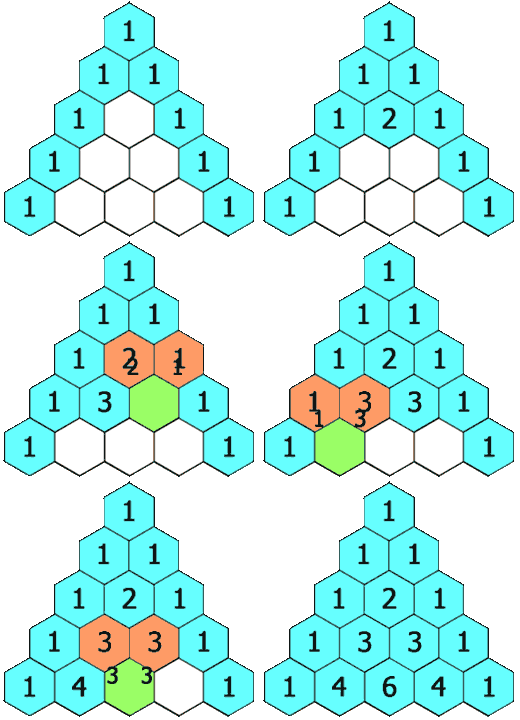
Example 1:
Input: numRows = 5
Output: [[1],[1,1],[1,2,1],[1,3,3,1],[1,4,6,4,1]]
Example 2:
Input: numRows = 1
Output: [[1]]
Constraints:
1 <= numRows <= 30
Approaches
2 approaches with complexity analysis and trade-offs.
This approach directly translates the mathematical definition of Pascal's Triangle into a recursive function. Each element T(i, j) is calculated by the recursive formula T(i, j) = T(i-1, j-1) + T(i-1, j). The base cases are the edges of the triangle, where T(i, 0) = 1 and T(i, i) = 1.
Algorithm
- Create a main list
triangleto store the result. - Loop for
ifrom 0 tonumRows - 1:- Create a new list
currentRow. - Loop for
jfrom 0 toi:- Calculate the value at
(i, j)using a recursive helper functioncomputeValue(i, j). - Add the value to
currentRow.
- Calculate the value at
- Add
currentRowtotriangle.
- Create a new list
- Return
triangle.
Helper function computeValue(row, col):
- If
col == 0orcol == row, return 1. - Return
computeValue(row - 1, col - 1) + computeValue(row - 1, col).
Walkthrough
We define a helper function, say getValue(row, col), that computes the value at a specific position in the triangle. The main function iterates from row = 0 to numRows - 1. For each row, it iterates from col = 0 to row. In the inner loop, it calls getValue(row, col) to compute the element and adds it to the current row's list.
The getValue(row, col) function works as follows: if col is 0 or col is equal to row, it returns 1 (base case). Otherwise, it makes two recursive calls: getValue(row - 1, col - 1) and getValue(row - 1, col), and returns their sum.
This method is straightforward but highly inefficient because it re-computes the same values multiple times. For instance, calculating T(5, 2) requires T(4, 1) and T(4, 2), and both of these require T(3, 1), leading to redundant calculations.
class Solution { public List<List<Integer>> generate(int numRows) { List<List<Integer>> triangle = new ArrayList<>(); for (int i = 0; i < numRows; i++) { List<Integer> row = new ArrayList<>(); for (int j = 0; j <= i; j++) { row.add(computeValue(i, j)); } triangle.add(row); } return triangle; } private int computeValue(int row, int col) { if (col == 0 || col == row) { return 1; } return computeValue(row - 1, col - 1) + computeValue(row - 1, col); }}Complexity
Time
O(2^numRows)
Space
O(numRows^2)
Trade-offs
Pros
Simple to understand as it directly follows the mathematical definition.
Cons
Extremely inefficient due to massive redundant computations.
Will likely result in a 'Time Limit Exceeded' error for larger inputs.
Solutions
Solution
class Solution { public List < List < Integer >> generate ( int numRows ) { List < List < Integer >> f = new ArrayList <>(); f . add ( List . of ( 1 )); for ( int i = 0 ; i < numRows - 1 ; ++ i ) { List < Integer > g = new ArrayList <>(); g . add ( 1 ); for ( int j = 0 ; j < f . get ( i ). size () - 1 ; ++ j ) { g . add ( f . get ( i ). get ( j ) + f . get ( i ). get ( j + 1 )); } g . add ( 1 ); f . add ( g ); } return f ; } }Video walkthrough
Newsletter
One sharp idea, every week
System design and interview prep — short enough to finish.
No spam. Unsubscribe anytime.
Practice
Same difficulty — related problems to reinforce the pattern.