
Prime In Diagonal
EasyPrompt
You are given a 0-indexed two-dimensional integer array nums.
Return the largest prime number that lies on at least one of the diagonals of nums. In case, no prime is present on any of the diagonals, return 0.
Note that:
- An integer is prime if it is greater than
1and has no positive integer divisors other than1and itself. - An integer
valis on one of the diagonals ofnumsif there exists an integerifor whichnums[i][i] = valor anifor whichnums[i][nums.length - i - 1] = val.
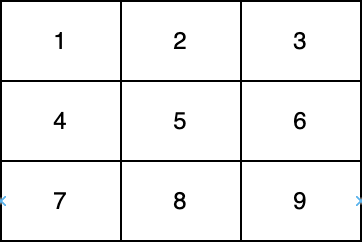
In the above diagram, one diagonal is [1,5,9] and another diagonal is [3,5,7].
Example 1:
Input: nums = [[1,2,3],[5,6,7],[9,10,11]]
Output: 11
Explanation: The numbers 1, 3, 6, 9, and 11 are the only numbers present on at least one of the diagonals. Since 11 is the largest prime, we return 11.
Example 2:
Input: nums = [[1,2,3],[5,17,7],[9,11,10]]
Output: 17
Explanation: The numbers 1, 3, 9, 10, and 17 are all present on at least one of the diagonals. 17 is the largest prime, so we return 17.
Constraints:
1 <= nums.length <= 300nums.length == numsi.length1 <= nums[i][j] <= 4*106
Approaches
3 approaches with complexity analysis and trade-offs.
This approach involves iterating through the two diagonals of the matrix. For each number encountered, a helper function is called to check if it is a prime number. The largest prime found is tracked and returned. The primality test is done in a naive way by checking for divisibility from 2 up to the number itself minus one.
Algorithm
- Initialize a variable
maxPrimeto 0. - Get the size of the matrix,
n = nums.length. - Iterate from
i = 0ton-1. - Inside the loop, consider the number on the main diagonal:
val1 = nums[i][i]. - Check if
val1is prime using a brute-force helper functionisPrime(val1). - If
isPrime(val1)is true andval1 > maxPrime, updatemaxPrime = val1. - Consider the number on the anti-diagonal:
val2 = nums[i][n-1-i]. - Check if
val2is prime usingisPrime(val2). - If
isPrime(val2)is true andval2 > maxPrime, updatemaxPrime = val2. - After the loop finishes, return
maxPrime.
isPrime(num) (Brute-Force):
- If
num <= 1, returnfalse. - Iterate from
j = 2tonum - 1. - If
num % j == 0, thennumis not prime, returnfalse. - If the loop completes,
numis prime, returntrue.
Walkthrough
The main logic iterates through the rows of the matrix from i = 0 to n-1, where n is the side length of the square matrix. In each iteration, it picks the two diagonal elements: nums[i][i] (main diagonal) and nums[i][n-1-i] (anti-diagonal). A helper function, isPrime(num), is used to determine primality. This function checks for divisibility by every integer from 2 up to num - 1. If a number is found to be prime and is larger than the current maximum prime found, the maximum is updated. The final result is the largest prime number found after checking all diagonal elements.
class Solution { private boolean isPrime(int n) { if (n <= 1) { return false; } for (int i = 2; i < n; i++) { if (n % i == 0) { return false; } } return true; } public int diagonalPrime(int[][] nums) { int n = nums.length; int maxPrime = 0; for (int i = 0; i < n; i++) { // Main diagonal int val1 = nums[i][i]; if (isPrime(val1)) { maxPrime = Math.max(maxPrime, val1); } // Anti-diagonal int val2 = nums[i][n - 1 - i]; if (isPrime(val2)) { maxPrime = Math.max(maxPrime, val2); } } return maxPrime; }}Complexity
Time
O(N * M), where `N` is the side length of the matrix and `M` is the maximum value of an element. For each of the `~2*N` diagonal elements, the primality test takes up to `O(M)` time.
Space
O(1) extra space.
Trade-offs
Pros
Simple to understand and implement.
Cons
Extremely inefficient due to the naive primality test.
Will not pass the time limits for the given constraints, resulting in a 'Time Limit Exceeded' error.
Solutions
Solution
class Solution {public int diagonalPrime(int[][] nums) { int n = nums.length; int ans = 0; for (int i = 0; i < n; ++i) { if (isPrime(nums[i][i])) { ans = Math.max(ans, nums[i][i]); } if (isPrime(nums[i][n - i - 1])) { ans = Math.max(ans, nums[i][n - i - 1]); } } return ans; }private boolean isPrime(int x) { if (x < 2) { return false; } for (int i = 2; i <= x / i; ++i) { if (x % i == 0) { return false; } } return true; }}Video walkthrough
Newsletter
One sharp idea, every week
System design and interview prep — short enough to finish.
No spam. Unsubscribe anytime.
Practice
Same difficulty — related problems to reinforce the pattern.