
Remove Linked List Elements
EasyPrompt
Given the head of a linked list and an integer val, remove all the nodes of the linked list that has Node.val == val, and return the new head.
Example 1:
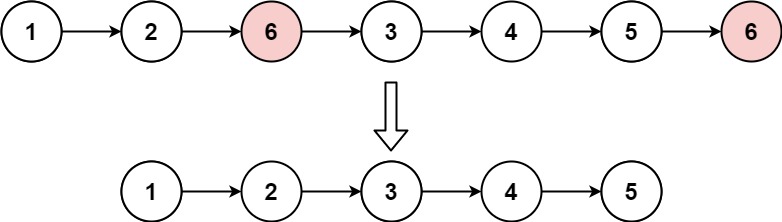
Input: head = [1,2,6,3,4,5,6], val = 6
Output: [1,2,3,4,5]
Example 2:
Input: head = [], val = 1
Output: []
Example 3:
Input: head = [7,7,7,7], val = 7
Output: []
Constraints:
- The number of nodes in the list is in the range
[0, 104]. 1 <= Node.val <= 500 <= val <= 50
Approaches
3 approaches with complexity analysis and trade-offs.
This approach uses a dummy node to simplify the logic of removing nodes from the linked list. By creating a dummy node that points to the head, we can handle the edge case where the head itself needs to be removed without special handling.
Algorithm
- Create a dummy node and point it to the head
- Initialize
prevpointer to dummy andcurrentpointer to head - While
currentis not null:- If
current.valequals target value:- Skip current node by setting
prev.next = current.next
- Skip current node by setting
- Else:
- Move
prevtocurrent
- Move
- Move
currenttocurrent.next
- If
- Return
dummy.nextas the new head
Walkthrough
We create a dummy node that points to the head of the linked list. This allows us to treat all nodes uniformly, including the head node. We then iterate through the list with two pointers: prev (starting at dummy) and current (starting at head). When we find a node with the target value, we skip it by updating prev.next to point to current.next. Otherwise, we move prev forward. Finally, we return dummy.next as the new head.
class ListNode { int val; ListNode next; ListNode() {} ListNode(int val) { this.val = val; } ListNode(int val, ListNode next) { this.val = val; this.next = next; }} public ListNode removeElements(ListNode head, int val) { ListNode dummy = new ListNode(0); dummy.next = head; ListNode prev = dummy; ListNode current = head; while (current != null) { if (current.val == val) { prev.next = current.next; } else { prev = current; } current = current.next; } return dummy.next;}Complexity
Time
O(n)
Space
O(1)
Trade-offs
Pros
Simple and intuitive logic
Handles edge cases (empty list, removing head) elegantly
Single pass through the list
Easy to understand and implement
Cons
Uses extra dummy node (minimal overhead)
Slightly more memory usage due to dummy node
Solutions
Solution
public class Solution { public ListNode RemoveElements ( ListNode head , int val ) { ListNode newHead = null ; ListNode newTail = null ; var current = head ; while ( current != null ) { if ( current . val != val ) { if ( newHead == null ) { newHead = newTail = current ; } else { newTail . next = current ; newTail = current ; } } current = current . next ; } if ( newTail != null ) newTail . next = null ; return newHead ; } }Video walkthrough
Newsletter
One sharp idea, every week
System design and interview prep — short enough to finish.
No spam. Unsubscribe anytime.
Practice
Same difficulty — related problems to reinforce the pattern.