
Reshape the Matrix
EasyPrompt
In MATLAB, there is a handy function called reshape which can reshape an m x n matrix into a new one with a different size r x c keeping its original data.
You are given an m x n matrix mat and two integers r and c representing the number of rows and the number of columns of the wanted reshaped matrix.
The reshaped matrix should be filled with all the elements of the original matrix in the same row-traversing order as they were.
If the reshape operation with given parameters is possible and legal, output the new reshaped matrix; Otherwise, output the original matrix.
Example 1:
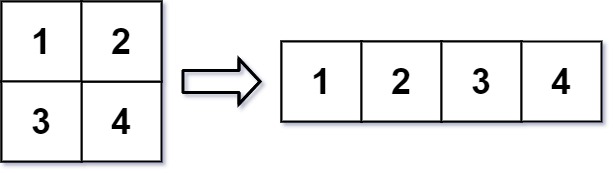
Input: mat = [[1,2],[3,4]], r = 1, c = 4
Output: [[1,2,3,4]]
Example 2:
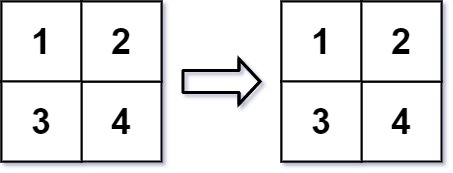
Input: mat = [[1,2],[3,4]], r = 2, c = 4
Output: [[1,2],[3,4]]
Constraints:
m == mat.lengthn == mat[i].length1 <= m, n <= 100-1000 <= mat[i][j] <= 10001 <= r, c <= 300
Approaches
2 approaches with complexity analysis and trade-offs.
This approach involves first flattening the original matrix into a one-dimensional data structure, like a queue or a list, and then constructing the new matrix by polling elements from this structure.
Algorithm
- Check if the total number of elements in the original matrix (
m * n) is equal to the total number of elements in the desired reshaped matrix (r * c). If not, return the original matrix. - Create a queue (e.g.,
LinkedListin Java) to store all elements of the original matrix. - Iterate through the original matrix
matrow by row, and add each elementmat[i][j]into the queue. - Create a new result matrix
reshapedMatof sizer x c. - Iterate through the
reshapedMatfrom(0, 0)to(r-1, c-1). - In each position
(i, j)of the new matrix, place the element removed from the front of the queue (queue.poll()). - Return the
reshapedMat.
Walkthrough
The core idea is to separate the process into two distinct steps: reading and writing. First, we perform the validity check: m * n must equal r * c. If not, the reshape is impossible, and we return the original matrix. If the reshape is possible, we create a queue to store the elements. We iterate through the original m x n matrix, mat, row by row, and add each element to the queue. This effectively linearizes the matrix data in the required row-traversing order. Next, we create a new matrix, reshapedMat, with the desired dimensions r x c. We then iterate through this new matrix, from row = 0 to r-1 and col = 0 to c-1, and for each cell, we poll an element from the front of the queue and place it in reshapedMat[row][col]. Finally, the fully populated reshapedMat is returned.
import java.util.LinkedList;import java.util.Queue; class Solution { public int[][] matrixReshape(int[][] mat, int r, int c) { int m = mat.length; int n = mat[0].length; if (m * n != r * c) { return mat; } Queue<Integer> queue = new LinkedList<>(); for (int i = 0; i < m; i++) { for (int j = 0; j < n; j++) { queue.add(mat[i][j]); } } int[][] reshapedMat = new int[r][c]; for (int i = 0; i < r; i++) { for (int j = 0; j < c; j++) { reshapedMat[i][j] = queue.poll(); } } return reshapedMat; }}Complexity
Time
O(m * n), where `m` and `n` are the dimensions of the original matrix. We traverse the original matrix once to populate the queue (O(m * n)) and then traverse the new matrix once to fill it (O(r * c)). Since `m * n = r * c`, the total time is O(m * n).
Space
O(m * n). An auxiliary queue is used to store all the elements of the original matrix, which requires space proportional to the number of elements.
Trade-offs
Pros
Simple to understand and implement.
The logic is straightforward: flatten then build.
Cons
Requires extra space proportional to the size of the matrix, which can be significant for large matrices.
Solutions
Solution
class Solution {public int[][] matrixReshape(int[][] mat, int r, int c) { int m = mat.length, n = mat[0].length; if (m * n != r * c) { return mat; } int[][] ans = new int[r][c]; for (int i = 0; i < m * n; ++i) { ans[i / c][i % c] = mat[i / n][i % n]; } return ans; }}Video walkthrough
Newsletter
One sharp idea, every week
System design and interview prep — short enough to finish.
No spam. Unsubscribe anytime.
Practice
Same difficulty — related problems to reinforce the pattern.