
Rings and Rods
EasyPrompt
There are n rings and each ring is either red, green, or blue. The rings are distributed across ten rods labeled from 0 to 9.
You are given a string rings of length 2n that describes the n rings that are placed onto the rods. Every two characters in rings forms a color-position pair that is used to describe each ring where:
- The first character of the
ithpair denotes theithring's color ('R','G','B'). - The second character of the
ithpair denotes the rod that theithring is placed on ('0'to'9').
For example, "R3G2B1" describes n == 3 rings: a red ring placed onto the rod labeled 3, a green ring placed onto the rod labeled 2, and a blue ring placed onto the rod labeled 1.
Return the number of rods that have all three colors of rings on them.
Example 1:
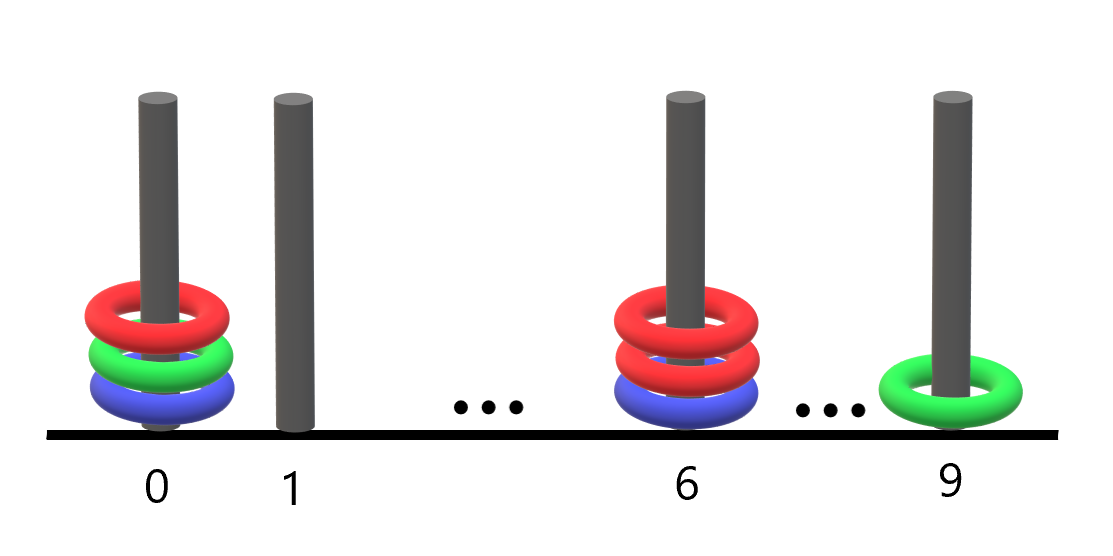
Input: rings = "B0B6G0R6R0R6G9"
Output: 1
Explanation:
- The rod labeled 0 holds 3 rings with all colors: red, green, and blue.
- The rod labeled 6 holds 3 rings, but it only has red and blue.
- The rod labeled 9 holds only a green ring.
Thus, the number of rods with all three colors is 1.
Example 2:
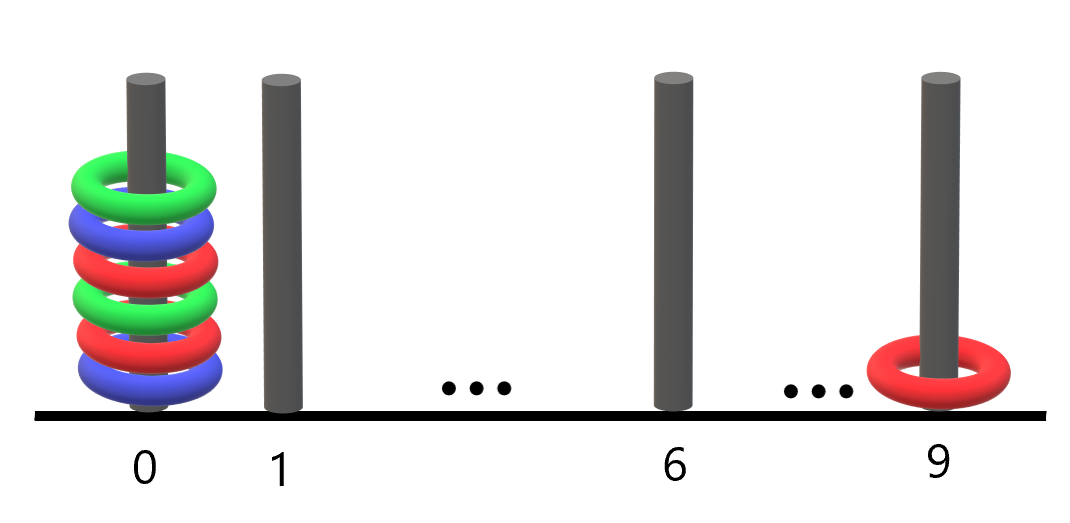
Input: rings = "B0R0G0R9R0B0G0"
Output: 1
Explanation:
- The rod labeled 0 holds 6 rings with all colors: red, green, and blue.
- The rod labeled 9 holds only a red ring.
Thus, the number of rods with all three colors is 1.
Example 3:
Input: rings = "G4"
Output: 0
Explanation:
Only one ring is given. Thus, no rods have all three colors.
Constraints:
rings.length == 2 * n1 <= n <= 100rings[i]whereiis even is either'R','G', or'B'(0-indexed).rings[i]whereiis odd is a digit from'0'to'9'(0-indexed).
Approaches
3 approaches with complexity analysis and trade-offs.
This approach uses a Hash Map to store the information about which colors are present on each rod. The keys of the map are the rod indices (0-9), and the values are Sets of characters representing the colors ('R', 'G', 'B'). Using a Set for colors automatically handles duplicate colors on the same rod, simplifying the logic.
Algorithm
- Create a
HashMap<Integer, Set<Character>>namedrodsto map rod indices to the set of colors on them. - Loop through the
ringsstring with a step of 2. - In each iteration, extract the
colorcharacter and therodIndexinteger. - Use
rods.putIfAbsent(rodIndex, new HashSet<>())to ensure a set exists for the current rod. - Add the
colorto the set for therodIndexusingrods.get(rodIndex).add(color). - After the loop, initialize a counter
countto 0. - Iterate over the values (the
Set<Character>) of therodsmap. - If a set's size is 3, it means all three colors are present, so increment
count. - Return
count.
Walkthrough
The core idea is to model the problem directly using data structures that fit the description. A map is a natural choice to associate rods (keys) with their properties (values). Since each rod can have multiple rings of different colors, a set is used as the value to store the unique colors found on that rod.
- Initialize a
HashMap<Integer, Set<Character>>. - Iterate through the input string
ringsby pairs of characters. For each pair, the first character is the color and the second is the rod index. - Parse the rod index and the color. For each rod, find its corresponding set in the map. If the rod is encountered for the first time, create a new
HashSetfor it. - Add the current color to the rod's set. The set will only store unique colors.
- After processing all the rings, iterate through the values of the map (which are the sets of colors).
- Count how many of these sets have a size of 3. A size of 3 indicates that the rod contains rings of all three distinct colors (Red, Green, and Blue).
- This count is the final answer.
import java.util.HashMap;import java.util.HashSet;import java.util.Map;import java.util.Set; class Solution { public int countPoints(String rings) { Map<Integer, Set<Character>> rods = new HashMap<>(); for (int i = 0; i < rings.length(); i += 2) { char color = rings.charAt(i); int rodIndex = rings.charAt(i + 1) - '0'; // Get the set of colors for the current rod, or create a new one rods.putIfAbsent(rodIndex, new HashSet<>()); // Add the color to the set for that rod rods.get(rodIndex).add(color); } int count = 0; // Iterate through the map's values (the sets of colors) for (Set<Character> colors : rods.values()) { // If a set has 3 colors, it means the rod has all three if (colors.size() == 3) { count++; } } return count; }}Complexity
Time
O(N), where N is the length of the `rings` string. We iterate through the string once. Map and set operations (put, get, add) take average O(1) time. The final loop runs at most 10 times, which is a constant factor.
Space
O(1) - Constant space. Since there are at most 10 rods and 3 colors, the space required for the map and sets is bounded by a constant (10 keys, each with a set of at most 3 characters).
Trade-offs
Pros
The logic is straightforward and easy to understand as it directly models the problem's entities.
It's flexible and would work even if the rod indices were not sequential or small integers.
Cons
Has slightly more overhead compared to using arrays due to the nature of hash maps (e.g., calculating hash codes, handling collisions).
Requires using wrapper classes (
Integer) andHashSetobjects, which can be less memory-efficient than primitive arrays.
Solutions
Solution
class Solution {public int countPoints(String rings) { int[] d = new int['Z']; d['R'] = 1; d['G'] = 2; d['B'] = 4; int[] mask = new int[10]; for (int i = 0, n = rings.length(); i < n; i += 2) { int c = rings.charAt(i); int j = rings.charAt(i + 1) - '0'; mask[j] |= d[c]; } int ans = 0; for (int x : mask) { if (x == 7) { ++ans; } } return ans; }}Video walkthrough
Newsletter
One sharp idea, every week
System design and interview prep — short enough to finish.
No spam. Unsubscribe anytime.
Practice
Same difficulty — related problems to reinforce the pattern.