
Shuffle String
EasyPrompt
You are given a string s and an integer array indices of the same length. The string s will be shuffled such that the character at the ith position moves to indices[i] in the shuffled string.
Return the shuffled string.
Example 1:
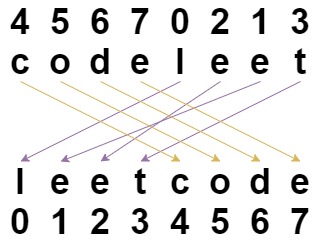
indicesExample 2:
indices
Constraints:
s.length == indices.length == n1 <= n <= 100sconsists of only lowercase English letters.0 <= indices[i] < n- All values of
indicesare unique.
Approaches
2 approaches with complexity analysis and trade-offs.
This approach attempts to solve the problem without using extra space for the result, by shuffling the characters and indices in-place. It uses the concept of cyclic sort. We iterate through each position, and if the character at that position is not the one that should be there, we swap it with the character from its correct original position. To keep track of the movements, we also swap the corresponding indices. This process is repeated until every character is in its final correct position.
Algorithm
- Convert the input string
sto a character arraycharArray. - Iterate from
i = 0ton-1. - Inside the loop, use a
whileloop that continues as long asindices[i] != i. This condition means the character currently atcharArray[i]is not in its final correct position. - Let
targetIndex = indices[i]. - Swap the character at
iwith the character attargetIndex. - Swap the index at
iwith the index attargetIndex. - This pair of swaps places one character into its correct final position and updates the
indicesarray to reflect the new state. Thewhileloop continues to resolve the new character that has been moved to positioni. - After the loops complete, the
charArrayis correctly ordered. - Convert the
charArrayback to a string and return it.
Walkthrough
The core idea is to place each character in its correct final position one by one. Since strings are immutable in Java, we first convert the input string s into a character array charArray.
We then iterate through the array from i = 0 to n-1. For each index i, we check if the character at charArray[i] is already in its correct place. The correct place for the character originally at s[i] is indices[i]. We use the indices array to track where each character should go. If indices[i] is not equal to i, it means the character at charArray[i] needs to be moved.
We perform a cycle of swaps. We swap charArray[i] with charArray[indices[i]]. To ensure we don't lose track of the correct positions, we also swap indices[i] with indices[indices[i]]. This process continues in a while loop until indices[i] == i, which signifies that the correct character has been placed at index i.
After the outer loop finishes, all characters will be in their correct shuffled positions within charArray.
class Solution { public String restoreString(String s, int[] indices) { char[] charArray = s.toCharArray(); int n = s.length(); for (int i = 0; i < n; i++) { // While the character at index i is not in its correct place while (indices[i] != i) { int targetIndex = indices[i]; // Swap the characters char tempChar = charArray[i]; charArray[i] = charArray[targetIndex]; charArray[targetIndex] = tempChar; // Swap the indices to reflect the character swap int tempIndex = indices[i]; indices[i] = indices[targetIndex]; indices[targetIndex] = tempIndex; } } return new String(charArray); }}Complexity
Time
O(n). Although there is a nested loop structure (`for` and `while`), each swap operation places at least one element in its correct final position. Since there are `n` elements, the total number of swaps across all iterations is at most `n-1`. Therefore, the total time complexity is linear.
Space
O(n). In Java, strings are immutable, so we must create a character array from the string, which takes `O(n)` space. If the input were a mutable character array, the space complexity would be `O(1)` as the shuffling is done in-place.
Trade-offs
Pros
The algorithm is clever and demonstrates an in-place sorting technique.
Conceptually, it uses O(1) auxiliary space (ignoring the space for the mutable copy of the string).
Cons
More complex to understand and implement compared to the auxiliary array approach.
It modifies the input
indicesarray, which might be an undesirable side effect.In Java, it doesn't offer a space advantage over the simpler method due to string immutability.
Solutions
Solution
class Solution {public String restoreString(String s, int[] indices) { int n = s.length(); char[] ans = new char[n]; for (int i = 0; i < n; ++i) { ans[indices[i]] = s.charAt(i); } return String.valueOf(ans); }}Video walkthrough
Newsletter
One sharp idea, every week
System design and interview prep — short enough to finish.
No spam. Unsubscribe anytime.
Practice
Same difficulty — related problems to reinforce the pattern.