
Symmetric Tree
EasyPrompt
Given the root of a binary tree, check whether it is a mirror of itself (i.e., symmetric around its center).
Example 1:
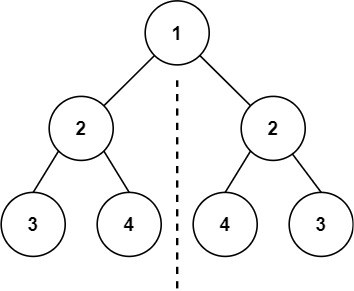
Input: root = [1,2,2,3,4,4,3]
Output: true
Example 2:
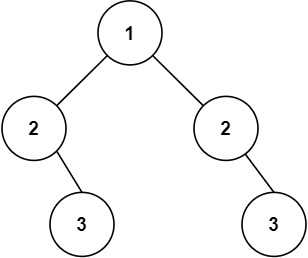
Input: root = [1,2,2,null,3,null,3]
Output: false
Constraints:
- The number of nodes in the tree is in the range
[1, 1000]. -100 <= Node.val <= 100
Follow up: Could you solve it both recursively and iteratively?
Approaches
2 approaches with complexity analysis and trade-offs.
This approach uses recursion to solve the problem. The core idea is that a tree is symmetric if its left subtree is a mirror image of its right subtree. We can define a helper function that takes two nodes, t1 and t2, and recursively checks if the subtrees rooted at these nodes are mirrors of each other.
Algorithm
- If the
rootisnull, the tree is symmetric by definition, so returntrue. - Create a helper function
isMirror(TreeNode t1, TreeNode t2)that takes two nodes and checks if the subtrees rooted at them are mirror images. - Base Cases for the recursion within
isMirror:- If both
t1andt2arenull, they are symmetric. Returntrue. - If one of the nodes is
nullbut the other isn't, they cannot be mirrors. Returnfalse. - If the values of the nodes
t1.valandt2.valare not equal, they are not mirrors. Returnfalse.
- If both
- Recursive Step: For the subtrees to be mirrors, the left child of
t1must be a mirror of the right child oft2, AND the right child oft1must be a mirror of the left child oft2. The function should return the result ofisMirror(t1.left, t2.right) && isMirror(t1.right, t2.left). - The initial call from the
isSymmetricfunction will beisMirror(root.left, root.right).
Walkthrough
A tree is symmetric if the root is null or if its left and right subtrees are mirrors of each other. We can implement a helper function, say isMirror(t1, t2), which takes two nodes as input and returns true if the trees rooted at t1 and t2 are mirror images. The isMirror function works as follows:
- If both
t1andt2arenull, they are symmetric. Returntrue. - If one of
t1ort2isnull(but not both), they are not symmetric. Returnfalse. - If the values of
t1andt2are different, they are not symmetric. Returnfalse. - The crucial step is the recursive call: the structure is symmetric only if
t1's left child is a mirror oft2's right child ANDt1's right child is a mirror oft2's left child. So, we returnisMirror(t1.left, t2.right) && isMirror(t1.right, t2.left).
The initial call from the main function isSymmetric will be isMirror(root.left, root.right).
/** * Definition for a binary tree node. * public class TreeNode { * int val; * TreeNode left; * TreeNode right; * TreeNode() {} * TreeNode(int val) { this.val = val; } * TreeNode(int val, TreeNode left, TreeNode right) { * this.val = val; * this.left = left; * this.right = right; * } * } */class Solution { public boolean isSymmetric(TreeNode root) { if (root == null) { return true; } return isMirror(root.left, root.right); } private boolean isMirror(TreeNode t1, TreeNode t2) { // Both are null, which is symmetric if (t1 == null && t2 == null) { return true; } // One is null, but not the other, not symmetric if (t1 == null || t2 == null) { return false; } // Values must be equal, and subtrees must be mirrors return (t1.val == t2.val) && isMirror(t1.right, t2.left) && isMirror(t1.left, t2.right); }}Complexity
Time
O(N), where N is the number of nodes in the tree. We visit each node exactly once.
Space
O(H), where H is the height of the tree. This space is consumed by the recursion call stack. In the worst case of a skewed tree, H can be N, leading to O(N) space. For a balanced tree, it's O(log N).
Trade-offs
Pros
The code is very clean, concise, and elegant.
It's a direct translation of the problem's definition, making it easy to understand and reason about.
Cons
For extremely deep trees, this approach could lead to a stack overflow error due to deep recursion. However, given the problem's constraint of 1000 nodes, this is not a practical concern.
As an alternative to recursion, we can solve the problem iteratively using a queue. This approach mimics a breadth-first search (BFS) by comparing nodes at each level. We add pairs of nodes (one from the left subtree, one from the right) to the queue and check them for symmetry.
Algorithm
- If the
rootisnull, returntrue. - Initialize a
Queue(e.g., aLinkedList) to store nodes for comparison. - Add the root's left child and right child to the queue. These are the first pair to be compared.
- Start a loop that continues as long as the queue is not empty.
- Inside the loop, dequeue two nodes,
t1andt2. - If both
t1andt2arenull, this pair is symmetric, socontinueto the next iteration. - If one of the nodes is
null(but not both), or if their valuest1.valandt2.valare different, the tree is not symmetric. Returnfalse. - If the nodes are valid so far, enqueue their children in a mirrored order for future comparison: add
t1.leftandt2.rightto the queue, then addt1.rightandt2.left. - If the loop completes without returning
false, it means all corresponding nodes matched, and the tree is symmetric. Returntrue.
Walkthrough
Instead of relying on the function call stack for recursion, we can use an explicit Queue to manage the pairs of nodes that need to be compared. This approach is often preferred to avoid potential stack overflow issues.
The algorithm works as follows:
- Initialize a queue and add the root's left and right children. These are the first two nodes to compare.
- Loop while the queue is not empty. In each step, we poll two nodes from the queue.
- Let the two nodes be
t1andt2. We apply the same checks as in the recursive approach:- If both are
null, they are symmetric, and we continue. - If one is
nullor their values differ, the tree is not symmetric, and we returnfalse.
- If both are
- If the nodes
t1andt2are a symmetric pair, we then add their children to the queue for the next level of checks. Crucially, we must add them in a mirrored order:t1.leftis paired witht2.right, andt1.rightis paired witht2.left. - If the queue becomes empty, it means we have successfully compared all the necessary pairs without finding any asymmetry, so the tree is symmetric.
/** * Definition for a binary tree node. * public class TreeNode { * int val; * TreeNode left; * TreeNode right; * TreeNode() {} * TreeNode(int val) { this.val = val; } * TreeNode(int val, TreeNode left, TreeNode right) { * this.val = val; * this.left = left; * this.right = right; * } * } */class Solution { public boolean isSymmetric(TreeNode root) { if (root == null) { return true; } Queue<TreeNode> queue = new LinkedList<>(); queue.add(root.left); queue.add(root.right); while (!queue.isEmpty()) { TreeNode t1 = queue.poll(); TreeNode t2 = queue.poll(); if (t1 == null && t2 == null) { continue; } if (t1 == null || t2 == null) { return false; } if (t1.val != t2.val) { return false; } // Enqueue in mirrored order queue.add(t1.left); queue.add(t2.right); queue.add(t1.right); queue.add(t2.left); } return true; }}Complexity
Time
O(N), where N is the number of nodes. Each node is enqueued and dequeued exactly once.
Space
O(W), where W is the maximum width of the binary tree. The space is used by the queue. In the worst case of a complete binary tree, the last level can contain up to N/2 nodes, making the space complexity O(N).
Trade-offs
Pros
Avoids recursion, thus preventing any risk of stack overflow, making it more robust for very deep trees.
Can be more space-efficient for certain tree structures, such as a skewed tree where its space complexity is O(1) while recursion's is O(N).
Cons
The code can be slightly more complex to write and follow compared to the recursive solution.
For a perfectly balanced tree, this approach may use more space (O(N)) compared to the recursive approach (O(log N)).
Solutions
Solution
/** * Definition for a binary tree node. * public class TreeNode { * int val; * TreeNode left; * TreeNode right; * TreeNode() {} * TreeNode(int val) { this.val = val; } * TreeNode(int val, TreeNode left, TreeNode right) { * this.val = val; * this.left = left; * this.right = right; * } * } */ class Solution { public boolean isSymmetric ( TreeNode root ) { return dfs ( root , root ); } private boolean dfs ( TreeNode root1 , TreeNode root2 ) { if ( root1 == null && root2 == null ) { return true ; } if ( root1 == null || root2 == null || root1 . val != root2 . val ) { return false ; } return dfs ( root1 . left , root2 . right ) && dfs ( root1 . right , root2 . left ); } }/** * Definition for a binary tree node. * function TreeNode(val, left, right) { * this.val = (val===undefined ? 0 : val) * this.left = (left===undefined ? null : left) * this.right = (right===undefined ? null : right) * } */ /** * @param {TreeNode} root * @return {boolean} */ var isSymmetric = function (root) { function dfs(root1, root2) { if (!root1 && !root2) return true; if (!root1 || !root2 || root1.val != root2.val) return false; return dfs(root1.left, root2.right) && dfs(root1.right, root2.left); } return dfs(root, root); };/** * Definition for a binary tree node. * struct TreeNode { * int val; * TreeNode *left; * TreeNode *right; * TreeNode() : val(0), left(nullptr), right(nullptr) {} * TreeNode(int x) : val(x), left(nullptr), right(nullptr) {} * TreeNode(int x, TreeNode *left, TreeNode *right) : val(x), left(left), right(right) {} * }; */ class Solution { public: bool isSymmetric ( TreeNode * root ) { function < bool ( TreeNode * , TreeNode * ) > dfs = [ & ]( TreeNode * root1 , TreeNode * root2 ) -> bool { if ( ! root1 && ! root2 ) return true ; if ( ! root1 || ! root2 || root1 -> val != root2 -> val ) return false ; return dfs ( root1 -> left , root2 -> right ) && dfs ( root1 -> right , root2 -> left ); }; return dfs ( root , root ); } };# Definition for a binary tree node. # class TreeNode: # def __init__(self, val=0, left=None, right=None): # self.val = val # self.left = left # self.right = right class Solution : def isSymmetric ( self , root : Optional [ TreeNode ]) -> bool : def dfs ( root1 , root2 ): if root1 is None and root2 is None : return True if root1 is None or root2 is None or root1 . val != root2 . val : return False return dfs ( root1 . left , root2 . right ) and dfs ( root1 . right , root2 . left ) return dfs ( root , root )Video walkthrough
Newsletter
One sharp idea, every week
System design and interview prep — short enough to finish.
No spam. Unsubscribe anytime.
Practice
Same difficulty — related problems to reinforce the pattern.