
Valid Mountain Array
EasyPrompt
Given an array of integers arr, return true if and only if it is a valid mountain array.
Recall that arr is a mountain array if and only if:
arr.length >= 3- There exists some
iwith0 < i < arr.length - 1such that:arr[0] < arr[1] < ... < arr[i - 1] < arr[i]arr[i] > arr[i + 1] > ... > arr[arr.length - 1]
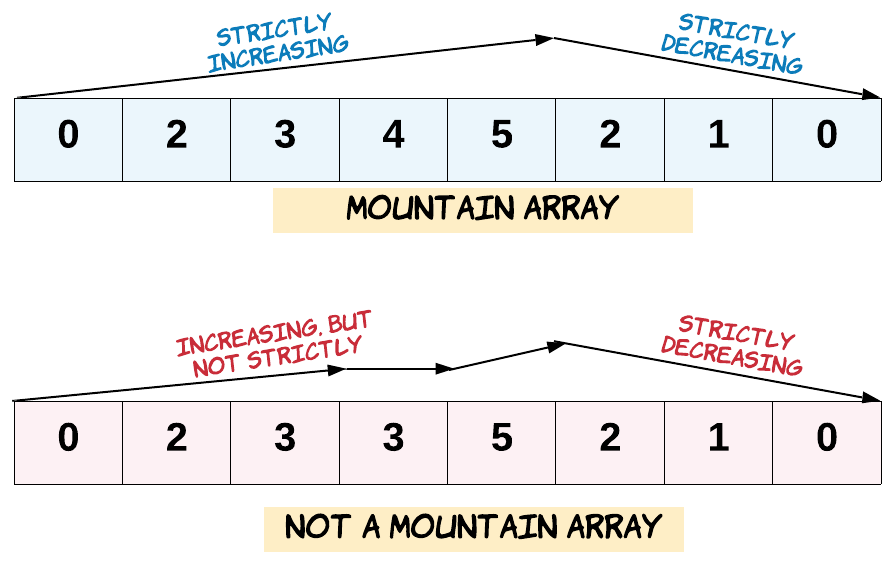
Example 1:
Input: arr = [2,1]
Output: false
Example 2:
Input: arr = [3,5,5]
Output: false
Example 3:
Input: arr = [0,3,2,1]
Output: true
Constraints:
1 <= arr.length <= 1040 <= arr[i] <= 104
Approaches
2 approaches with complexity analysis and trade-offs.
This approach breaks the problem into two distinct steps. First, we iterate through the array to find the peak (the maximum element). Then, we perform two more traversals: one from the start to the peak and another from the peak to the end, to verify the mountain properties.
Algorithm
- If the array length
nis less than 3, it cannot be a mountain array, so returnfalse. - Find the index of the maximum element in the array. Let's call this
peakIndex. - If there are multiple maximum elements, the index of the first one is typically found.
- According to the definition, the peak cannot be the first or the last element. If
peakIndexis 0 orn - 1, returnfalse. - Verify the strictly increasing part (the 'uphill' slope). Iterate from index 0 to
peakIndex - 1. Ifarr[i] >= arr[i+1]for anyi, it's not a valid mountain. Returnfalse. - Verify the strictly decreasing part (the 'downhill' slope). Iterate from
peakIndexton - 2. Ifarr[i] <= arr[i+1]for anyi, it's not a valid mountain. Returnfalse. - If all the above checks pass, the array is a valid mountain. Return
true.
Walkthrough
The core idea is to first locate the highest point of the potential mountain. We traverse the array to find the index of the maximum element. Let's call this peakIndex.
According to the definition of a mountain array, the peak cannot be the first or the last element. So, if peakIndex is 0 or arr.length - 1, we can immediately return false. This also handles arrays that are purely increasing or decreasing.
Next, we need to verify the two slopes of the mountain.
- We check the 'uphill' part: from the beginning of the array up to
peakIndex. We iterate from index 0 topeakIndex - 1and ensure thatarr[i] < arr[i+1]for alliin this range. If we find any pair that violates this (i.e.,arr[i] >= arr[i+1]), it's not a valid mountain, so we returnfalse. - Then, we check the 'downhill' part: from
peakIndexto the end of the array. We iterate frompeakIndextoarr.length - 2and ensure thatarr[i] > arr[i+1]for alliin this range. If we find any pair that violates this (i.e.,arr[i] <= arr[i+1]), it's not a valid mountain, so we returnfalse.
If the array passes all these checks, it is a valid mountain array, and we return true. A preliminary check for arr.length < 3 is also necessary at the beginning.
class Solution { public boolean validMountainArray(int[] arr) { int n = arr.length; if (n < 3) { return false; } // Find the peak index int maxVal = -1; int peakIndex = -1; for (int i = 0; i < n; i++) { if (arr[i] > maxVal) { maxVal = arr[i]; peakIndex = i; } } // Peak cannot be the first or last element if (peakIndex == 0 || peakIndex == n - 1) { return false; } // Check the uphill part for (int i = 0; i < peakIndex; i++) { if (arr[i] >= arr[i + 1]) { return false; } } // Check the downhill part for (int i = peakIndex; i < n - 1; i++) { if (arr[i] <= arr[i + 1]) { return false; } } return true; }}Complexity
Time
O(N). The first pass to find the peak takes O(N). The subsequent two passes to verify the slopes take O(peakIndex) and O(N - peakIndex) respectively, which sum up to O(N). The total time complexity is O(N) + O(N) = O(N).
Space
O(1). We only use a few variables to store the peak index and loop counters.
Trade-offs
Pros
Conceptually straightforward and easy to understand.
Separates the logic of finding the peak and verifying the slopes, which can make debugging easier.
Cons
Requires multiple passes over the array (one to find the peak, and up to two more to verify the slopes), which can be slightly less performant in practice than a single-pass solution.
The logic is split into separate parts, which might make the code slightly longer.
Solutions
Solution
class Solution { public boolean validMountainArray ( int [] arr ) { int n = arr . length ; if ( n < 3 ) { return false ; } int l = 0 , r = n - 1 ; while ( l + 1 < n - 1 && arr [ l ] < arr [ l + 1 ]) { ++ l ; } while ( r - 1 > 0 && arr [ r ] < arr [ r - 1 ]) { -- r ; } return l == r ; } }Video walkthrough
Newsletter
One sharp idea, every week
System design and interview prep — short enough to finish.
No spam. Unsubscribe anytime.
Practice
Same difficulty — related problems to reinforce the pattern.