
Add Two Numbers
MedPrompt
You are given two non-empty linked lists representing two non-negative integers. The digits are stored in reverse order, and each of their nodes contains a single digit. Add the two numbers and return the sum as a linked list.
You may assume the two numbers do not contain any leading zero, except the number 0 itself.
Example 1:
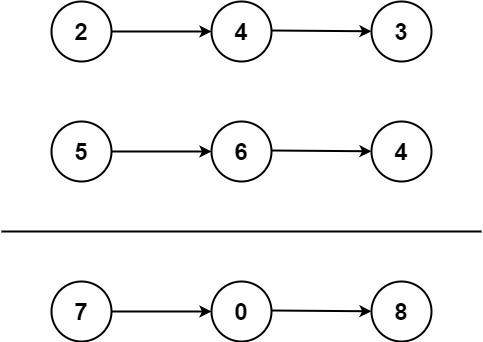
Input: l1 = [2,4,3], l2 = [5,6,4]
Output: [7,0,8]
Explanation: 342 + 465 = 807.
Example 2:
Input: l1 = [0], l2 = [0]
Output: [0]
Example 3:
Input: l1 = [9,9,9,9,9,9,9], l2 = [9,9,9,9]
Output: [8,9,9,9,0,0,0,1]
Constraints:
- The number of nodes in each linked list is in the range
[1, 100]. 0 <= Node.val <= 9- It is guaranteed that the list represents a number that does not have leading zeros.
Approaches
2 approaches with complexity analysis and trade-offs.
This approach involves converting the two linked lists into their corresponding integer representations. After converting, we add these two numbers together. Finally, the resulting sum is converted back into a linked list in the required reverse-digit format.
Algorithm
- Create a helper function
listToBigIntthat converts a linked list to aBigInteger. - Inside
listToBigInt, iterate through the list, building a string representation of the number by prepending each digit. This correctly reverses the list order. - Convert the final string to a
BigInteger. - In the main function, call
listToBigIntfor bothl1andl2. - Use the
addmethod ofBigIntegerto compute the sum. - Convert the resulting
BigIntegersum back to a string. - Create a
dummyHeadfor the result list. - Iterate through the sum string from right to left (end to start).
- For each character, parse the digit, create a new
ListNode, and append it to the result list. - Return
dummyHead.next. Handle the edge case where the sum is 0.
Walkthrough
The core idea is to transform the linked list representation of numbers into a standard numerical type that the computer can perform arithmetic on directly.
-
Convert Linked Lists to Numbers: We traverse each linked list,
l1andl2. Since the digits are in reverse order, we can build the number by effectively multiplying each digit by its corresponding power of 10. A crucial point is that the numbers can be very large, exceeding the capacity of standard 64-bit integers (longin Java). Therefore, we must use a class designed for arbitrary-precision arithmetic, likejava.math.BigInteger. -
Sum the Numbers: Once we have the two numbers as
BigIntegerobjects, we simply use theaddmethod to compute their sum. -
Convert Sum back to Linked List: We convert the
BigIntegersum back to a string. We then iterate through this string in reverse to create the new linked list, as the problem requires digits in reverse order. Each character is converted to a digit and placed in a newListNode.
import java.math.BigInteger; /** * Definition for singly-linked list. * public class ListNode { * int val; * ListNode next; * ListNode() {} * ListNode(int val) { this.val = val; } * ListNode(int val, ListNode next) { this.val = val; this.next = next; } * } */class Solution { public ListNode addTwoNumbers(ListNode l1, ListNode l2) { // Step 1: Convert linked lists to BigInteger BigInteger num1 = listToBigInt(l1); BigInteger num2 = listToBigInt(l2); // Step 2: Add the numbers BigInteger sum = num1.add(num2); // Step 3: Convert sum back to a linked list String sumStr = sum.toString(); ListNode dummyHead = new ListNode(0); ListNode current = dummyHead; // Handle the case of sum being 0 if (sum.equals(BigInteger.ZERO)) { return new ListNode(0); } for (int i = sumStr.length() - 1; i >= 0; i--) { int digit = sumStr.charAt(i) - '0'; current.next = new ListNode(digit); current = current.next; } return dummyHead.next; } private BigInteger listToBigInt(ListNode node) { StringBuilder sb = new StringBuilder(); while (node != null) { sb.insert(0, node.val); node = node.next; } return new BigInteger(sb.toString()); }}Complexity
Time
O(max(N, M))
Space
O(max(N, M))
Trade-offs
Pros
Conceptually simple to understand if the
BigIntegerclass is familiar.Leverages powerful, built-in arithmetic capabilities.
Cons
Suffers from integer overflow if standard integer types like
longare used. Requires a special class likeBigInteger.Less efficient due to the overhead of converting between data structures (list to string, string to BigInteger, BigInteger back to string, and string back to list).
This approach might be considered less fundamental as it abstracts away the core logic of addition into a library function.
Solutions
Solution
/** * Definition for singly-linked list. * public class ListNode { * public int val; * public ListNode next; * public ListNode(int val=0, ListNode next=null) { * this.val = val; * this.next = next; * } * } */ public class Solution { public ListNode AddTwoNumbers ( ListNode l1 , ListNode l2 ) { ListNode dummy = new ListNode (); int carry = 0 ; ListNode cur = dummy ; while ( l1 != null || l2 != null || carry != 0 ) { int s = ( l1 == null ? 0 : l1 . val ) + ( l2 == null ? 0 : l2 . val ) + carry ; carry = s / 10 ; cur . next = new ListNode ( s % 10 ); cur = cur . next ; l1 = l1 == null ? null : l1 . next ; l2 = l2 == null ? null : l2 . next ; } return dummy . next ; } }Video walkthrough
Newsletter
One sharp idea, every week
System design and interview prep — short enough to finish.
No spam. Unsubscribe anytime.
Practice
Same difficulty — related problems to reinforce the pattern.