
Binary Tree Inorder Traversal
EasyPrompt
Given the root of a binary tree, return the inorder traversal of its nodes' values.
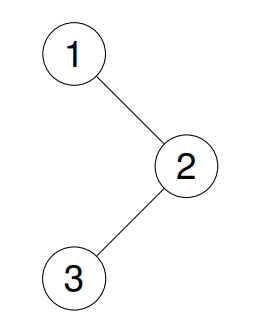
Example 1:
Input: root = [1,null,2,3]
Output: [1,3,2]
Explanation:
Example 2:
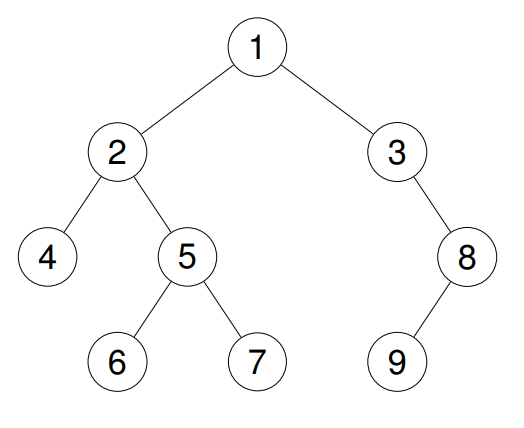
Input: root = [1,2,3,4,5,null,8,null,null,6,7,9]
Output: [4,2,6,5,7,1,3,9,8]
Explanation:
Example 3:
Input: root = []
Output: []
Example 4:
Input: root = [1]
Output: [1]
Constraints:
- The number of nodes in the tree is in the range
[0, 100]. -100 <= Node.val <= 100
Follow up: Recursive solution is trivial, could you do it iteratively?
Approaches
3 approaches with complexity analysis and trade-offs.
This is the most straightforward and intuitive approach. The structure of the recursive algorithm directly mirrors the definition of an inorder traversal (Left, Root, Right). We create a helper function that is called recursively on the left child, then processes the current node, and finally is called on the right child.
Algorithm
The core idea of inorder traversal is to visit nodes in the order: Left Subtree, Root, Right Subtree. A recursive function naturally models this process.
- Define a helper function, let's say
inorderHelper(TreeNode node, List<Integer> result). - The base case for the recursion is when the
nodeisnull. In this case, we simply return. - If the node is not
null: a. Make a recursive call on the left child:inorderHelper(node.left, result). b. After the left subtree has been fully traversed, visit the current node by adding its value to the result list:result.add(node.val). c. Finally, make a recursive call on the right child:inorderHelper(node.right, result). - The main function initializes an empty list and calls the helper function with the root of the tree.
Walkthrough
/** * Definition for a binary tree node. * public class TreeNode { * int val; * TreeNode left; * TreeNode right; * TreeNode() {} * TreeNode(int val) { this.val = val; } * TreeNode(int val, TreeNode left, TreeNode right) { * this.val = val; * this.left = left; * this.right = right; * } * } */class Solution { public List<Integer> inorderTraversal(TreeNode root) { List<Integer> result = new ArrayList<>(); inorderHelper(root, result); return result; } private void inorderHelper(TreeNode node, List<Integer> result) { if (node == null) { return; } // 1. Traverse the left subtree inorderHelper(node.left, result); // 2. Visit the root node result.add(node.val); // 3. Traverse the right subtree inorderHelper(node.right, result); }}Complexity
Time
O(N), where N is the number of nodes in the tree, because we visit each node exactly once.
Space
O(H), where H is the height of the tree. In the worst case of a skewed tree, this becomes O(N), where N is the number of nodes. In the best case of a balanced tree, it's O(log N). This space is used by the recursion call stack.
Trade-offs
Pros
The code is simple, clean, and easy to understand as it directly follows the definition of inorder traversal.
It requires minimal code to implement.
Cons
For very deep or skewed trees, this can lead to a
StackOverflowErrorbecause the depth of the recursion call stack can exceed its limit.The space used by the call stack is implicit and not directly controlled by the programmer.
Solutions
Solution
import java.util.ArrayList ; import java.util.HashSet ; import java.util.List ; import java.util.Stack ; public class Binary_Tree_Inorder_Traversal { /** * Definition for a binary tree node. * public class TreeNode { * int val; * TreeNode left; * TreeNode right; * TreeNode(int x) { val = x; } * } */ public class Solution_optmize { public List < Integer > inorderTraversal ( TreeNode root ) { List < Integer > list = new ArrayList < Integer >(); if ( root == null ) { return list ; } Stack < TreeNode > sk = new Stack <>(); TreeNode current = root ; while (! sk . isEmpty () || current != null ) { while ( current != null ) { sk . push ( current ); current = current . left ; } // @note: 一逼撸到最左边 // @note: 没有push left的操作,就不会无限循环,也不需要mark是否visited TreeNode leftOrMiddle = sk . pop (); list . add ( leftOrMiddle . val ); current = leftOrMiddle . right ; // if right is null here, next time pop parent node } return list ; } } class Solution_noStack { // but modifying original tree public List < Integer > inorderTraversal ( TreeNode root ) { List < Integer > result = new ArrayList <>(); TreeNode current = root ; TreeNode prev ; while ( current != null ) { if ( current . left == null ) { result . add ( current . val ); // only handle right child current = current . right ; // move to next right node } else { // has a left subtree prev = current . left ; while ( prev . right != null ) { // find rightmost prev = prev . right ; } prev . right = current ; // put cur after the pre node TreeNode temp = current ; // store cur node current = current . left ; // move cur to the top of the new tree temp . left = null ; // original cur left be null, avoid infinite loops } } return result ; } } public class Solution { List < Integer > list = new ArrayList < Integer >(); public List < Integer > inorderTraversal ( TreeNode root ) { // mark if a node is visited already: true is visited. or, just use a Set HashSet < TreeNode > hs = new HashSet <>(); Stack < TreeNode > sk = new Stack <>(); sk . push ( root ); while (! sk . isEmpty ()) { TreeNode current = sk . pop (); if ( current == null ) { continue ; } // @note: careful to check left visited, or else infinite looping if ( current . left != null && ! hs . contains ( current . left )) { sk . push ( current ); sk . push ( current . left ); } else { if ( current . right != null && ! hs . contains ( current . right )) { sk . push ( current . right ); } hs . add ( current ); list . add ( current . val ); } } return list ; } } class Solution_recursion { List < Integer > result = new ArrayList <>(); public List < Integer > inorderTraversal ( TreeNode root ) { dfs ( root ); return result ; } public void dfs ( TreeNode root ) { if ( root == null ) { return ; } dfs ( root . left ); result . add ( root . val ); dfs ( root . right ); } } } ////// /** * Definition for a binary tree node. * public class TreeNode { * int val; * TreeNode left; * TreeNode right; * TreeNode() {} * TreeNode(int val) { this.val = val; } * TreeNode(int val, TreeNode left, TreeNode right) { * this.val = val; * this.left = left; * this.right = right; * } * } */ class Solution { public List < Integer > inorderTraversal ( TreeNode root ) { List < Integer > ans = new ArrayList <>(); while ( root != null ) { if ( root . left == null ) { ans . add ( root . val ); root = root . right ; } else { TreeNode prev = root . left ; while ( prev . right != null && prev . right != root ) { prev = prev . right ; } if ( prev . right == null ) { prev . right = root ; root = root . left ; } else { ans . add ( root . val ); prev . right = null ; root = root . right ; } } } return ans ; } }Video walkthrough
Newsletter
One sharp idea, every week
System design and interview prep — short enough to finish.
No spam. Unsubscribe anytime.
Practice
Same difficulty — related problems to reinforce the pattern.