
Count Complete Tree Nodes
EasyPrompt
Given the root of a complete binary tree, return the number of the nodes in the tree.
According to Wikipedia, every level, except possibly the last, is completely filled in a complete binary tree, and all nodes in the last level are as far left as possible. It can have between 1 and 2h nodes inclusive at the last level h.
Design an algorithm that runs in less than O(n) time complexity.
Example 1:
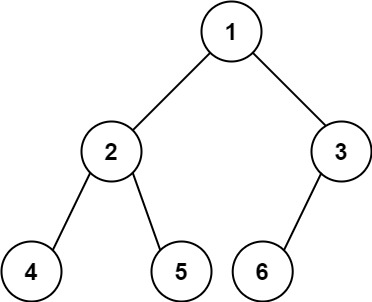
Input: root = [1,2,3,4,5,6]
Output: 6
Example 2:
Input: root = []
Output: 0
Example 3:
Input: root = [1]
Output: 1
Constraints:
- The number of nodes in the tree is in the range
[0, 5 * 104]. 0 <= Node.val <= 5 * 104- The tree is guaranteed to be complete.
Approaches
3 approaches with complexity analysis and trade-offs.
The most straightforward approach is to traverse the entire tree using DFS (Depth First Search) and count all nodes.
Algorithm
- If root is null, return 0
- Recursively count nodes in left subtree
- Recursively count nodes in right subtree
- Return 1 (current node) + left count + right count
Walkthrough
We can use a simple recursive DFS approach to traverse through all nodes of the tree. For each node, we add 1 to our count and recursively process the left and right children.
class Solution { public int countNodes(TreeNode root) { if (root == null) return 0; return 1 + countNodes(root.left) + countNodes(root.right); }}This solution will visit every node exactly once. While simple to implement, it doesn't take advantage of the complete binary tree property.
Complexity
Time
O(n) where n is the number of nodes in the tree
Space
O(h) where h is the height of the tree, due to recursive call stack
Trade-offs
Pros
Simple to implement
Works for any binary tree
Easy to understand
Cons
Doesn't utilize the complete binary tree property
Visits every node in the tree
Not optimal for complete binary trees
Solutions
Solution
/** * Definition for a binary tree node. * public class TreeNode { * public int val; * public TreeNode left; * public TreeNode right; * public TreeNode(int val=0, TreeNode left=null, TreeNode right=null) { * this.val = val; * this.left = left; * this.right = right; * } * } */ public class Solution { public int CountNodes ( TreeNode root ) { if ( root == null ) { return 0 ; } int left = depth ( root . left ); int right = depth ( root . right ); if ( left == right ) { return ( 1 << left ) + CountNodes ( root . right ); } return ( 1 << right ) + CountNodes ( root . left ); } private int depth ( TreeNode root ) { int d = 0 ; for (; root != null ; root = root . left ) { ++ d ; } return d ; } }Video walkthrough
Newsletter
One sharp idea, every week
System design and interview prep — short enough to finish.
No spam. Unsubscribe anytime.
Practice
Same difficulty — related problems to reinforce the pattern.