
Flood Fill
EasyPrompt
You are given an image represented by an m x n grid of integers image, where image[i][j] represents the pixel value of the image. You are also given three integers sr, sc, and color. Your task is to perform a flood fill on the image starting from the pixel image[sr][sc].
To perform a flood fill:
- Begin with the starting pixel and change its color to
color. - Perform the same process for each pixel that is directly adjacent (pixels that share a side with the original pixel, either horizontally or vertically) and shares the same color as the starting pixel.
- Keep repeating this process by checking neighboring pixels of the updated pixels and modifying their color if it matches the original color of the starting pixel.
- The process stops when there are no more adjacent pixels of the original color to update.
Return the modified image after performing the flood fill.
Example 1:
Input: image = [[1,1,1],[1,1,0],[1,0,1]], sr = 1, sc = 1, color = 2
Output: [[2,2,2],[2,2,0],[2,0,1]]
Explanation:
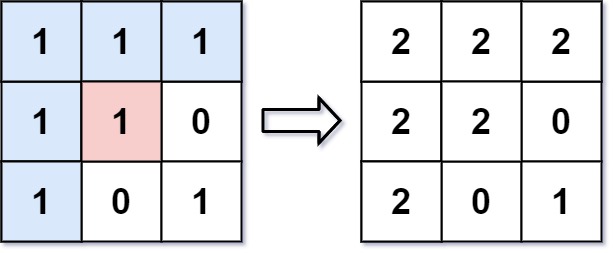
From the center of the image with position (sr, sc) = (1, 1) (i.e., the red pixel), all pixels connected by a path of the same color as the starting pixel (i.e., the blue pixels) are colored with the new color.
Note the bottom corner is not colored 2, because it is not horizontally or vertically connected to the starting pixel.
Example 2:
Input: image = [[0,0,0],[0,0,0]], sr = 0, sc = 0, color = 0
Output: [[0,0,0],[0,0,0]]
Explanation:
The starting pixel is already colored with 0, which is the same as the target color. Therefore, no changes are made to the image.
Constraints:
m == image.lengthn == image[i].length1 <= m, n <= 500 <= image[i][j], color < 2160 <= sr < m0 <= sc < n
Approaches
2 approaches with complexity analysis and trade-offs.
This approach utilizes recursion to perform a Depth-First Search (DFS) starting from the given pixel. It explores as far as possible along each branch before backtracking. The system's call stack is implicitly used to keep track of the pixels to visit.
Algorithm
- Get the color of the starting pixel
(sr, sc), let's call itinitialColor. - If
initialColoris the same as the targetcolor, return the image as no changes are needed. This check is crucial to prevent infinite recursion. - Create a recursive helper function
dfs(image, r, c, initialColor, color). - Inside
dfs:- Check for boundary conditions: if
rorcis out of bounds, return. - Check for color condition: if
image[r][c]is not equal toinitialColor, return. - If the conditions are passed, update the pixel's color:
image[r][c] = color. - Make recursive calls for the four neighbors:
dfs(r+1, c),dfs(r-1, c),dfs(r, c+1),dfs(r, c-1).
- Check for boundary conditions: if
- Start the process by calling
dfs(image, sr, sc, initialColor, color). - Return the modified
image.
Walkthrough
The core idea is to have a recursive function that explores the grid. First, we check an important edge case: if the starting pixel's color is already the target color, no action is needed, and we can return the image immediately. This prevents infinite recursion. We store the original color of the starting pixel. We then call a recursive helper function, let's call it dfs. The dfs function takes the image, current coordinates (row, col), the original color, and the new color as arguments.
Base Cases for recursion: The function returns if the current coordinates are out of the grid's bounds, or if the color of the pixel at the current coordinates is not the original color we are trying to replace.
Recursive Step: If the base cases are not met, we update the color of the current pixel to the new color. Then, we make four recursive calls for the adjacent pixels (up, down, left, and right) to continue the flood fill process.
class Solution { public int[][] floodFill(int[][] image, int sr, int sc, int color) { int initialColor = image[sr][sc]; if (initialColor != color) { dfs(image, sr, sc, initialColor, color); } return image; } private void dfs(int[][] image, int r, int c, int initialColor, int newColor) { if (r < 0 || r >= image.length || c < 0 || c >= image[0].length || image[r][c] != initialColor) { return; } image[r][c] = newColor; dfs(image, r + 1, c, initialColor, newColor); dfs(image, r - 1, c, initialColor, newColor); dfs(image, r, c + 1, initialColor, newColor); dfs(image, r, c - 1, initialColor, newColor); }}Complexity
Time
`O(N * M)`, where `N` is the number of rows and `M` is the number of columns. In the worst-case scenario, we might have to visit every pixel in the grid.
Space
`O(N * M)` in the worst case. This is due to the recursion depth of the call stack. If the area to be filled forms a long, winding path, the stack depth could be proportional to the number of pixels in the grid.
Trade-offs
Pros
The recursive implementation is often very intuitive and leads to concise code for graph traversal problems.
It's easy to reason about the logic.
Cons
For large grids or deeply connected components, this approach can lead to a
StackOverflowErrorif the recursion depth exceeds the system's stack limit.
Solutions
Solution
class Solution {private int[] dirs = {-1, 0, 1, 0, -1};private int[][] image;private int nc;private int oc;public int[][] floodFill(int[][] image, int sr, int sc, int color) { nc = color; oc = image[sr][sc]; this.image = image; dfs(sr, sc); return image; }private void dfs(int i, int j) { if (i < 0 || i >= image.length || j < 0 || j >= image[0].length || image[i][j] != oc || image[i][j] == nc) { return; } image[i][j] = nc; for (int k = 0; k < 4; ++k) { dfs(i + dirs[k], j + dirs[k + 1]); } }}Video walkthrough
Newsletter
One sharp idea, every week
System design and interview prep — short enough to finish.
No spam. Unsubscribe anytime.
Practice
Same difficulty — related problems to reinforce the pattern.