
Maximum Depth of Binary Tree
EasyPrompt
Given the root of a binary tree, return its maximum depth.
A binary tree's maximum depth is the number of nodes along the longest path from the root node down to the farthest leaf node.
Example 1:
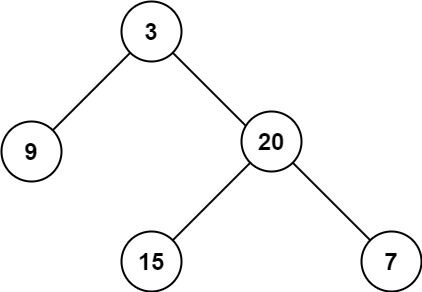
Input: root = [3,9,20,null,null,15,7]
Output: 3
Example 2:
Input: root = [1,null,2]
Output: 2
Constraints:
- The number of nodes in the tree is in the range
[0, 104]. -100 <= Node.val <= 100
Approaches
2 approaches with complexity analysis and trade-offs.
This is the most intuitive and common approach. It leverages the recursive nature of a tree. The maximum depth of a tree is defined as 1 (for the root) plus the maximum of the depths of its left and right subtrees.
Algorithm
- If the
rootnode isnull, return 0. - Calculate the depth of the left subtree by making a recursive call:
leftDepth = maxDepth(root.left). - Calculate the depth of the right subtree by making a recursive call:
rightDepth = maxDepth(root.right). - Return
1 + max(leftDepth, rightDepth).
Walkthrough
The algorithm works by defining a function that calculates the depth of a subtree rooted at a given node.
- Base Case: If the current node is
null, it represents an empty tree or the end of a path, which has a depth of 0. - Recursive Step: For a non-null node, we recursively call the function on its left and right children to find the depths of the left and right subtrees (
leftDepthandrightDepth). - The depth of the tree rooted at the current node is then
1 + Math.max(leftDepth, rightDepth). The+1accounts for the current node itself. The process starts by calling this function with the root of the entire tree.
/** * Definition for a binary tree node. * public class TreeNode { * int val; * TreeNode left; * TreeNode right; * TreeNode() {} * TreeNode(int val) { this.val = val; } * TreeNode(int val, TreeNode left, TreeNode right) { * this.val = val; * this.left = left; * this.right = right; * } * } */class Solution { public int maxDepth(TreeNode root) { if (root == null) { return 0; } int leftDepth = maxDepth(root.left); int rightDepth = maxDepth(root.right); return Math.max(leftDepth, rightDepth) + 1; }}Complexity
Time
O(N)
Space
O(H)
Trade-offs
Pros
The code is very concise, elegant, and easy to understand.
It directly models the recursive definition of a tree's depth.
Cons
For extremely deep trees, it might lead to a
StackOverflowErrordue to deep recursion.Can be less space-efficient than BFS for very skewed trees where the height approaches the number of nodes.
Solutions
Solution
/** * Definition for a binary tree node. * public class TreeNode { * int val; * TreeNode left; * TreeNode right; * TreeNode() {} * TreeNode(int val) { this.val = val; } * TreeNode(int val, TreeNode left, TreeNode right) { * this.val = val; * this.left = left; * this.right = right; * } * } */ class Solution { public int maxDepth ( TreeNode root ) { if ( root == null ) { return 0 ; } int l = maxDepth ( root . left ); int r = maxDepth ( root . right ); return 1 + Math . max ( l , r ); } }Video walkthrough
Newsletter
One sharp idea, every week
System design and interview prep — short enough to finish.
No spam. Unsubscribe anytime.
Practice
Same difficulty — related problems to reinforce the pattern.