
Binary Tree Zigzag Level Order Traversal
MedPrompt
Given the root of a binary tree, return the zigzag level order traversal of its nodes' values. (i.e., from left to right, then right to left for the next level and alternate between).
Example 1:
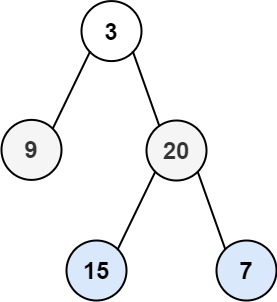
Input: root = [3,9,20,null,null,15,7]
Output: [[3],[20,9],[15,7]]
Example 2:
Input: root = [1]
Output: [[1]]
Example 3:
Input: root = []
Output: []
Constraints:
- The number of nodes in the tree is in the range
[0, 2000]. -100 <= Node.val <= 100
Approaches
3 approaches with complexity analysis and trade-offs.
This approach builds upon the standard BFS level-order traversal. We traverse the tree level by level using a queue. For each level, we store the node values in a temporary list. A flag or a level counter is used to determine the traversal direction. If the current level needs to be traversed from right to left, we simply reverse the temporary list before adding it to our final result.
Algorithm
- Initialize an empty list
resultto store the final zigzag traversal. - If the
rootis null, return the emptyresult. - Initialize a queue (e.g.,
LinkedList) and add therootto it. - Initialize a boolean flag
leftToRighttotrue. - While the queue is not empty:
- Get the number of nodes in the current level,
levelSize. - Create a new list
currentLevelto store the values for this level. - Loop
levelSizetimes:- Dequeue a node.
- Add its value to
currentLevel. - Enqueue its left child if it's not null.
- Enqueue its right child if it's not null.
- If
leftToRightisfalse, reverse thecurrentLevellist. - Add
currentLevelto theresultlist. - Flip the
leftToRightflag for the next level.
- Get the number of nodes in the current level,
- Return the
result.
Walkthrough
This method is a direct extension of the standard Breadth-First Search (BFS) algorithm for level-order traversal. The main idea is to perform a regular level-order traversal and collect all nodes at a given level. After a level is fully processed, we decide whether to add it to the result as is (for left-to-right levels) or to reverse it first (for right-to-left levels). A boolean flag, toggled at the end of each level's processing, keeps track of the required order.
/** * Definition for a binary tree node. * public class TreeNode { * int val; * TreeNode left; * TreeNode right; * TreeNode() {} * TreeNode(int val) { this.val = val; } * TreeNode(int val, TreeNode left, TreeNode right) { * this.val = val; * this.left = left; * this.right = right; * } * } */class Solution { public List<List<Integer>> zigzagLevelOrder(TreeNode root) { List<List<Integer>> result = new ArrayList<>(); if (root == null) { return result; } Queue<TreeNode> queue = new LinkedList<>(); queue.offer(root); boolean leftToRight = true; while (!queue.isEmpty()) { int levelSize = queue.size(); List<Integer> currentLevel = new ArrayList<>(levelSize); for (int i = 0; i < levelSize; i++) { TreeNode node = queue.poll(); currentLevel.add(node.val); if (node.left != null) { queue.offer(node.left); } if (node.right != null) { queue.offer(node.right); } } if (!leftToRight) { Collections.reverse(currentLevel); } result.add(currentLevel); leftToRight = !leftToRight; } return result; }}Complexity
Time
O(N)
Space
O(W)
Trade-offs
Pros
Easy to understand as it's a small modification of the standard level-order traversal.
The logic is straightforward and simple to implement.
Cons
The explicit reversal step (
Collections.reverse) adds a performance overhead compared to more optimized solutions, as it requires an extra pass over the nodes of every other level.
Solutions
Solution
/** * Definition for a binary tree node. * public class TreeNode { * int val; * TreeNode left; * TreeNode right; * TreeNode() {} * TreeNode(int val) { this.val = val; } * TreeNode(int val, TreeNode left, TreeNode right) { * this.val = val; * this.left = left; * this.right = right; * } * } */ class Solution { public List < List < Integer >> zigzagLevelOrder ( TreeNode root ) { List < List < Integer >> ans = new ArrayList <>(); if ( root == null ) { return ans ; } Deque < TreeNode > q = new ArrayDeque <>(); q . offer ( root ); boolean left = true ; while (! q . isEmpty ()) { List < Integer > t = new ArrayList <>(); for ( int n = q . size (); n > 0 ; -- n ) { TreeNode node = q . poll (); t . add ( node . val ); if ( node . left != null ) { q . offer ( node . left ); } if ( node . right != null ) { q . offer ( node . right ); } } if (! left ) { Collections . reverse ( t ); } ans . add ( t ); left = ! left ; } return ans ; } } ////// public class Binary_Tree_Zigzag_Level_Order_Traversal { /** * Definition for a binary tree node. * public class TreeNode { * int val; * TreeNode left; * TreeNode right; * TreeNode(int x) { val = x; } * } */ // count as level marker class Solution { public List < List < Integer >> zigzagLevelOrder ( TreeNode root ) { List < List < Integer >> result = new ArrayList <>(); if ( root == null ) { return result ; } boolean isLeftToRight = true ; Queue < TreeNode > q = new LinkedList <>(); q . offer ( root ); int currentLevelCount = 1 ; int nextLevelCount = 0 ; List < Integer > one = new ArrayList <>(); while (! q . isEmpty ()) { TreeNode current = q . poll (); currentLevelCount --; if ( isLeftToRight ) { one . add ( current . val ); } else { one . add ( 0 , current . val ); } if ( current . left != null ) { q . offer ( current . left ); nextLevelCount ++; } if ( current . right != null ) { q . offer ( current . right ); nextLevelCount ++; } if ( currentLevelCount == 0 ) { currentLevelCount = nextLevelCount ; nextLevelCount = 0 ; result . add ( one ); one = new ArrayList <>(); isLeftToRight = ! isLeftToRight ; } } return result ; } } public class Solution_nullAsMarker { public List < List < Integer >> zigzagLevelOrder ( TreeNode root ) { List < List < Integer >> list = new ArrayList < List < Integer >>(); if ( root == null ) { return list ; } Queue < TreeNode > q = new LinkedList <>(); q . offer ( root ); q . offer ( null ); // @note: use null as marker for end of level boolean direction = true ; // true: left=>right, false: right=>left List < Integer > oneLevel = new ArrayList <>(); while (! q . isEmpty ()) { TreeNode current = q . poll (); if ( current == null ) { List < Integer > copy = new ArrayList <>( oneLevel ); list . add ( copy ); // clean after one level recorded oneLevel . clear (); // @memorize: this api direction = ! direction ; // @note:@memorize: if stack is now empty then DO NOT add null, or else infinite looping // sk.offer(null); // add marker if (! q . isEmpty ()) { q . offer ( null ); // add marker } continue ; } if ( direction ) { oneLevel . add ( current . val ); } else { oneLevel . add ( 0 , current . val ); } // @note:@memorize: since using null as marker, then must avoid adding null when children are null // sk.offer(current.left); // sk.offer(current.right); if ( current . left != null ) { q . offer ( current . left ); } if ( current . right != null ) { q . offer ( current . right ); } } return list ; } } }Video walkthrough
Newsletter
One sharp idea, every week
System design and interview prep — short enough to finish.
No spam. Unsubscribe anytime.
Practice
Same difficulty — related problems to reinforce the pattern.