
Sum of Root To Leaf Binary Numbers
EasyPrompt
You are given the root of a binary tree where each node has a value 0 or 1. Each root-to-leaf path represents a binary number starting with the most significant bit.
- For example, if the path is
0 -> 1 -> 1 -> 0 -> 1, then this could represent01101in binary, which is13.
For all leaves in the tree, consider the numbers represented by the path from the root to that leaf. Return the sum of these numbers.
The test cases are generated so that the answer fits in a 32-bits integer.
Example 1:
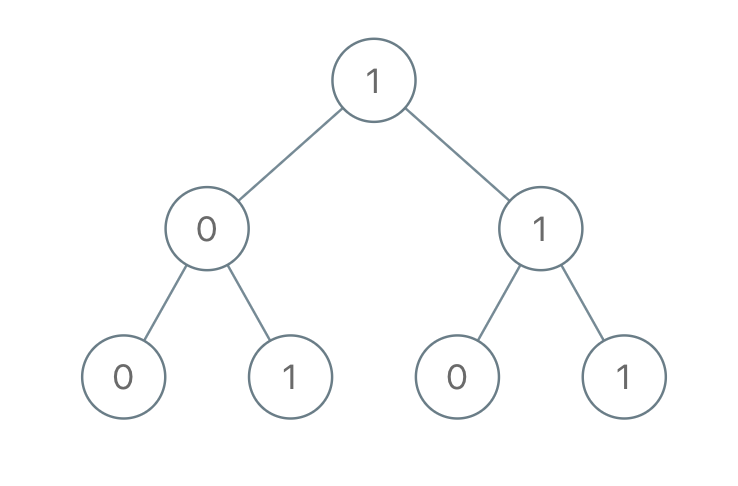
Input: root = [1,0,1,0,1,0,1]
Output: 22
Explanation: (100) + (101) + (110) + (111) = 4 + 5 + 6 + 7 = 22
Example 2:
Input: root = [0]
Output: 0
Constraints:
- The number of nodes in the tree is in the range
[1, 1000]. Node.valis0or1.
Approaches
3 approaches with complexity analysis and trade-offs.
This approach uses a standard Depth-First Search (DFS) traversal. As we traverse from the root to a leaf, we build a string representing the binary number along that path. When a leaf node is reached, this binary string is converted to its integer equivalent, and this value is added to a running total.
Algorithm
- Initialize a global variable
totalSumto 0. - Create a recursive helper function
dfs(node, pathString)that takes the current node and the binary string representation of the path so far. - In the main function, call the helper function with the root node and an empty string:
dfs(root, ""). - Inside the
dfsfunction:- If the current node is
null, return. - Append the current node's value to
pathString. - If the current node is a leaf (both children are
null), convertpathStringto an integer from base 2 and add it tototalSum. - Recursively call
dfsfor the left and right children with the updatedpathString.
- If the current node is
- After the initial call returns,
totalSumwill hold the final result.
Walkthrough
This method is straightforward but less efficient. We traverse the tree using recursion, maintaining the current path from the root as a string of '0's and '1's.
- Initialization: We use a member variable,
totalSum, to accumulate the sum of all path numbers. - Traversal: A recursive function, say
findPathSum(node, currentPath), is used. It's initially called with therootand an empty string"". - Path Building: In each recursive call, we append the current
node.valto thecurrentPathstring. - Leaf Node Check: When we encounter a leaf node (a node where both
leftandrightchildren arenull), it signifies the end of a root-to-leaf path. At this point, thecurrentPathstring holds the complete binary representation of a number. - Conversion and Summation: We convert this binary string into an integer using
Integer.parseInt(currentPath, 2)and add the result to ourtotalSum. - Recursion: For non-leaf nodes, we continue the process by making recursive calls for the left and right children.
class Solution { int totalSum = 0; public int sumRootToLeaf(TreeNode root) { findPathSum(root, ""); return totalSum; } private void findPathSum(TreeNode node, String currentPath) { if (node == null) { return; } // Append current node's value to the path string currentPath += node.val; // If it's a leaf node, parse the binary string and add to sum if (node.left == null && node.right == null) { totalSum += Integer.parseInt(currentPath, 2); return; } // Recur for left and right children findPathSum(node.left, currentPath); findPathSum(node.right, currentPath); }}Complexity
Time
O(N * H), where N is the number of nodes and H is the height of the tree. The traversal itself visits each node once (O(N)). However, string concatenation in a loop can take O(H) time, and parsing the string at each of the L leaf nodes also takes O(H) time. This leads to a complexity that is worse than linear.
Space
O(H), where H is the height of the tree. This space is used by the recursion call stack and to store the path string. In the worst-case scenario of a skewed tree, H can be equal to N, making the space complexity O(N).
Trade-offs
Pros
The logic is very intuitive and directly follows the problem statement.
Easy to implement for those familiar with basic tree traversal.
Cons
Inefficient due to the overhead of string concatenation and parsing.
The time complexity is worse than linear, making it unsuitable for large or deep trees.
Solutions
Solution
/** * Definition for a binary tree node. * public class TreeNode { * int val; * TreeNode left; * TreeNode right; * TreeNode() {} * TreeNode(int val) { this.val = val; } * TreeNode(int val, TreeNode left, TreeNode right) { * this.val = val; * this.left = left; * this.right = right; * } * } */ class Solution { public int sumRootToLeaf ( TreeNode root ) { return dfs ( root , 0 ); } private int dfs ( TreeNode root , int t ) { if ( root == null ) { return 0 ; } t = ( t << 1 ) | root . val ; if ( root . left == null && root . right == null ) { return t ; } return dfs ( root . left , t ) + dfs ( root . right , t ); } }Video walkthrough
Newsletter
One sharp idea, every week
System design and interview prep — short enough to finish.
No spam. Unsubscribe anytime.
Practice
Same difficulty — related problems to reinforce the pattern.