
Allocate Mailboxes
HardPrompt
Given the array houses where houses[i] is the location of the ith house along a street and an integer k, allocate k mailboxes in the street.
Return the minimum total distance between each house and its nearest mailbox.
The test cases are generated so that the answer fits in a 32-bit integer.
Example 1:
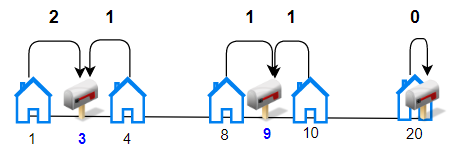
Input: houses = [1,4,8,10,20], k = 3
Output: 5
Explanation: Allocate mailboxes in position 3, 9 and 20.
Minimum total distance from each houses to nearest mailboxes is |3-1| + |4-3| + |9-8| + |10-9| + |20-20| = 5
Example 2:
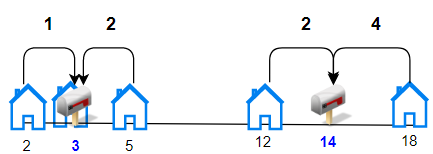
Input: houses = [2,3,5,12,18], k = 2
Output: 9
Explanation: Allocate mailboxes in position 3 and 14.
Minimum total distance from each houses to nearest mailboxes is |2-3| + |3-3| + |5-3| + |12-14| + |18-14| = 9.
Constraints:
1 <= k <= houses.length <= 1001 <= houses[i] <= 104- All the integers of
housesare unique.
Approaches
3 approaches with complexity analysis and trade-offs.
This approach uses recursion to solve the problem by breaking it down into smaller, overlapping subproblems. We define a function, say solve(i, k), which calculates the minimum cost to serve houses from index i to the end using k mailboxes. To avoid recomputing the same subproblem, we use a memoization table (a 2D array) to store the results. The core idea is to try all possible partitions for the first of the k mailboxes and recursively solve for the rest.
Algorithm
-
- Sort the
housesarray. Letnbe the number of houses.
- Sort the
-
- Precompute a
cost[i][j]table storing the minimum cost to serve housesithroughjwith one mailbox. This cost issum(|houses[l] - median|)forlfromitoj, where the median ishouses[(i+j)/2].
- Precompute a
-
- Create a memoization table
memo[n][k+1], initialized to an indicator like -1.
- Create a memoization table
-
- Define a recursive function
solve(i, k):
- Base case 1: If
k=0andi=n, all houses are covered. Return 0. - Base case 2: If
k=0(no mailboxes left) ori=n(no houses left), but not both, it's an impossible state. Return a large value (infinity). - Memoization check: If
memo[i][k]is not -1, return the stored value. - Recursive step: Initialize
min_cost = infinity. Iteratejfromiton-1. Calculatecurrent_cost = cost[i][j] + solve(j+1, k-1). Updatemin_cost = min(min_cost, current_cost). - Store
min_costinmemo[i][k]and return it.
- Define a recursive function
-
- Call
solve(0, k)to get the final answer.
- Call
Walkthrough
First, sort the houses array to handle them in positional order. The core of the problem is to partition the sorted houses into k contiguous groups. For any single group of houses, the optimal placement for a mailbox that minimizes the sum of distances is at the median house location.
We can precompute the cost of serving any contiguous group of houses houses[i...j] with one mailbox. Let's call this cost[i][j]. This can be calculated in O(N^2) time.
We define a recursive function solve(i, k) which computes the minimum cost to serve houses from index i to n-1 using k mailboxes. In solve(i, k), we try all possible endpoints j for the first group of houses houses[i...j]. The cost for this choice is cost[i][j] plus the result of the recursive call for the rest of the houses and mailboxes, solve(j+1, k-1). We take the minimum over all possible j.
To make this efficient, we use a 2D array memo[i][k] to store the result of solve(i, k), so each subproblem is solved only once. The final answer is the result of solve(0, k).
class Solution { int[][] cost; int[][] memo; int n; int[] houses; final int INF = 1_000_000_000; public int minDistance(int[] houses, int k) { this.n = houses.length; this.houses = houses; Arrays.sort(this.houses); // Precompute cost for one mailbox for houses[i...j] cost = new int[n][n]; for (int i = 0; i < n; i++) { for (int j = i; j < n; j++) { int median = this.houses[(i + j) / 2]; int currentCost = 0; for (int l = i; l <= j; l++) { currentCost += Math.abs(this.houses[l] - median); } cost[i][j] = currentCost; } } memo = new int[n][k + 1]; for (int[] row : memo) { Arrays.fill(row, -1); } return solve(0, k); } private int solve(int i, int k) { if (k == 0 && i == n) return 0; if (k == 0 || i == n) return INF; if (memo[i][k] != -1) return memo[i][k]; int minCost = INF; for (int j = i; j < n; j++) { minCost = Math.min(minCost, cost[i][j] + solve(j + 1, k - 1)); } return memo[i][k] = minCost; }}Complexity
Time
O(k * N^2). Sorting takes O(N log N). The `cost` table precomputation takes O(N^3) with a naive implementation, or O(N^2) with an optimized one. The recursive function has O(k * N) states, and each state computation involves a loop of size up to O(N), leading to a total time of O(k * N^2).
Space
O(N^2). We need O(N^2) space for the `cost` table and O(k * N) for the memoization table. Since `k <= N`, the total space is dominated by the `cost` table.
Trade-offs
Pros
Directly translates the recurrence relation into code, which can be more intuitive.
Handles complex state transitions naturally through recursion.
Cons
May lead to stack overflow for very deep recursion (not an issue for these constraints).
Function call overhead can make it slightly slower than the iterative bottom-up version.
This is an iterative dynamic programming approach that builds the solution from the smallest subproblems up to the final problem. It uses a 2D DP table to store the minimum cost for covering a certain number of houses with a certain number of mailboxes.
Algorithm
-
- Sort the
housesarray. Letnbe the number of houses.
- Sort the
-
- Precompute the
cost[i][j]table as in the previous approach.
- Precompute the
-
- Initialize a DP table
dp[n+1][k+1]with a large value (infinity). Setdp[0][0] = 0.
- Initialize a DP table
-
- Loop
jfrom 1 tok(for mailboxes).
- Loop
-
- Inside, loop
ifrom 1 ton(for houses).
- Inside, loop
-
- Inside, loop
pfrom 0 toi-1(for the split point).
- Inside, loop
-
- Update
dp[i][j]using the recurrence:dp[i][j] = min(dp[i][j], dp[p][j-1] + cost[p][i-1]).
- Update
-
- The final answer is
dp[n][k].
- The final answer is
Walkthrough
This approach avoids recursion by systematically filling a DP table. First, sort the houses array.
As before, precompute the cost[i][j] table for serving houses i to j with one mailbox.
We define a DP table dp[i][j], which will store the minimum cost to serve the first i houses (i.e., houses[0...i-1]) using j mailboxes. The table is of size (n+1) x (k+1). dp[0][0] is 0, as it costs nothing to serve 0 houses with 0 mailboxes.
We iterate from j = 1 to k (number of mailboxes). For each j, we iterate from i = 1 to n (number of houses). To calculate dp[i][j], we consider all possible split points p. We assume the last mailbox serves houses from p to i-1, and the first j-1 mailboxes serve houses from 0 to p-1. The cost is dp[p][j-1] + cost[p][i-1]. We take the minimum over all valid p.
The final answer is stored in dp[n][k].
class Solution { public int minDistance(int[] houses, int k) { int n = houses.length; Arrays.sort(houses); final int INF = 1_000_000_000; // cost[i][j]: min cost for houses i to j with one mailbox int[][] cost = new int[n][n]; for (int i = 0; i < n; i++) { for (int j = i; j < n; j++) { int median = houses[(i + j) / 2]; for (int l = i; l <= j; l++) { cost[i][j] += Math.abs(houses[l] - median); } } } // dp[i][j]: min cost for first i houses (0 to i-1) with j mailboxes int[][] dp = new int[n + 1][k + 1]; for (int[] row : dp) { Arrays.fill(row, INF); } dp[0][0] = 0; for (int j = 1; j <= k; j++) { // Number of mailboxes for (int i = 1; i <= n; i++) { // Number of houses for (int p = 0; p < i; p++) { // Split point // Use j-1 mailboxes for first p houses (0..p-1) // Use 1 mailbox for houses p..i-1 if (dp[p][j - 1] != INF) { dp[i][j] = Math.min(dp[i][j], dp[p][j - 1] + cost[p][i - 1]); } } } } return dp[n][k]; }}Complexity
Time
O(k * N^2). The three nested loops for `j` (up to `k`), `i` (up to `N`), and `p` (up to `N`) determine the time complexity.
Space
O(N^2). O(N^2) for the `cost` table and O(k * N) for the `dp` table.
Trade-offs
Pros
Avoids recursion overhead and potential stack overflow.
Generally more efficient in practice than the top-down approach due to better memory locality and no function call overhead.
Cons
The iterative structure with multiple nested loops can sometimes be harder to reason about than a recursive definition.
This is a highly optimized version of the bottom-up DP. It improves the time complexity by exploiting a special property of the cost function (the Quadrangle Inequality). This property implies that the optimal split point for partitioning the houses is monotonic, which allows us to find it more efficiently using a divide and conquer strategy instead of a full linear scan.
Algorithm
-
- Sort
housesand precompute thecost[i][j]table.
- Sort
-
- Initialize
dp[n+1][k+1]table. Setdp[0][0] = 0.
- Initialize
-
- Fill the base case for
j=1:dp[i][1] = cost[0][i-1]for alli.
- Fill the base case for
-
- Loop
jfrom 2 tok. In each iteration, call a recursive helpercompute(j, 1, n, 0, n-1).
- Loop
-
- The
compute(j, i_start, i_end, p_start, p_end)function:
- If
i_start > i_end, return. - Let
i_mid = (i_start + i_end) / 2. - Find the optimal split point
p_optimalfordp[i_mid][j]by iteratingpfromp_starttomin(i_mid-1, p_end). - Recursively call
compute(j, i_start, i_mid - 1, p_start, p_optimal). - Recursively call
compute(j, i_mid + 1, i_end, p_optimal, p_end).
- The
-
- The final answer is
dp[n][k].
- The final answer is
Walkthrough
The setup is similar: sort houses, precompute the cost table, and use a dp table. The key idea is to optimize the calculation of dp[i][j] = min_{0 <= p < i} (dp[p][j-1] + cost[p][i-1]).
Let opt(i, j) be the optimal split point p for dp[i][j]. It can be proven that opt(i, j) <= opt(i+1, j). This is the monotonicity property.
We can leverage this. For a fixed number of mailboxes j, we compute the dp[i][j] values for all i using a recursive helper function, compute(i_start, i_end, p_start, p_end). This function computes dp values for i in the range [i_start, i_end], given that their optimal split points p are in the range [p_start, p_end].
Inside compute, we first find the optimal split p_mid for the middle element i_mid = (i_start + i_end) / 2 by searching p only in [p_start, p_end]. Then, we recursively call compute for the left half of i's ([i_start, i_mid-1]) with the restricted p range [p_start, p_mid], and for the right half ([i_mid+1, i_end]) with p range [p_mid, p_end]. This reduces the O(N) search for the split point to an amortized O(log N) search.
class Solution { int[][] cost; int[][] dp; int n; public int minDistance(int[] houses, int k) { n = houses.length; Arrays.sort(houses); final int INF = 1_000_000_000; cost = new int[n][n]; for (int i = 0; i < n; i++) { for (int j = i; j < n; j++) { int median = houses[(i + j) / 2]; for (int l = i; l <= j; l++) { cost[i][j] += Math.abs(houses[l] - median); } } } dp = new int[n + 1][k + 1]; for (int[] row : dp) Arrays.fill(row, INF); dp[0][0] = 0; for (int i = 1; i <= n; i++) { dp[i][1] = cost[0][i - 1]; } for (int j = 2; j <= k; j++) { compute(j, 1, n, 0, n - 1); } return dp[n][k]; } private void compute(int j, int i_start, int i_end, int p_start, int p_end) { if (i_start > i_end) return; int i_mid = i_start + (i_end - i_start) / 2; int p_optimal = -1; // Search for optimal split point p for dp[i_mid][j] for (int p = p_start; p <= Math.min(i_mid - 1, p_end); p++) { if (dp[p][j - 1] != INF) { int current_cost = dp[p][j - 1] + cost[p][i_mid - 1]; if (current_cost < dp[i_mid][j]) { dp[i_mid][j] = current_cost; p_optimal = p; } } } // Recurse on left and right halves with restricted search ranges for p compute(j, i_start, i_mid - 1, p_start, p_optimal); compute(j, i_mid + 1, i_end, p_optimal, p_end); }}Complexity
Time
O(N^2 + k * N log N). O(N^2) for precomputing the `cost` table. For each of the `k` mailboxes, the divide and conquer part takes O(N log N). Since `k <= N`, the total complexity is often stated as O(N^2).
Space
O(N^2). O(N^2) for the `cost` table and O(k * N) for the `dp` table.
Trade-offs
Pros
Most efficient solution with a time complexity of O(k * N log N) for the DP part.
Significant performance improvement over the standard DP for larger N.
Cons
Considerably more complex to understand and implement.
The correctness relies on the Quadrangle Inequality property, which is non-trivial.
Solutions
Solution
class Solution {public int minDistance(int[] houses, int k) { Arrays.sort(houses); int n = houses.length; int[][] g = new int[n][n]; for (int i = n - 2; i >= 0; --i) { for (int j = i + 1; j < n; ++j) { g[i][j] = g[i + 1][j - 1] + houses[j] - houses[i]; } } int[][] f = new int[n][k + 1]; final int inf = 1 << 30; for (int[] e : f) { Arrays.fill(e, inf); } for (int i = 0; i < n; ++i) { f[i][1] = g[0][i]; for (int j = 2; j <= k && j <= i + 1; ++j) { for (int p = 0; p < i; ++p) { f[i][j] = Math.min(f[i][j], f[p][j - 1] + g[p + 1][i]); } } } return f[n - 1][k]; }}class Solution {public: int minDistance(vector<int> &houses, int k) { int n = houses.size(); sort(houses.begin(), houses.end()); int g[n][n]; memset(g, 0, sizeof(g)); for (int i = n - 2; ~i; --i) { for (int j = i + 1; j < n; ++j) { g[i][j] = g[i + 1][j - 1] + houses[j] - houses[i]; } } int f[n][k + 1]; memset(f, 0x3f, sizeof(f)); for (int i = 0; i < n; ++i) { f[i][1] = g[0][i]; for (int j = 1; j <= k && j <= i + 1; ++j) { for (int p = 0; p < i; ++p) { f[i][j] = min(f[i][j], f[p][j - 1] + g[p + 1][i]); } } } return f[n - 1][k]; }};class Solution: def minDistance(self, houses: List[int], k: int) -> int: houses . sort() n = len(houses) g = [[0] * n for _ in range(n)] for i in range(n - 2, - 1, - 1): for j in range(i + 1, n): g[i][j] = g[i + 1][j - 1] + houses[j] - houses[i] f = [[inf] * (k + 1) for _ in range(n)] for i in range(n): f[i][1] = g[0][i] for j in range(2, min(k + 1, i + 2)): for p in range(i): f[i][j] = min(f[i][j], f[p][j - 1] + g[p + 1][i]) return f[- 1][k]Video walkthrough
Newsletter
One sharp idea, every week
System design and interview prep — short enough to finish.
No spam. Unsubscribe anytime.
Practice
Same difficulty — related problems to reinforce the pattern.