
Reverse Nodes in k-Group
HardPrompt
Given the head of a linked list, reverse the nodes of the list k at a time, and return the modified list.
k is a positive integer and is less than or equal to the length of the linked list. If the number of nodes is not a multiple of k then left-out nodes, in the end, should remain as it is.
You may not alter the values in the list's nodes, only nodes themselves may be changed.
Example 1:
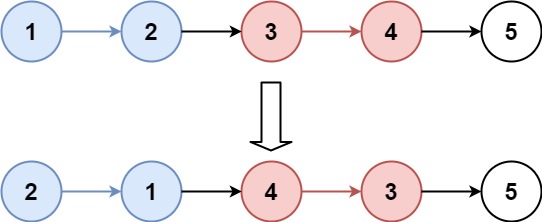
Input: head = [1,2,3,4,5], k = 2
Output: [2,1,4,3,5]
Example 2:
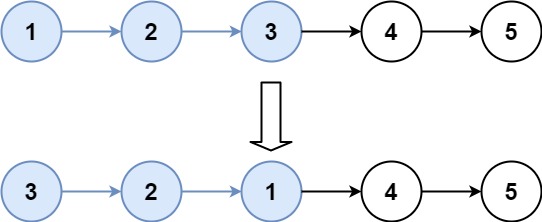
Input: head = [1,2,3,4,5], k = 3
Output: [3,2,1,4,5]
Constraints:
- The number of nodes in the list is
n. 1 <= k <= n <= 50000 <= Node.val <= 1000
Follow-up: Can you solve the problem in O(1) extra memory space?
Approaches
3 approaches with complexity analysis and trade-offs.
This approach uses a stack to reverse nodes in groups of k. We iterate through the linked list, and for each group of k nodes, we push them onto a stack. Then, we pop the nodes from the stack and relink them in reversed order. This process is repeated until the end of the list is reached. If the last group has fewer than k nodes, it is left unchanged.
Algorithm
- Create a
dummynode pointing toheadand aprevpointer todummy. - Create a stack to store nodes.
- Loop through the list:
- First, check if there are
knodes available starting fromprev.next. - If not, break the loop.
- If yes, push the
knodes onto the stack. - Pop nodes from the stack and relink them.
prev.nextwill point to the first popped node. Updateprevafter each pop. - After the group is reversed, link the tail of the reversed group to the start of the next group.
- First, check if there are
- Return
dummy.next.
Walkthrough
This method provides a straightforward way to reverse the groups by leveraging the Last-In, First-Out (LIFO) property of a stack.
Algorithm:
- Create a
dummynode that points to theheadof the list. This simplifies handling the list's head. - Initialize a
ppointer to thedummynode. This pointer will track the end of the previously reversed group. - Use a
whileloop to traverse the list. In each iteration, we first check if there are at leastknodes remaining. - If a group of
knodes exists, push theseknodes onto a stack. - Pop the nodes from the stack one by one and link them back into the list starting from
p.next. Updatepto point to the last node of the newly reversed group. - The
nextof the new tail of the group should point to the start of the next group. - If fewer than
knodes remain, the check at the beginning of the loop will fail, and we return the result. - Return
dummy.next.
import java.util.Stack; class Solution { public ListNode reverseKGroup(ListNode head, int k) { if (head == null || k == 1) return head; Stack<ListNode> stack = new Stack<>(); ListNode dummy = new ListNode(0); dummy.next = head; ListNode p = dummy; while (true) { ListNode check = p.next; int i = 0; for (; i < k; i++) { if (check == null) break; check = check.next; } if (i < k) break; // Not enough nodes ListNode temp = p.next; for (i = 0; i < k; i++) { stack.push(temp); temp = temp.next; } while (!stack.isEmpty()) { p.next = stack.pop(); p = p.next; } p.next = temp; } return dummy.next; }}Complexity
Time
O(N)
Space
O(k)
Trade-offs
Pros
Conceptually simple and easy to understand.
Leverages a standard data structure.
Cons
Uses O(k) extra space, which is not optimal and fails the follow-up constraint.
Solutions
Solution
/** * Definition for singly-linked list. * public class ListNode { * public int val; * public ListNode next; * public ListNode(int val=0, ListNode next=null) { * this.val = val; * this.next = next; * } * } */ public class Solution { public ListNode ReverseKGroup ( ListNode head , int k ) { ListNode dummy = new ListNode ( 0 , head ); ListNode pre = dummy , cur = dummy ; while ( cur . next != null ) { for ( int i = 0 ; i < k && cur != null ; ++ i ) { cur = cur . next ; } if ( cur == null ) { return dummy . next ; } ListNode t = cur . next ; cur . next = null ; ListNode start = pre . next ; pre . next = ReverseList ( start ); start . next = t ; pre = start ; cur = pre ; } return dummy . next ; } private ListNode ReverseList ( ListNode head ) { ListNode pre = null , p = head ; while ( p != null ) { ListNode q = p . next ; p . next = pre ; pre = p ; p = q ; } return pre ; } }Video walkthrough
Newsletter
One sharp idea, every week
System design and interview prep — short enough to finish.
No spam. Unsubscribe anytime.
Practice
Same difficulty — related problems to reinforce the pattern.