
Swap Nodes in Pairs
MedPrompt
Given a linked list, swap every two adjacent nodes and return its head. You must solve the problem without modifying the values in the list's nodes (i.e., only nodes themselves may be changed.)
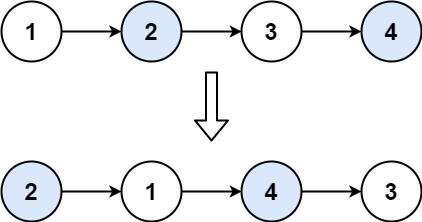
Example 1:
Input: head = [1,2,3,4]
Output: [2,1,4,3]
Explanation:
Example 2:
Input: head = []
Output: []
Example 3:
Input: head = [1]
Output: [1]
Example 4:
Input: head = [1,2,3]
Output: [2,1,3]
Constraints:
- The number of nodes in the list is in the range
[0, 100]. 0 <= Node.val <= 100
Approaches
2 approaches with complexity analysis and trade-offs.
This approach solves the problem by defining a function that swaps the first two nodes of a list and then recursively calls itself on the rest of the list. The base case for the recursion is a list with zero or one node, which is returned as is.
Algorithm
- Check for the base case: if the list is empty (
head == null) or has only one node (head.next == null), return theheadas no swap is possible. - Identify the first two nodes to be swapped:
firstNode = headandsecondNode = head.next. - The rest of the list, starting from
secondNode.next, needs to be processed recursively. CallswapPairs(secondNode.next). - Link the
firstNodeto the result of the recursive call. This meansfirstNode.nextwill point to the head of the swapped sublist. - Perform the swap for the current pair:
secondNode.nextshould point tofirstNode. - Return
secondNode, as it is the new head of this swapped pair.
Walkthrough
The recursive solution elegantly mirrors the definition of the problem. The main idea is to handle the first pair of nodes and then delegate the swapping of the remaining pairs to a recursive call.
Let's consider the list 1 -> 2 -> 3 -> 4. The function swapPairs is called on the head (node 1).
- It identifies the first pair (1, 2).
- It knows that after swapping, node 1's
nextpointer should point to the result of swapping the rest of the list, which is3 -> 4. - It makes a recursive call
swapPairs(3). This call will return the head of the swapped sublist, which is4 -> 3. - Now, it can complete the swap of the first pair. It sets
1.nextto4and2.nextto1. - Finally, it returns
2as the new head of the entire list.
/** * Definition for singly-linked list. * public class ListNode { * int val; * ListNode next; * ListNode() {} * ListNode(int val) { this.val = val; } * ListNode(int val, ListNode next) { this.val = val; this.next = next; } * } */class Solution { public ListNode swapPairs(ListNode head) { // Base case: if the list has 0 or 1 node, no swaps needed. if (head == null || head.next == null) { return head; } // Nodes to be swapped ListNode firstNode = head; ListNode secondNode = head.next; // Recursively call for the list starting from the third node. // This will be the new next for the first node after swapping. firstNode.next = swapPairs(secondNode.next); // Swap the first two nodes by changing pointers secondNode.next = firstNode; // secondNode is the new head of the swapped pair return secondNode; }}Complexity
Time
O(N)
Space
O(N)
Trade-offs
Pros
The code is concise and closely follows the recursive structure of the problem, which can make it easier to understand.
It naturally handles the head of the list without needing a special dummy node.
Cons
The space complexity is O(N) due to the recursion call stack, which is less efficient than an iterative solution.
For extremely long linked lists, this approach could lead to a
StackOverflowError(though not an issue with the problem's constraints).
Solutions
Solution
/** * Definition for singly-linked list. * public class ListNode { * public int val; * public ListNode next; * public ListNode(int val=0, ListNode next=null) { * this.val = val; * this.next = next; * } * } */ public class Solution { public ListNode SwapPairs ( ListNode head ) { if ( head is null || head . next is null ) { return head ; } ListNode t = SwapPairs ( head . next . next ); ListNode p = head . next ; p . next = head ; head . next = t ; return p ; } }Video walkthrough
Newsletter
One sharp idea, every week
System design and interview prep — short enough to finish.
No spam. Unsubscribe anytime.
Practice
Same difficulty — related problems to reinforce the pattern.