
Alternating Groups II
MedPrompt
There is a circle of red and blue tiles. You are given an array of integers colors and an integer k. The color of tile i is represented by colors[i]:
colors[i] == 0means that tileiis red.colors[i] == 1means that tileiis blue.
An alternating group is every k contiguous tiles in the circle with alternating colors (each tile in the group except the first and last one has a different color from its left and right tiles).
Return the number of alternating groups.
Note that since colors represents a circle, the first and the last tiles are considered to be next to each other.
Example 1:
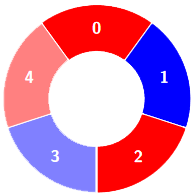
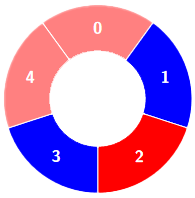
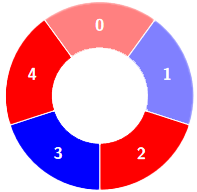
Input: colors = [0,1,0,1,0], k = 3
Output: 3
Explanation:
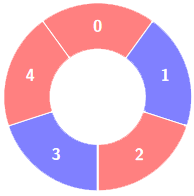
Alternating groups:
Example 2:
Input: colors = [0,1,0,0,1,0,1], k = 6
Output: 2
Explanation:
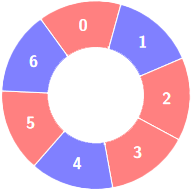
Alternating groups:
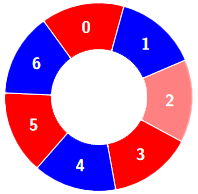
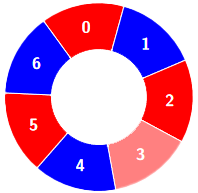
Example 3:
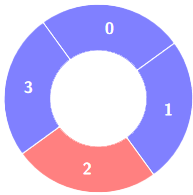
Input: colors = [1,1,0,1], k = 4
Output: 0
Explanation:
Constraints:
3 <= colors.length <= 1050 <= colors[i] <= 13 <= k <= colors.length
Approaches
3 approaches with complexity analysis and trade-offs.
The most straightforward approach is to check every possible contiguous group of k tiles. We iterate through each possible starting index i from 0 to n-1, where n is the number of tiles. For each starting index, we then check if the subsequent k-1 tiles form an alternating color pattern. To handle the circular nature of the tiles, we use the modulo operator (%) to wrap around the array indices.
Algorithm
- Initialize a counter
alternatingGroupsCountto 0. - Iterate with an index
ifrom0ton-1, representing the starting tile of a group. - For each
i, assume the current group is alternating by setting a flagisAlternatingtotrue. - Start an inner loop with an index
jfrom0tok-2to check adjacent pairs within the group. - Compare
colors[(i + j) % n]andcolors[(i + j + 1) % n]. If they are the same, setisAlternatingtofalseand break the inner loop. - After the inner loop, if
isAlternatingis stilltrue, incrementalternatingGroupsCount. - After the outer loop finishes, return
alternatingGroupsCount.
Walkthrough
We can implement this by using two nested loops. The outer loop selects the starting tile of a potential group, and the inner loop verifies the alternating color condition for all k tiles in that group.
public class Solution { public int numberOfAlternatingGroups(int[] colors, int k) { int n = colors.length; if (k > n) { return 0; } int count = 0; for (int i = 0; i < n; i++) { boolean isAlternating = true; for (int j = 0; j < k - 1; j++) { int currentIdx = (i + j) % n; int nextIdx = (i + j + 1) % n; if (colors[currentIdx] == colors[nextIdx]) { isAlternating = false; break; } } if (isAlternating) { count++; } } return count; }}The code iterates through all n possible starting positions. For each start, it checks k-1 pairs, leading to a total of n * (k-1) comparisons in the worst case.
Complexity
Time
O(n * k), where `n` is the length of `colors`. For each of the `n` starting positions, we perform up to `k-1` comparisons.
Space
O(1), as we only use a few variables to store the count and loop indices.
Trade-offs
Pros
Very simple to understand and implement.
Requires no extra space.
Cons
Highly inefficient and will likely result in a 'Time Limit Exceeded' error for large inputs, as the complexity is quadratic in the worst case (
kcan be close ton).
Solutions
Solution
class Solution {public int numberOfAlternatingGroups(int[] colors, int k) { int n = colors.length; int ans = 0, cnt = 0; for (int i = 0; i < n << 1; ++i) { if (i > 0 && colors[i % n] == colors[(i - 1) % n]) { cnt = 1; } else { ++cnt; } ans += i >= n && cnt >= k ? 1 : 0; } return ans; }}Video walkthrough
Newsletter
One sharp idea, every week
System design and interview prep — short enough to finish.
No spam. Unsubscribe anytime.
Practice
Same difficulty — related problems to reinforce the pattern.