
Build a Matrix With Conditions
HardPrompt
You are given a positive integer k. You are also given:
- a 2D integer array
rowConditionsof sizenwhererowConditions[i] = [abovei, belowi], and - a 2D integer array
colConditionsof sizemwherecolConditions[i] = [lefti, righti].
The two arrays contain integers from 1 to k.
You have to build a k x k matrix that contains each of the numbers from 1 to k exactly once. The remaining cells should have the value 0.
The matrix should also satisfy the following conditions:
- The number
aboveishould appear in a row that is strictly above the row at which the numberbelowiappears for allifrom0ton - 1. - The number
leftishould appear in a column that is strictly left of the column at which the numberrightiappears for allifrom0tom - 1.
Return any matrix that satisfies the conditions. If no answer exists, return an empty matrix.
Example 1:
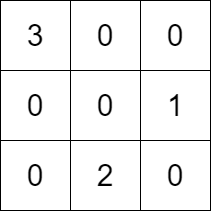
Input: k = 3, rowConditions = [[1,2],[3,2]], colConditions = [[2,1],[3,2]]
Output: [[3,0,0],[0,0,1],[0,2,0]]
Explanation: The diagram above shows a valid example of a matrix that satisfies all the conditions.
The row conditions are the following:
- Number 1 is in row 1, and number 2 is in row 2, so 1 is above 2 in the matrix.
- Number 3 is in row 0, and number 2 is in row 2, so 3 is above 2 in the matrix.
The column conditions are the following:
- Number 2 is in column 1, and number 1 is in column 2, so 2 is left of 1 in the matrix.
- Number 3 is in column 0, and number 2 is in column 1, so 3 is left of 2 in the matrix.
Note that there may be multiple correct answers.
Example 2:
Input: k = 3, rowConditions = [[1,2],[2,3],[3,1],[2,3]], colConditions = [[2,1]]
Output: []
Explanation: From the first two conditions, 3 has to be below 1 but the third conditions needs 3 to be above 1 to be satisfied.
No matrix can satisfy all the conditions, so we return the empty matrix.
Constraints:
2 <= k <= 4001 <= rowConditions.length, colConditions.length <= 104rowConditions[i].length == colConditions[i].length == 21 <= abovei, belowi, lefti, righti <= kabovei != belowilefti != righti
Approaches
2 approaches with complexity analysis and trade-offs.
This approach correctly identifies that the problem can be split into two independent topological sort problems: one for determining the row ordering of numbers and another for the column ordering. It implements topological sort by repeatedly scanning all numbers to find a node with an in-degree of zero. While conceptually straightforward, this method of finding the next node in the topological order is less efficient than standard queue-based or DFS-based algorithms.
Algorithm
- Define a helper function
topologicalSort(k, conditions):- Build a graph using an adjacency list and an in-degree array for numbers 1 to
kbased on the givenconditions. - Initialize an empty list
orderto store the sorted result. - Loop
ktimes to find one number for the order in each iteration. - Inside the loop, iterate from 1 to
kto find a numbernodethat has an in-degree of 0 and has not been placed in theorderlist yet. - If no such
nodeis found, it means there's a cycle in the dependencies. Return an empty list to indicate failure. - Add the found
nodeto theorderlist. To mark it as 'processed', set its in-degree to a special value like -1. - For each neighbor of the
node, decrement its in-degree. - After the main loop, if successful, return the
orderlist.
- Build a graph using an adjacency list and an in-degree array for numbers 1 to
- In the main
buildMatrixfunction:- Call
topologicalSortforrowConditionsto getrowOrder. - Call
topologicalSortforcolConditionsto getcolOrder. - If either
rowOrderorcolOrderis empty, it's impossible to build the matrix, so return an empty matrix. - Create two hashmaps,
rowMapandcolMap, to store the row and column index for each number from 1 tok. - Populate these maps using
rowOrderandcolOrder. - Create a
k x kmatrix initialized with zeros. - For each number
ifrom 1 tok, place it in the matrix atmatrix[rowMap.get(i)][colMap.get(i)]. - Return the constructed matrix.
- Call
Walkthrough
The problem requires satisfying two separate sets of constraints: relative row positions and relative column positions. This suggests we can solve for the row and column placements independently. Each set of conditions, like [above, below] or [left, right], can be modeled as a directed edge in a graph where the numbers 1 to k are vertices. An edge u -> v means u must come before v in the ordering. Finding a valid sequence that respects these constraints is a classic topological sorting problem.
This approach implements a basic version of topological sort. For each of the k positions in the final ordering, it iterates through all k numbers to find one that can be placed next (i.e., one with an in-degree of 0). Once a valid number is found, it's added to the order, and the in-degrees of its dependent numbers are updated. This process is repeated for both row and column conditions. If a topological sort is possible for both, the two resulting orders are used to determine the exact (row, col) coordinates for each number in the final k x k matrix. If either sort fails (due to a cycle in conditions), no solution exists.
class Solution { public int[][] buildMatrix(int k, int[][] rowConditions, int[][] colConditions) { List<Integer> rowOrder = topologicalSort(k, rowConditions); List<Integer> colOrder = topologicalSort(k, colConditions); if (rowOrder.isEmpty() || colOrder.isEmpty()) { return new int[0][0]; } Map<Integer, Integer> rowMap = new HashMap<>(); for (int i = 0; i < k; i++) { rowMap.put(rowOrder.get(i), i); } Map<Integer, Integer> colMap = new HashMap<>(); for (int i = 0; i < k; i++) { colMap.put(colOrder.get(i), i); } int[][] matrix = new int[k][k]; for (int i = 1; i <= k; i++) { matrix[rowMap.get(i)][colMap.get(i)] = i; } return matrix; } private List<Integer> topologicalSort(int k, int[][] conditions) { List<Integer>[] adj = new ArrayList[k + 1]; int[] inDegree = new int[k + 1]; for (int i = 1; i <= k; i++) { adj[i] = new ArrayList<>(); } for (int[] condition : conditions) { adj[condition[0]].add(condition[1]); inDegree[condition[1]]++; } List<Integer> order = new ArrayList<>(); for (int i = 0; i < k; i++) { int nodeToProcess = -1; for (int j = 1; j <= k; j++) { if (inDegree[j] == 0) { nodeToProcess = j; break; } } if (nodeToProcess == -1) { return new ArrayList<>(); // Cycle detected } order.add(nodeToProcess); inDegree[nodeToProcess] = -1; // Mark as processed for (int neighbor : adj[nodeToProcess]) { inDegree[neighbor]--; } } return order; }}Complexity
Time
O(k^2 + n + m) - Building the graph for row conditions takes O(n) and for column conditions takes O(m). The topological sort for rows takes O(k^2 + n) due to the O(k) scan inside a loop that runs `k` times. Similarly, it's O(k^2 + m) for columns. Constructing the final matrix takes O(k^2). The total complexity is dominated by the sorting and matrix construction.
Space
O(k^2 + n + m) - We need O(k + n) space for the row condition graph and O(k + m) for the column condition graph. The maps for row and column positions take O(k) space. The final matrix requires O(k^2) space.
Trade-offs
Pros
The logic is relatively easy to follow: find a valid item, place it, update dependencies, and repeat.
It correctly separates the problem into two manageable subproblems.
Cons
The topological sort implementation is inefficient. The nested loop structure for finding a zero in-degree node results in a time complexity of O(k^2) for the sorting part, which is slower than the standard O(k + E) algorithms.
For large
k, this performance difference can be significant.
Solutions
Solution
class Solution {private int k;public int[][] buildMatrix(int k, int[][] rowConditions, int[][] colConditions) { this.k = k; List<Integer> row = f(rowConditions); List<Integer> col = f(colConditions); if (row == null || col == null) { return new int[0][0]; } int[][] ans = new int[k][k]; int[] m = new int[k + 1]; for (int i = 0; i < k; ++i) { m[col.get(i)] = i; } for (int i = 0; i < k; ++i) { ans[i][m[row.get(i)]] = row.get(i); } return ans; }private List<Integer> f(int[][] cond) { List<Integer>[] g = new List[k + 1]; Arrays.setAll(g, key->new ArrayList<>()); int[] indeg = new int[k + 1]; for (var e : cond) { int a = e[0], b = e[1]; g[a].add(b); ++indeg[b]; } Deque<Integer> q = new ArrayDeque<>(); for (int i = 1; i < indeg.length; ++i) { if (indeg[i] == 0) { q.offer(i); } } List<Integer> res = new ArrayList<>(); while (!q.isEmpty()) { for (int n = q.size(); n > 0; --n) { int i = q.pollFirst(); res.add(i); for (int j : g[i]) { if (--indeg[j] == 0) { q.offer(j); } } } } return res.size() == k ? res : null; }}Video walkthrough
Newsletter
One sharp idea, every week
System design and interview prep — short enough to finish.
No spam. Unsubscribe anytime.
Practice
Same difficulty — related problems to reinforce the pattern.