
Build Array Where You Can Find The Maximum Exactly K Comparisons
HardPrompt
You are given three integers n, m and k. Consider the following algorithm to find the maximum element of an array of positive integers:
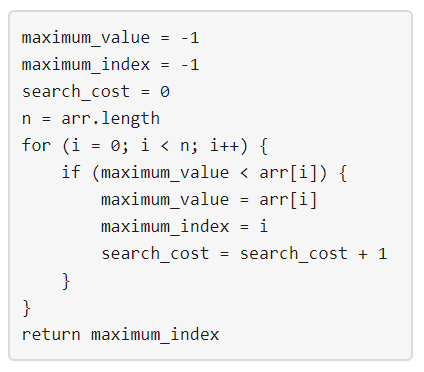
You should build the array arr which has the following properties:
arrhas exactlynintegers.1 <= arr[i] <= mwhere(0 <= i < n).- After applying the mentioned algorithm to
arr, the valuesearch_costis equal tok.
Return the number of ways to build the array arr under the mentioned conditions. As the answer may grow large, the answer must be computed modulo 109 + 7.
Example 1:
Input: n = 2, m = 3, k = 1
Output: 6
Explanation: The possible arrays are [1, 1], [2, 1], [2, 2], [3, 1], [3, 2] [3, 3]
Example 2:
Input: n = 5, m = 2, k = 3
Output: 0
Explanation: There are no possible arrays that satisfy the mentioned conditions.
Example 3:
Input: n = 9, m = 1, k = 1
Output: 1
Explanation: The only possible array is [1, 1, 1, 1, 1, 1, 1, 1, 1]
Constraints:
1 <= n <= 501 <= m <= 1000 <= k <= n
Approaches
3 approaches with complexity analysis and trade-offs.
This approach uses bottom-up dynamic programming. We define a 3D DP state dp[i][j][l] representing the number of ways to build an array of length i with a maximum value of exactly j and a search cost of l. The key to improving efficiency over the naive DP is to optimize the transition. The transition requires summing up values from the previous state, which can be done efficiently using a prefix sum technique, reducing the complexity of each state calculation from O(m) to O(1).
Algorithm
- Initialize a 3D DP table
dp[n+1][m+1][k+1]. - Set base cases:
dp[1][j][1] = 1forjfrom 1 tom. - Iterate
ifrom 2 ton(length of array). - Iterate
lfrom 1 tok(cost). - Initialize
prefixSum = 0. - Iterate
jfrom 1 tom(max value).- Calculate
dp[i][j][l] = (dp[i-1][j][l] * j + prefixSum) % MOD. - Update
prefixSum = (prefixSum + dp[i-1][j][l-1]) % MOD.
- Calculate
- Sum up
dp[n][j][k]for alljfrom 1 tomto get the final answer.
Walkthrough
Let dp[i][j][l] be the number of ways to construct an array of length i such that its maximum element is j and the search cost is l.
Our goal is to compute sum(dp[n][j][k]) for all j from 1 to m.
Base Case: For an array of length 1, arr = [j], the maximum is j and the cost is 1. So, dp[1][j][1] = 1 for 1 <= j <= m.
Recurrence Relation: To compute dp[i][j][l], we consider how the i-th element is added to an array of length i-1.
- Case 1: The
i-th element is not a new maximum. This means the maximum of the firsti-1elements was alreadyj, and thei-th element is chosen from1, ..., j. There arejchoices for thei-th element. The number of ways isdp[i-1][j][l] * j. - Case 2: The
i-th element is a new maximum, and its value isj. This means the maximum of the firsti-1elements was some valuep < j, and the cost for the prefix wasl-1. The number of ways is the sum ofdp[i-1][p][l-1]for allpfrom1toj-1.
The full recurrence is: dp[i][j][l] = (dp[i-1][j][l] * j) + (sum_{p=1}^{j-1} dp[i-1][p][l-1]).
Optimization: The summation term sum_{p=1}^{j-1} dp[i-1][p][l-1] is a prefix sum. As we iterate j from 1 to m (for fixed i and l), we can maintain this sum in a variable, updating it in O(1) at each step.
class Solution { public int numOfArrays(int n, int m, int k) { if (k == 0) return 0; int MOD = 1_000_000_007; long[][][] dp = new long[n + 1][m + 1][k + 1]; // Base case: for length 1, any max j in [1, m] has cost 1. for (int j = 1; j <= m; j++) { dp[1][j][1] = 1; } for (int i = 2; i <= n; i++) { for (int l = 1; l <= k; l++) { long prefixSum = 0; for (int j = 1; j <= m; j++) { // Case 1: The i-th element is not a new maximum. long ways = (dp[i - 1][j][l] * j) % MOD; // Case 2: The i-th element is a new maximum, j. // The prefix sum is sum_{p=1}^{j-1} dp[i-1][p][l-1]. ways = (ways + prefixSum) % MOD; dp[i][j][l] = ways; // Update prefix sum for the next iteration of j. prefixSum = (prefixSum + dp[i - 1][j][l - 1]) % MOD; } } } long ans = 0; for (int j = 1; j <= m; j++) { ans = (ans + dp[n][j][k]) % MOD; } return (int)ans; }}Complexity
Time
O(n * m * k). We have three nested loops for `i`, `l`, and `j`. The operations inside the innermost loop are `O(1)`.
Space
O(n * m * k). For the 3D DP table.
Trade-offs
Pros
Much more efficient than the unoptimized DP due to the prefix sum calculation.
A systematic, iterative approach that avoids recursion overhead.
Cons
Requires a large amount of memory for the 3D DP table.
Solutions
Solution
class Solution {private static final int MOD = (int)1 e9 + 7;public int numOfArrays(int n, int m, int k) { if (k == 0) { return 0; } long[][][] dp = new long[n + 1][k + 1][m + 1]; for (int i = 1; i <= m; ++i) { dp[1][1][i] = 1; } for (int i = 2; i <= n; ++i) { for (int c = 1; c <= Math.min(i, k); ++c) { for (int j = 1; j <= m; ++j) { dp[i][c][j] = (dp[i - 1][c][j] * j) % MOD; for (int j0 = 1; j0 < j; ++j0) { dp[i][c][j] = (dp[i][c][j] + dp[i - 1][c - 1][j0]) % MOD; } } } } long ans = 0; for (int i = 1; i <= m; ++i) { ans = (ans + dp[n][k][i]) % MOD; } return (int)ans; }}Video walkthrough
Newsletter
One sharp idea, every week
System design and interview prep — short enough to finish.
No spam. Unsubscribe anytime.
Practice
Same difficulty — related problems to reinforce the pattern.