
Bulb Switcher
MedPrompt
There are n bulbs that are initially off. You first turn on all the bulbs, then you turn off every second bulb.
On the third round, you toggle every third bulb (turning on if it's off or turning off if it's on). For the ith round, you toggle every i bulb. For the nth round, you only toggle the last bulb.
Return the number of bulbs that are on after n rounds.
Example 1:
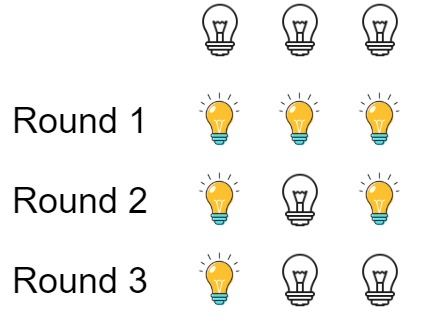
Input: n = 3
Output: 1
Explanation: At first, the three bulbs are [off, off, off].
After the first round, the three bulbs are [on, on, on].
After the second round, the three bulbs are [on, off, on].
After the third round, the three bulbs are [on, off, off].
So you should return 1 because there is only one bulb is on.
Example 2:
Input: n = 0
Output: 0
Example 3:
Input: n = 1
Output: 1
Constraints:
0 <= n <= 109
Approaches
3 approaches with complexity analysis and trade-offs.
The most straightforward approach is to simulate the entire process. We create an array of n bulbs and toggle each bulb according to the rules for each round.
Algorithm
- Create a boolean array of size n to represent bulbs (initially all false/off)
- For each round i from 1 to n:
- Toggle every i-th bulb (starting from position i-1)
- Count the number of bulbs that are true (on)
- Return the count
Walkthrough
We simulate the entire bulb switching process by maintaining an array to track the state of each bulb. For each round i (from 1 to n), we toggle every i-th bulb. After all rounds, we count how many bulbs remain on.
public int bulbSwitch(int n) { if (n == 0) return 0; boolean[] bulbs = new boolean[n]; // Simulate each round for (int round = 1; round <= n; round++) { // Toggle every round-th bulb for (int i = round - 1; i < n; i += round) { bulbs[i] = !bulbs[i]; } } // Count bulbs that are on int count = 0; for (boolean bulb : bulbs) { if (bulb) count++; } return count;}This approach directly implements the problem description. In round 1, we toggle all bulbs (turning them on). In round 2, we toggle every 2nd bulb. This continues until round n where we only toggle the n-th bulb.
Complexity
Time
O(n × n/1 + n × n/2 + ... + n × 1) ≈ O(n²) - For each round i, we toggle n/i bulbs, and the sum of n/i for i from 1 to n is approximately n × log(n), but the nested loops make it O(n²)
Space
O(n) - We need an array of size n to store the state of each bulb
Trade-offs
Pros
Easy to understand and implement
Directly follows the problem description
Good for understanding the problem pattern
Cons
Very inefficient for large values of n
Will cause Time Limit Exceeded for n up to 10^9
Uses significant memory for large n
Solutions
Solution
class Solution {public int bulbSwitch(int n) { return (int)Math.sqrt(n); }}Video walkthrough
Newsletter
One sharp idea, every week
System design and interview prep — short enough to finish.
No spam. Unsubscribe anytime.
Practice
Same difficulty — related problems to reinforce the pattern.