
Check if a Parentheses String Can Be Valid
MedPrompt
A parentheses string is a non-empty string consisting only of '(' and ')'. It is valid if any of the following conditions is true:
- It is
(). - It can be written as
AB(Aconcatenated withB), whereAandBare valid parentheses strings. - It can be written as
(A), whereAis a valid parentheses string.
You are given a parentheses string s and a string locked, both of length n. locked is a binary string consisting only of '0's and '1's. For each index i of locked,
- If
locked[i]is'1', you cannot changes[i]. - But if
locked[i]is'0', you can changes[i]to either'('or')'.
Return true if you can make s a valid parentheses string. Otherwise, return false.
Example 1:
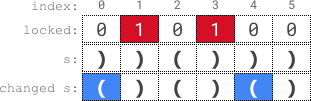
Input: s = "))()))", locked = "010100"
Output: true
Explanation: locked[1] == '1' and locked[3] == '1', so we cannot change s[1] or s[3].
We change s[0] and s[4] to '(' while leaving s[2] and s[5] unchanged to make s valid.
Example 2:
Input: s = "()()", locked = "0000"
Output: true
Explanation: We do not need to make any changes because s is already valid.
Example 3:
Input: s = ")", locked = "0"
Output: false
Explanation: locked permits us to change s[0].
Changing s[0] to either '(' or ')' will not make s valid.
Example 4:
Input: s = "(((())(((())", locked = "111111010111"
Output: true
Explanation: locked permits us to change s[6] and s[8].
We change s[6] and s[8] to ')' to make s valid.
Constraints:
n == s.length == locked.length1 <= n <= 105s[i]is either'('or')'.locked[i]is either'0'or'1'.
Approaches
3 approaches with complexity analysis and trade-offs.
This approach refines the greedy strategy into a single pass. Instead of making a fixed greedy choice for unlocked characters, we track the possible range of balances at each prefix. We maintain a minOpen and maxOpen counter, representing the minimum and maximum possible balance (count('(') - count(')')) for the prefix processed so far. minOpen is achieved by treating all unlocked characters as ')', and maxOpen by treating them as '('.
Algorithm
- First, check if
nis odd. If so, returnfalse. - Initialize two counters,
minOpenandmaxOpen, to 0. These will track the minimum and maximum possible balance of the current prefix. - Iterate through the string from
i = 0ton-1:- If
locked[i] == '0'(unlocked character):- To get the minimum balance, we'd choose
')', so decrementminOpen. - To get the maximum balance, we'd choose
'(', so incrementmaxOpen.
- To get the minimum balance, we'd choose
- If
locked[i] == '1'(fixed character):- If
s[i] == '(', increment bothminOpenandmaxOpen. - If
s[i] == ')', decrement bothminOpenandmaxOpen.
- If
- After updating the counters, perform two checks:
- If
maxOpen < 0, it means that even if we change all unlocked characters to'(', the balance becomes negative. This prefix can never be valid, so returnfalse. minOpencan become negative, which represents a choice of')'that makes the balance negative. However, we can always choose'('instead at an unlocked position to prevent this. So, we clampminOpenat 0:minOpen = Math.max(0, minOpen).
- If
- If
- After the loop, we need to check if a final balance of 0 is achievable. Since we've ensured that a non-negative balance is always possible for any prefix (by checking
maxOpen >= 0and clampingminOpen), we only need to check if a total balance of 0 is possible. This is true if and only if the finalminOpenis 0. IfminOpen > 0, it means even changing all unlocked characters to')'results in a positive balance, so 0 cannot be reached. - Return
minOpen == 0.
Walkthrough
The core idea is to maintain a range [minOpen, maxOpen] of possible net balances for the prefix s[0...i]. A net balance is the number of open parentheses minus the number of closed ones.
-
maxOpen: This is the balance if we greedily convert all unlocked characters in the prefix to'('. For any prefix to be part of a valid string, there must be some way to assign characters to make its balance non-negative. IfmaxOpendrops below zero, it means even the most optimistic assignment results in a negative balance, so we can immediately say it's impossible. -
minOpen: This is the balance if we greedily convert all unlocked characters to')'. This value can temporarily go negative. However, a negativeminOpendoesn't mean failure, because it just represents one possible (pessimistic) assignment. We can always choose to flip an unlocked')'to an'('to increase the balance. Therefore, we clampminOpenat 0 at each step (minOpen = Math.max(0, minOpen)). This essentially means we are only concerned with the lowest achievable non-negative balance.
After iterating through the entire string, we need to be able to form a string with a total balance of exactly 0. The final range of possible balances is [minOpen, maxOpen]. Since we've clamped minOpen to be non-negative, if the final minOpen is greater than 0, it means even the most ')'-heavy assignment results in a positive balance, making a balance of 0 impossible. If the final minOpen is 0, it means a balance of 0 is achievable. (We also know the final maxOpen will be even if n is even, and the range [minOpen, maxOpen] contains values with the same parity, so if 0 is in the range, it's reachable).
class Solution { public boolean canBeValid(String s, String locked) { int n = s.length(); if (n % 2 != 0) { return false; } int minOpen = 0; // Minimum possible balance int maxOpen = 0; // Maximum possible balance for (int i = 0; i < n; i++) { if (locked.charAt(i) == '1') { if (s.charAt(i) == '(') { minOpen++; maxOpen++; } else { minOpen--; maxOpen--; } } else { // unlocked // We can choose ')' to decrease balance minOpen--; // We can choose '(' to increase balance maxOpen++; } // If maxOpen is negative, it's impossible to have a valid prefix if (maxOpen < 0) { return false; } // minOpen can be negative, but we can always use unlocked '(' to raise it. // So, the effective minimum balance can't be less than 0. minOpen = Math.max(0, minOpen); } // At the end, a balance of 0 must be achievable. // Since we clamped minOpen at 0, this is equivalent to checking if minOpen is 0. return minOpen == 0; }}Complexity
Time
O(n) - A single linear scan of the string is performed.
Space
O(1) - Only a constant number of variables are used.
Trade-offs
Pros
The most efficient solution, requiring only a single pass over the string.
Excellent performance with O(n) time and O(1) space complexity.
Provides an elegant way to handle the flexibility of unlocked characters by tracking a range of possibilities.
Cons
The logic, particularly the role of
minOpenand why it's clamped at 0, can be more subtle and harder to grasp than the two-pass approach.
Solutions
Solution
class Solution {public boolean canBeValid(String s, String locked) { int n = s.length(); if (n % 2 == 1) { return false; } int x = 0; for (int i = 0; i < n; ++i) { if (s.charAt(i) == '(' || locked.charAt(i) == '0') { ++x; } else if (x > 0) { --x; } else { return false; } } x = 0; for (int i = n - 1; i >= 0; --i) { if (s.charAt(i) == ')' || locked.charAt(i) == '0') { ++x; } else if (x > 0) { --x; } else { return false; } } return true; }}Video walkthrough
Newsletter
One sharp idea, every week
System design and interview prep — short enough to finish.
No spam. Unsubscribe anytime.
Practice
Same difficulty — related problems to reinforce the pattern.