
Check Knight Tour Configuration
MedPrompt
There is a knight on an n x n chessboard. In a valid configuration, the knight starts at the top-left cell of the board and visits every cell on the board exactly once.
You are given an n x n integer matrix grid consisting of distinct integers from the range [0, n * n - 1] where grid[row][col] indicates that the cell (row, col) is the grid[row][col]th cell that the knight visited. The moves are 0-indexed.
Return true if grid represents a valid configuration of the knight's movements or false otherwise.
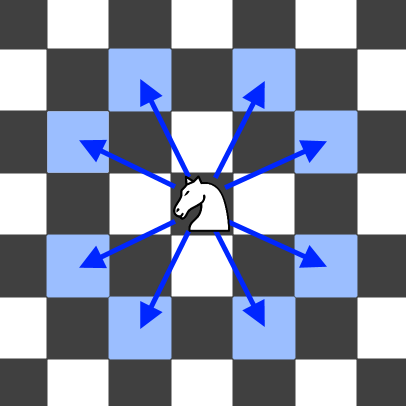
Note that a valid knight move consists of moving two squares vertically and one square horizontally, or two squares horizontally and one square vertically. The figure below illustrates all the possible eight moves of a knight from some cell.
Example 1:
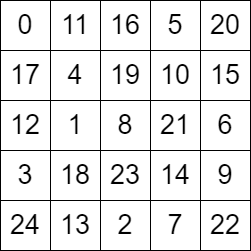
Input: grid = [[0,11,16,5,20],[17,4,19,10,15],[12,1,8,21,6],[3,18,23,14,9],[24,13,2,7,22]]
Output: true
Explanation: The above diagram represents the grid. It can be shown that it is a valid configuration.
Example 2:
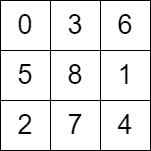
Input: grid = [[0,3,6],[5,8,1],[2,7,4]]
Output: false
Explanation: The above diagram represents the grid. The 8th move of the knight is not valid considering its position after the 7th move.
Constraints:
n == grid.length == grid[i].length3 <= n <= 70 <= grid[row][col] < n * n- All integers in
gridare unique.
Approaches
2 approaches with complexity analysis and trade-offs.
This method simulates the knight's journey step-by-step. Starting from move 0 at (0,0), it iteratively finds the location of the next move (1, 2, 3, ...) by scanning the entire grid. At each step, it verifies if the jump from the previous location to the current one is a valid knight's move.
Algorithm
-
- Check if
grid[0][0]is0. If not, returnfalse.
- Check if
-
- Initialize the current position
(currR, currC)to(0, 0).
- Initialize the current position
-
- Loop through move numbers
kfrom1ton*n - 1.
- Loop through move numbers
-
- Inside the loop, perform a nested loop over the grid to find the cell
(nextR, nextC)wheregrid[nextR][nextC] == k.
- Inside the loop, perform a nested loop over the grid to find the cell
-
- Validate the move from
(currR, currC)to(nextR, nextC). If invalid, returnfalse.
- Validate the move from
-
- Update
currR = nextRandcurrC = nextC.
- Update
-
- If the loop completes, return
true.
- If the loop completes, return
Walkthrough
First, it checks the starting condition: grid[0][0] must be 0. If not, the tour is invalid.
It initializes the knight's current position to (0, 0).
The algorithm then enters a loop that iterates from move k = 1 to n*n - 1.
Inside the loop, it searches the entire n x n grid to find the coordinates (nextR, nextC) of the cell containing the value k.
Once found, it calculates the difference in rows and columns between the current position and the next position: dr = abs(currR - nextR) and dc = abs(currC - nextC).
It validates the move using the knight's move rule: (dr == 1 && dc == 2) || (dr == 2 && dc == 1).
If the move is invalid, the function returns false.
If the move is valid, it updates the current position to (nextR, nextC) and continues to the next iteration.
If the loop completes without returning false, it means all n*n - 1 moves were valid, so the function returns true.
class Solution { public boolean checkValidGrid(int[][] grid) { if (grid[0][0] != 0) { return false; } int n = grid.length; int currR = 0; int currC = 0; for (int k = 1; k < n * n; k++) { boolean foundNext = false; // Search for the cell with value k for (int r = 0; r < n; r++) { for (int c = 0; c < n; c++) { if (grid[r][c] == k) { int dr = Math.abs(currR - r); int dc = Math.abs(currC - c); if (!((dr == 2 && dc == 1) || (dr == 1 && dc == 2))) { return false; // Invalid move } // Update current position for the next move currR = r; currC = c; foundNext = true; break; } } if (foundNext) { break; } } } return true; }}Complexity
Time
O(n^4). The outer loop runs `n*n - 1` times. For each iteration, the inner nested loops scan the grid, taking `O(n^2)` time in the worst case. This results in a total time complexity of `O(n^2 * n^2) = O(n^4)`.
Space
O(1). Only a few variables are used to store the current position and loop counters.
Trade-offs
Pros
Simple logic, easy to follow.
Requires no extra space, i.e.,
O(1)space complexity.
Cons
Inefficient time complexity of
O(n^4)because for each of then*nmoves, it scans the entiren*ngrid.Will be very slow for larger grid sizes, though it passes for the given constraints.
This approach significantly improves performance by avoiding repeated searches. It first creates a lookup table (an array) to store the coordinates of every move number. After this one-time setup, it can retrieve the position of any move in constant time. The algorithm then iterates through the moves sequentially, using the lookup table to get the current and next positions, and verifies each move's validity.
Algorithm
-
- Check if
grid[0][0]is0. If not, returnfalse.
- Check if
-
- Create a
positionsarray of sizen*nto store(row, col)coordinates.
- Create a
-
- Iterate through the
gridto populate thepositionsarray:positions[grid[r][c]] = {r, c}.
- Iterate through the
-
- Loop through move numbers
ifrom0ton*n - 2.
- Loop through move numbers
-
- Get current position
(r1, c1)frompositions[i]and next position(r2, c2)frompositions[i+1].
- Get current position
-
- Validate the move from
(r1, c1)to(r2, c2). If invalid, returnfalse.
- Validate the move from
-
- If the loop completes, return
true.
- If the loop completes, return
Walkthrough
The algorithm begins with the mandatory check: grid[0][0] must be 0.
It then creates an auxiliary 2D array, positions, of size (n*n) x 2. This array will act as a map where positions[k] stores the (row, col) coordinates of the cell with value k.
To populate this positions array, it iterates through the input grid once. For each cell (r, c), it performs the assignment: positions[grid[r][c]] = {r, c}. This entire pre-computation step takes O(n^2) time.
With the positions map built, the algorithm verifies the tour. It loops from k = 0 to n*n - 2.
In each iteration, it fetches the coordinates for the current move k and the next move k+1 directly from the positions array in O(1) time.
(r1, c1) = positions[k](r2, c2) = positions[k+1]It then checks if the move from(r1, c1)to(r2, c2)is a valid knight's move by checking ifabs(r1 - r2) * abs(c1 - c2) == 2. If an invalid move is detected, it returnsfalse. If the loop finishes, all moves are valid, and it returnstrue.
class Solution { public boolean checkValidGrid(int[][] grid) { if (grid[0][0] != 0) { return false; } int n = grid.length; int[][] positions = new int[n * n][2]; for (int r = 0; r < n; r++) { for (int c = 0; c < n; c++) { positions[grid[r][c]][0] = r; positions[grid[r][c]][1] = c; } } for (int i = 0; i < n * n - 1; i++) { int r1 = positions[i][0]; int c1 = positions[i][1]; int r2 = positions[i + 1][0]; int c2 = positions[i + 1][1]; int dr = Math.abs(r1 - r2); int dc = Math.abs(c1 - c2); if (!((dr == 2 && dc == 1) || (dr == 1 && dc == 2))) { return false; } } return true; }}Complexity
Time
O(n^2). Populating the `positions` array by iterating through the grid takes `O(n^2)`. Verifying the `n*n - 1` moves using the pre-computed positions takes another `O(n^2)`. The total complexity is dominated by these steps, resulting in `O(n^2)`.
Space
O(n^2). An auxiliary array of size `n*n` is used to store the coordinates of each move number.
Trade-offs
Pros
Highly efficient with a time complexity of
O(n^2).The logic is straightforward: build a map, then check the path.
Cons
Requires extra space of
O(n^2)for the positions lookup table.
Solutions
Solution
class Solution {public boolean checkValidGrid(int[][] grid) { if (grid[0][0] != 0) { return false; } int n = grid.length; int[][] pos = new int[n * n][2]; for (int i = 0; i < n; ++i) { for (int j = 0; j < n; ++j) { pos[grid[i][j]] = new int[]{i, j}; } } for (int i = 1; i < n * n; ++i) { int[] p1 = pos[i - 1]; int[] p2 = pos[i]; int dx = Math.abs(p1[0] - p2[0]); int dy = Math.abs(p1[1] - p2[1]); boolean ok = (dx == 1 && dy == 2) || (dx == 2 && dy == 1); if (!ok) { return false; } } return true; }}class Solution {public: bool checkValidGrid(vector<vector<int>> &grid) { if (grid[0][0] != 0) { return false; } int n = grid.size(); vector<pair<int, int>> pos(n * n); for (int i = 0; i < n; ++i) { for (int j = 0; j < n; ++j) { pos[grid[i][j]] = {i, j}; } } for (int i = 1; i < n * n; ++i) { auto [x1, y1] = pos[i - 1]; auto [x2, y2] = pos[i]; int dx = abs(x1 - x2); int dy = abs(y1 - y2); bool ok = (dx == 1 && dy == 2) || (dx == 2 && dy == 1); if (!ok) { return false; } } return true; }};class Solution: def checkValidGrid(self, grid: List[List[int]]) -> bool: if grid[0][0]: return False n = len(grid) pos = [None] * (n * n) for i in range(n): for j in range(n): pos[grid[i][j]] = (i, j) for (x1, y1), (x2, y2) in pairwise(pos): dx, dy = abs(x1 - x2), abs(y1 - y2) ok = (dx == 1 and dy == 2) or (dx == 2 and dy == 1) if not ok: return False return TrueVideo walkthrough
Newsletter
One sharp idea, every week
System design and interview prep — short enough to finish.
No spam. Unsubscribe anytime.
Practice
Same difficulty — related problems to reinforce the pattern.