
Count Collisions of Monkeys on a Polygon
MedPrompt
There is a regular convex polygon with n vertices. The vertices are labeled from 0 to n - 1 in a clockwise direction, and each vertex has exactly one monkey. The following figure shows a convex polygon of 6 vertices.
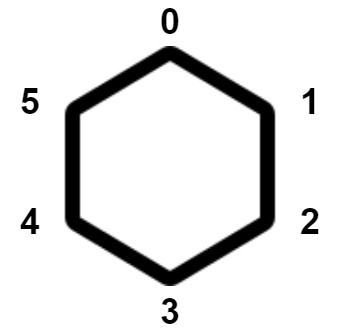
Simultaneously, each monkey moves to a neighboring vertex. A collision happens if at least two monkeys reside on the same vertex after the movement or intersect on an edge.
Return the number of ways the monkeys can move so that at least one collision happens. Since the answer may be very large, return it modulo 109 + 7.
Example 1:
Input: n = 3
Output: 6
Explanation:
There are 8 total possible movements.
Two ways such that they collide at some point are:
- Monkey 1 moves in a clockwise direction; monkey 2 moves in an anticlockwise direction; monkey 3 moves in a clockwise direction. Monkeys 1 and 2 collide.
- Monkey 1 moves in an anticlockwise direction; monkey 2 moves in an anticlockwise direction; monkey 3 moves in a clockwise direction. Monkeys 1 and 3 collide.
Example 2:
Input: n = 4
Output: 14
Constraints:
3 <= n <= 109
Approaches
2 approaches with complexity analysis and trade-offs.
This approach first identifies the core mathematical formula for the problem: (Total Ways - Non-Collision Ways). The total number of ways is 2^n since each of the n monkeys has 2 choices. Non-collision ways occur only when all monkeys move in the same direction (all clockwise or all counter-clockwise), which accounts for 2 ways. Thus, the number of ways with at least one collision is 2^n - 2. This approach then calculates 2^n using a simple loop, taking the modulo 10^9 + 7 at each step to prevent overflow.
Algorithm
-
- Define the modulus
M = 10^9 + 7.
- Define the modulus
-
- Initialize a variable
power_of_2to 1.
- Initialize a variable
-
- Loop from
i = 0ton-1.
- Loop from
-
- In each iteration, update
power_of_2 = (power_of_2 * 2) % M.
- In each iteration, update
-
- After the loop,
power_of_2holds the value of2^n mod M.
- After the loop,
-
- Calculate the final result as
(power_of_2 - 2 + M) % M.
- Calculate the final result as
-
- Return the result as an integer.
Walkthrough
The problem can be simplified by calculating the total number of possible movements and subtracting the number of movements that result in no collisions.
- Each of the
nmonkeys can move to one of two adjacent vertices (clockwise or counter-clockwise). Therefore, the total number of possible movement combinations is2 * 2 * ... * 2(ntimes), which equals2^n. - A collision is avoided only if all monkeys move in unison, maintaining their relative positions. This happens in two scenarios:
- All monkeys move one step clockwise.
- All monkeys move one step counter-clockwise.
- So, there are only 2 non-colliding scenarios.
- The number of ways with at least one collision is
(Total ways) - (Non-colliding ways) = 2^n - 2. - To compute
2^n mod M(whereM = 10^9 + 7), this approach uses a simple for-loop that iteratesntimes. - We initialize a variable
power_of_2to 1. In each iteration, we multiply it by 2 and take the moduloM. - After the loop, we subtract 2 from the result and take the modulo again to get the final answer. Note that we add
Mbefore the final modulo operation to handle potential negative results ifpower_of_2is less than 2.
class Solution { public int countCollisions(int n) { long M = 1_000_000_007; long power_of_2 = 1; for (int i = 0; i < n; i++) { power_of_2 = (power_of_2 * 2) % M; } // The result is (2^n - 2) mod M // We add M before taking the final modulo to handle negative results long result = (power_of_2 - 2 + M) % M; return (int) result; }}Complexity
Time
O(n). The loop runs `n` times to calculate the power, which is too slow for the given constraints.
Space
O(1). We only use a few variables to store the intermediate results.
Trade-offs
Pros
Simple to understand and implement.
Correctly identifies the mathematical formula.
Cons
The time complexity is linear in
n.It will result in a "Time Limit Exceeded" (TLE) error for large values of
n(up to10^9).
This approach uses the same mathematical formula as the naive approach: (2^n - 2) mod M. However, it calculates 2^n mod M much more efficiently using a technique called Binary Exponentiation (or Exponentiation by Squaring). This algorithm computes powers in logarithmic time, which is necessary to pass the time constraints given n can be as large as 10^9.
Algorithm
-
- Identify the formula for the number of collisions:
(2^n - 2) mod M, whereM = 10^9 + 7.
- Identify the formula for the number of collisions:
-
- Implement a helper function
power(base, exp, mod)to calculate(base^exp) mod modusing binary exponentiation.
- Implement a helper function
-
- Inside the
powerfunction:
- a. Initialize
res = 1. - b. Loop while
exp > 0. - c. If
expis odd, updateres = (res * base) % mod. - d. Update
base = (base * base) % mod. - e. Update
exp = exp / 2. - f. Return
res.
- Inside the
-
- Call the
powerfunction withbase=2,exp=n, andmod=Mto get2^n mod M.
- Call the
-
- Calculate the final result as
(power_of_2 - 2 + M) % M.
- Calculate the final result as
-
- Return the result.
Walkthrough
The core idea is to find (2^n - 2) mod M. The bottleneck is calculating 2^n mod M for a very large n.
Binary Exponentiation is an efficient algorithm for this. It works by repeatedly squaring the base and using the binary representation of the exponent.
The principle is:
- If the exponent
nis even,a^n = (a^2)^(n/2). - If the exponent
nis odd,a^n = a * a^(n-1) = a * (a^2)^((n-1)/2).
This allows us to reduce the problem size by half in each step, leading to a logarithmic time complexity.
We can implement this iteratively. We initialize result = 1 and base = 2. We iterate while n > 0.
- If the current last bit of
nis 1 (i.e.,n % 2 == 1), we multiply ourresultby the currentbase. - Then, we square the
base(base = base * base) and right-shiftnby one (n = n / 2). - All multiplications are performed under the modulus
M. - After computing
2^n mod M, we subtract 2 and take the final modulo to get the answer.
class Solution { public int countCollisions(int n) { long M = 1_000_000_007; long power_of_2 = power(2, n, M); // The result is (2^n - 2) mod M long result = (power_of_2 - 2 + M) % M; return (int) result; } // Helper function for binary exponentiation (exponentiation by squaring) private long power(long base, long exp, long mod) { long res = 1; base %= mod; while (exp > 0) { // If exp is odd, multiply base with res if (exp % 2 == 1) { res = (res * base) % mod; } // exp must be even now, so we can square the base // and halve the exponent. exp >>= 1; // exp = exp / 2 base = (base * base) % mod; } return res; }}Complexity
Time
O(log n). The number of iterations in the binary exponentiation algorithm is proportional to the number of bits in `n`, which is `log2(n)`.
Space
O(1) for the iterative implementation. A recursive implementation would use O(log n) stack space.
Trade-offs
Pros
Extremely efficient, with logarithmic time complexity.
Easily handles the large constraint on
n.It's a standard and widely applicable algorithm for modular arithmetic.
Cons
The logic for binary exponentiation is slightly more complex than a simple loop.
Solutions
Solution
class Solution {public int monkeyMove(int n) { final int mod = (int)1 e9 + 7; return (qpow(2, n, mod) - 2 + mod) % mod; }private int qpow(long a, int n, int mod) { long ans = 1; for (; n > 0; n >>= 1) { if ((n & 1) == 1) { ans = ans * a % mod; } a = a * a % mod; } return (int)ans; }}class Solution {public: int monkeyMove(int n) { const int mod = 1e9 + 7; using ll = long long; auto qpow = [&](ll a, int n) { ll ans = 1; for (; n; n >>= 1) { if (n & 1) { ans = ans * a % mod; } a = a * a % mod; } return ans; }; return (qpow(2, n) - 2 + mod) % mod; }};class Solution: def monkeyMove(self, n: int) -> int: mod = 10 ** 9 + 7 return (pow(2, n, mod) - 2) % modVideo walkthrough
Newsletter
One sharp idea, every week
System design and interview prep — short enough to finish.
No spam. Unsubscribe anytime.
Practice
Same difficulty — related problems to reinforce the pattern.