
Count Nodes Equal to Average of Subtree
MedPrompt
Given the root of a binary tree, return the number of nodes where the value of the node is equal to the average of the values in its subtree.
Note:
- The average of
nelements is the sum of thenelements divided bynand rounded down to the nearest integer. - A subtree of
rootis a tree consisting ofrootand all of its descendants.
Example 1:
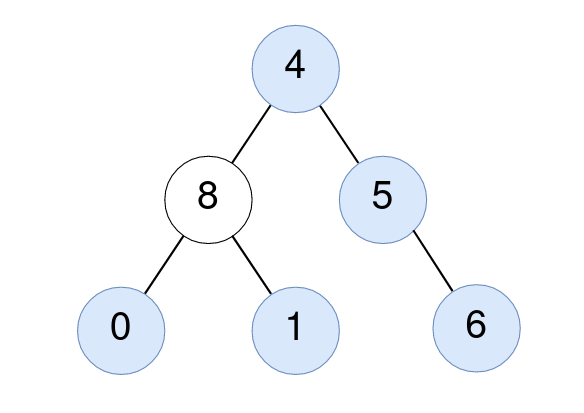
Input: root = [4,8,5,0,1,null,6]
Output: 5
Explanation:
For the node with value 4: The average of its subtree is (4 + 8 + 5 + 0 + 1 + 6) / 6 = 24 / 6 = 4.
For the node with value 5: The average of its subtree is (5 + 6) / 2 = 11 / 2 = 5.
For the node with value 0: The average of its subtree is 0 / 1 = 0.
For the node with value 1: The average of its subtree is 1 / 1 = 1.
For the node with value 6: The average of its subtree is 6 / 1 = 6.
Example 2:

Input: root = [1]
Output: 1
Explanation: For the node with value 1: The average of its subtree is 1 / 1 = 1.
Constraints:
- The number of nodes in the tree is in the range
[1, 1000]. 0 <= Node.val <= 1000
Approaches
2 approaches with complexity analysis and trade-offs.
This approach iterates through every node in the tree. For each node, it performs a separate, full traversal of that node's subtree to calculate the sum of values and the number of nodes. It then computes the average and checks if it matches the node's value. This method is straightforward but computationally expensive.
Algorithm
- Initialize a global counter
resultto 0. - Create a main traversal function,
traverse(node), that visits every node in the tree (e.g., using pre-order traversal). - For each
nodevisited bytraverse:- Call a separate helper function,
getSubtreeInfo(node), to compute the properties of its subtree. - The
getSubtreeInfofunction recursively traverses the subtree starting fromnodeto calculate the totalsumof node values and the totalcountof nodes. - It returns these two values, for example, in an array
[sum, count]. - Back in the
traversefunction, calculate the average:average = sum / count. - If
node.valis equal toaverage, increment the globalresultcounter.
- Call a separate helper function,
- After the
traversefunction finishes, return the finalresult.
Walkthrough
The core idea is to decouple the process of visiting each node from the process of calculating its subtree's properties. We use a primary traversal to iterate through all potential nodes that could satisfy the condition. For each of these nodes, we initiate a secondary, independent traversal on its subtree to gather the necessary data (sum and count) for the average calculation.
/** * Definition for a binary tree node. * public class TreeNode { * int val; * TreeNode left; * TreeNode right; * TreeNode(int val) { this.val = val; } * TreeNode(int val, TreeNode left, TreeNode right) { * this.val = val; * this.left = left; * this.right = right; * } * } */class Solution { int result = 0; public int averageOfSubtree(TreeNode root) { // Main traversal to visit every node traverse(root); return result; } // This function iterates through each node of the tree private void traverse(TreeNode node) { if (node == null) { return; } // For the current node, get its subtree's sum and count int[] subtreeInfo = getSubtreeInfo(node); int sum = subtreeInfo[0]; int count = subtreeInfo[1]; // Check if the node's value equals the average of its subtree if (count > 0 && (sum / count) == node.val) { result++; } // Continue to the next nodes traverse(node.left); traverse(node.right); } // This helper function calculates the sum and count for a given subtree private int[] getSubtreeInfo(TreeNode subRoot) { if (subRoot == null) { return new int[]{0, 0}; // {sum, count} } int[] leftInfo = getSubtreeInfo(subRoot.left); int[] rightInfo = getSubtreeInfo(subRoot.right); int totalSum = subRoot.val + leftInfo[0] + rightInfo[0]; int nodeCount = 1 + leftInfo[1] + rightInfo[1]; return new int[]{totalSum, nodeCount}; }}Complexity
Time
O(N^2) in the worst case. The main `traverse` function visits N nodes. For each node, `getSubtreeInfo` is called, which traverses that node's entire subtree. In a skewed tree (like a linked list), this leads to a complexity of N + (N-1) + ... + 1, which is O(N^2). For a perfectly balanced tree, the complexity is O(N log N).
Space
O(N) in the worst case. The space is determined by the maximum depth of the recursion stack. For a skewed tree, the height is N, leading to O(N) space.
Trade-offs
Pros
Conceptually simple and easy to follow.
Separates the logic of iterating through nodes from the logic of calculating subtree properties.
Cons
Highly inefficient due to massive redundant computations. The sum and count for a subtree are recalculated multiple times as the main traversal moves up the tree.
A more efficient approach uses a single post-order traversal. By processing children before their parent (a bottom-up approach), we can calculate the sum and count for a subtree and pass this information up to the parent. This avoids redundant calculations, as the information for each subtree is computed only once, leading to an optimal linear time solution.
Algorithm
- Initialize a global or member variable
resultCountto 0. - Create a recursive helper function,
postOrder(node), that performs a post-order traversal. - This function will return an array or pair
[subtreeSum, subtreeCount]for the subtree rooted atnode. - Base Case: If
nodeisnull, return[0, 0]as an empty subtree has zero sum and zero count. - Recursive Step:
- Recursively call
postOrderon the left child to get[leftSum, leftCount]. - Recursively call
postOrderon the right child to get[rightSum, rightCount]. - Now, process the current
node(this is the 'post-order' part). - Calculate the sum and count for its subtree:
currentSum = node.val + leftSum + rightSumandcurrentCount = 1 + leftCount + rightCount. - Calculate the average:
average = currentSum / currentCount. - If
node.val == average, incrementresultCount. - Return
[currentSum, currentCount]to the calling function (the parent node).
- Recursively call
- The main function will call
postOrder(root)and then returnresultCount.
Walkthrough
The problem has optimal substructure, meaning the solution for a node depends on the solutions for its children. This is a perfect fit for a post-order traversal, which naturally computes results for subproblems (subtrees) before using them to solve the larger problem (the parent's subtree). We design a recursive function that, for any given node, returns the sum and count of its subtree. While doing so, it also performs the required average check for that node.
/** * Definition for a binary tree node. * public class TreeNode { * int val; * TreeNode left; * TreeNode right; * TreeNode(int val) { this.val = val; } * TreeNode(int val, TreeNode left, TreeNode right) { * this.val = val; * this.left = left; * this.right = right; * } * } */class Solution { int resultCount = 0; public int averageOfSubtree(TreeNode root) { postOrder(root); return resultCount; } // Returns a pair [sum, count] for the subtree rooted at 'node' private int[] postOrder(TreeNode node) { if (node == null) { return new int[]{0, 0}; // {sum, count} } // 1. Traverse left and right subtrees first (post-order) int[] leftSubtree = postOrder(node.left); int[] rightSubtree = postOrder(node.right); // 2. Process the current node using results from children int currentSum = node.val + leftSubtree[0] + rightSubtree[0]; int currentCount = 1 + leftSubtree[1] + rightSubtree[1]; // Calculate average and check the condition if (currentSum / currentCount == node.val) { resultCount++; } // 3. Return sum and count for the parent's calculation return new int[]{currentSum, currentCount}; }}Complexity
Time
O(N), where N is the number of nodes in the tree. Each node is visited and processed exactly once during the single post-order traversal.
Space
O(H), where H is the height of the tree. This space is used by the recursion stack. In the worst case of a skewed tree, H can be N, leading to O(N) space. For a balanced tree, it's O(log N).
Trade-offs
Pros
Optimal time complexity of O(N).
Very efficient as it computes the sum and count for each subtree only once.
Cons
The logic can be slightly less intuitive than the brute-force approach, as the recursive function has to manage and return multiple pieces of information (sum and count).
Solutions
Solution
/** * Definition for a binary tree node. * public class TreeNode { * int val; * TreeNode left; * TreeNode right; * TreeNode() {} * TreeNode(int val) { this.val = val; } * TreeNode(int val, TreeNode left, TreeNode right) { * this.val = val; * this.left = left; * this.right = right; * } * } */ class Solution { private int ans ; public int averageOfSubtree ( TreeNode root ) { ans = 0 ; dfs ( root ); return ans ; } private int [] dfs ( TreeNode root ) { if ( root == null ) { return new int [] { 0 , 0 }; } int [] l = dfs ( root . left ); int [] r = dfs ( root . right ); int s = l [ 0 ] + r [ 0 ] + root . val ; int n = l [ 1 ] + r [ 1 ] + 1 ; if ( s / n == root . val ) { ++ ans ; } return new int [] { s , n }; } }/** * Definition for a binary tree node. * struct TreeNode { * int val; * TreeNode *left; * TreeNode *right; * TreeNode() : val(0), left(nullptr), right(nullptr) {} * TreeNode(int x) : val(x), left(nullptr), right(nullptr) {} * TreeNode(int x, TreeNode *left, TreeNode *right) : val(x), left(left), right(right) {} * }; */ class Solution { public: int ans ; int averageOfSubtree ( TreeNode * root ) { ans = 0 ; dfs ( root ); return ans ; } vector < int > dfs ( TreeNode * root ) { if ( ! root ) return { 0 , 0 }; auto l = dfs ( root -> left ); auto r = dfs ( root -> right ); int s = l [ 0 ] + r [ 0 ] + root -> val ; int n = l [ 1 ] + r [ 1 ] + 1 ; if ( s / n == root -> val ) ++ ans ; return { s , n }; } };# Definition for a binary tree node. # class TreeNode: # def __init__(self, val=0, left=None, right=None): # self.val = val # self.left = left # self.right = right class Solution : def averageOfSubtree ( self , root : Optional [ TreeNode ]) -> int : def dfs ( root ): if root is None : return 0 , 0 ls , ln = dfs ( root . left ) rs , rn = dfs ( root . right ) s = ls + rs + root . val n = ln + rn + 1 if s // n == root . val : nonlocal ans ans += 1 return s , n ans = 0 dfs ( root ) return ansVideo walkthrough
Newsletter
One sharp idea, every week
System design and interview prep — short enough to finish.
No spam. Unsubscribe anytime.
Practice
Same difficulty — related problems to reinforce the pattern.