
Count Nodes With the Highest Score
MedPrompt
There is a binary tree rooted at 0 consisting of n nodes. The nodes are labeled from 0 to n - 1. You are given a 0-indexed integer array parents representing the tree, where parents[i] is the parent of node i. Since node 0 is the root, parents[0] == -1.
Each node has a score. To find the score of a node, consider if the node and the edges connected to it were removed. The tree would become one or more non-empty subtrees. The size of a subtree is the number of the nodes in it. The score of the node is the product of the sizes of all those subtrees.
Return the number of nodes that have the highest score.
Example 1:
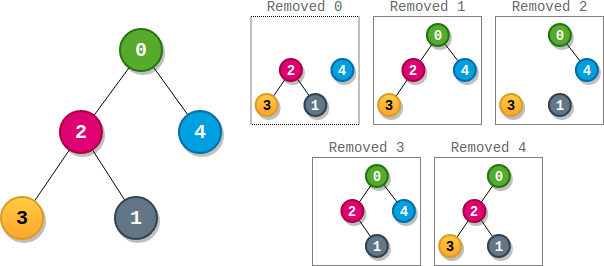
Input: parents = [-1,2,0,2,0]
Output: 3
Explanation:
- The score of node 0 is: 3 * 1 = 3
- The score of node 1 is: 4 = 4
- The score of node 2 is: 1 * 1 * 2 = 2
- The score of node 3 is: 4 = 4
- The score of node 4 is: 4 = 4
The highest score is 4, and three nodes (node 1, node 3, and node 4) have the highest score.
Example 2:
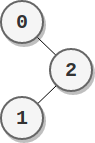
Input: parents = [-1,2,0]
Output: 2
Explanation:
- The score of node 0 is: 2 = 2
- The score of node 1 is: 2 = 2
- The score of node 2 is: 1 * 1 = 1
The highest score is 2, and two nodes (node 0 and node 1) have the highest score.
Constraints:
n == parents.length2 <= n <= 105parents[0] == -10 <= parents[i] <= n - 1fori != 0parentsrepresents a valid binary tree.
Approaches
2 approaches with complexity analysis and trade-offs.
This approach iterates through each node of the tree. For each node, it simulates its removal and then performs a graph traversal (like DFS or BFS) on the remaining parts to identify the resulting subtrees. The sizes of these components are multiplied to get the score for the current node. This process is repeated for all nodes, keeping track of the highest score and the count of nodes achieving it.
Algorithm
- Build an adjacency list
adjfrom theparentsarray to represent the tree structure, whereadj[i]contains the children of nodei. - Define a helper function,
getSubtreeSize(startNode, adj), which performs a traversal (like DFS or BFS) starting fromstartNodeto count all nodes in its subtree. This function takes O(N) time in the worst case. - Initialize
maxScore = -1Landcount = 0. - Iterate through each node
ifrom0ton-1. - For each node
i, calculate its score:- Initialize
currentScore = 1LandnodesBelow = 0. - For each
childof nodeiinadj[i]:- Call
getSubtreeSize(child, adj)to get the size of the child's subtree. - Multiply
currentScoreby this size. - Add this size to
nodesBelow.
- Call
- Calculate the size of the component 'above' node
i. This isparentComponentSize = n - 1 - nodesBelow. - If
parentComponentSizeis greater than 0, multiplycurrentScoreby it.
- Initialize
- Compare
currentScorewithmaxScore.- If
currentScore > maxScore, updatemaxScore = currentScoreand setcount = 1. - If
currentScore == maxScore, incrementcount.
- If
- After the loop, return
count.
Walkthrough
The brute-force method directly implements the score calculation for each node one by one. First, we convert the parents array into a more usable tree structure, like an adjacency list. Then, we loop through every node i from 0 to n-1. For each i, we need to find the sizes of the components that would form if i were removed. These components are the subtrees of i's children and the rest of the tree (containing i's parent).
To find the size of each child's subtree, we can perform a separate traversal (like BFS or DFS) starting from that child. After calculating the sizes of all children's subtrees, we sum them up. The size of the parent component is then n minus 1 (for node i itself) minus the sum of its children's subtree sizes. The score is the product of these component sizes. We use a long to store the score to avoid overflow. We keep track of the maximum score seen so far and how many nodes achieve it.
import java.util.*; class Solution { public int countHighestScoreNodes(int[] parents) { int n = parents.length; List<Integer>[] adj = new ArrayList[n]; for (int i = 0; i < n; i++) { adj[i] = new ArrayList<>(); } for (int i = 1; i < n; i++) { adj[parents[i]].add(i); } long maxScore = -1; int count = 0; for (int i = 0; i < n; i++) { long currentScore = 1; int nodesBelow = 0; for (int child : adj[i]) { int childSubtreeSize = getSubtreeSize(child, adj); currentScore *= childSubtreeSize; nodesBelow += childSubtreeSize; } int parentComponentSize = n - 1 - nodesBelow; if (parentComponentSize > 0) { currentScore *= parentComponentSize; } if (currentScore > maxScore) { maxScore = currentScore; count = 1; } else if (currentScore == maxScore) { count++; } } return count; } private int getSubtreeSize(int startNode, List<Integer>[] adj) { int size = 0; Queue<Integer> queue = new LinkedList<>(); queue.offer(startNode); while (!queue.isEmpty()) { int u = queue.poll(); size++; for (int v : adj[u]) { queue.offer(v); } } return size; }}Complexity
Time
O(N^2). The main loop runs N times. Inside the loop, for each child of the current node, we call `getSubtreeSize`. In the worst case (a skewed tree), `getSubtreeSize` can take O(N) time. Since this is inside a loop that runs N times, the total time complexity is O(N^2).
Space
O(N) to store the adjacency list and for the queue/stack used in the traversal within the loop.
Trade-offs
Pros
Conceptually simple and directly follows the problem definition.
Cons
Highly inefficient due to redundant calculations. The size of the same subtree is computed multiple times.
The time complexity of O(N^2) can be too slow for the given constraints (N up to 10^5), likely resulting in a 'Time Limit Exceeded' error.
Solutions
Solution
public class Solution { private List < int > [] g; private int ans; private long mx; private int n; public int CountHighestScoreNodes(int[] parents) { n = parents.Length; g = new List < int > [n]; for (int i = 0; i < n; ++i) { g[i] = new List < int > (); } for (int i = 1; i < n; ++i) { g[parents[i]].Add(i); } Dfs(0, -1); return ans; } private int Dfs(int i, int fa) { int cnt = 1; long score = 1; foreach(int j in g[i]) { if (j != fa) { int t = Dfs(j, i); cnt += t; score *= t; } } if (n - cnt > 0) { score *= n - cnt; } if (mx < score) { mx = score; ans = 1; } else if (mx == score) { ++ans; } return cnt; }}Video walkthrough
Newsletter
One sharp idea, every week
System design and interview prep — short enough to finish.
No spam. Unsubscribe anytime.
Practice
Same difficulty — related problems to reinforce the pattern.