
Count Number of Ways to Place Houses
MedPrompt
There is a street with n * 2 plots, where there are n plots on each side of the street. The plots on each side are numbered from 1 to n. On each plot, a house can be placed.
Return the number of ways houses can be placed such that no two houses are adjacent to each other on the same side of the street. Since the answer may be very large, return it modulo 109 + 7.
Note that if a house is placed on the ith plot on one side of the street, a house can also be placed on the ith plot on the other side of the street.
Example 1:
Input: n = 1
Output: 4
Explanation:
Possible arrangements:
1. All plots are empty.
2. A house is placed on one side of the street.
3. A house is placed on the other side of the street.
4. Two houses are placed, one on each side of the street.
Example 2:
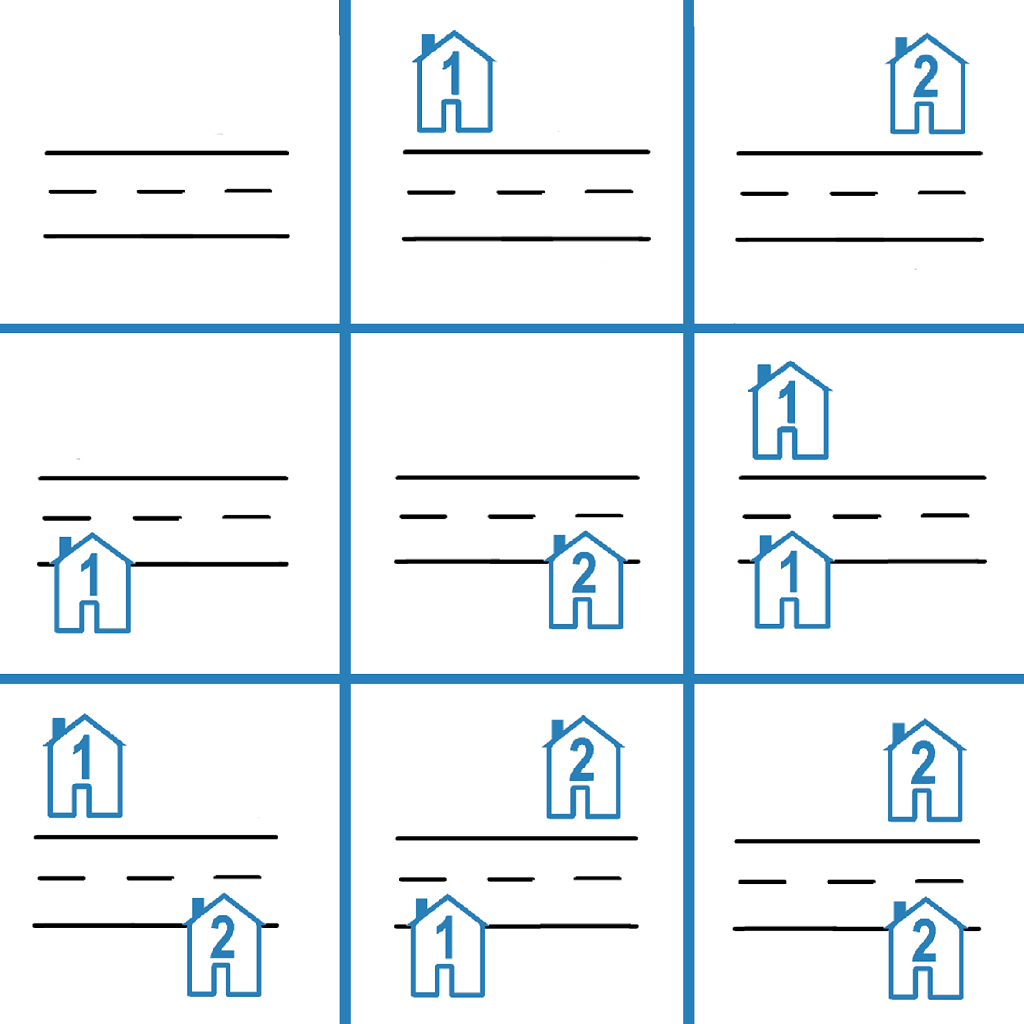
Input: n = 2
Output: 9
Explanation: The 9 possible arrangements are shown in the diagram above.
Constraints:
1 <= n <= 104
Approaches
3 approaches with complexity analysis and trade-offs.
The core of the problem is to find the number of ways to arrange houses on a single line of n plots with no two houses being adjacent. The arrangements on the two sides of the street are independent, so if we find the number of ways for one side, let's say W, the total number of ways is W * W.
The number of ways for a single side follows the Fibonacci sequence. Let ways(n) be the number of ways for n plots. We can derive the recurrence ways(n) = ways(n-1) + ways(n-2). This is because the last plot can either be empty (leaving ways(n-1) possibilities for the prefix) or have a house (which forces the second to last plot to be empty, leaving ways(n-2) possibilities).
This approach uses recursion with memoization (a top-down dynamic programming technique) to compute ways(n). We store the result for each n in a memoization table to avoid redundant calculations, which would otherwise lead to an exponential time complexity.
Algorithm
- First, observe that the house placements on the two sides of the street are independent of each other. If there are
Wways to place houses on one side, the total number of ways for the entire street isW * W. - The problem now is to find the number of ways to place houses on a single row of
nplots such that no two houses are adjacent. Let's call thisways(n). - This subproblem can be solved using dynamic programming. Let
dp[i]be the number of valid ways foriplots. - The recurrence relation is
dp[i] = dp[i-1] + dp[i-2]. This is because foriplots, thei-th plot can either be empty (leavingdp[i-1]ways for the firsti-1plots) or have a house. If thei-th plot has a house, the(i-1)-th plot must be empty, which means we are looking at valid arrangements fori-2plots, givingdp[i-2]ways. - The base cases are
dp[0] = 1(one way for zero plots: the empty arrangement) anddp[1] = 2(two ways for one plot: empty or a house). - We can implement this using a top-down recursive approach with a memoization table to store the results of
dp[i]to avoid re-computation. - Create a memoization array
memoof sizen+1. - Implement a recursive function
solve(k)that returnsdp[k]. Inside the function, check the memo table before computing recursively. - The main function calls
solve(n)to get the ways for one side, squares it, and returns the result modulo10^9 + 7.
Walkthrough
We define a recursive function, say solve(k), that calculates the number of ways for k plots. To prevent re-calculating the same state multiple times, we use a memoization array, memo, initialized to a value indicating that the state has not been computed (e.g., 0).
The base cases for our recursion are solve(0) = 1 and solve(1) = 2. For any other k, we first check if memo[k] has been computed. If it has, we return the stored value. Otherwise, we compute it using the recurrence solve(k) = solve(k-1) + solve(k-2), store the result in memo[k], and then return it. All additions are performed modulo 10^9 + 7.
Finally, the main function calls this helper to get the number of ways for one side with n plots, and then squares this result for the final answer.
class Solution { long MOD = 1_000_000_007; long[] memo; public int countHousePlacements(int n) { memo = new long[n + 1]; long waysForOneSide = solve(n); return (int)((waysForOneSide * waysForOneSide) % MOD); } private long solve(int k) { if (k == 0) return 1; if (k == 1) return 2; if (memo[k] != 0) { return memo[k]; } long result = (solve(k - 1) + solve(k - 2)) % MOD; memo[k] = result; return result; }}Complexity
Time
O(n) - Each state from `0` to `n` is computed only once due to memoization.
Space
O(n) - for the memoization array and the depth of the recursion stack.
Trade-offs
Pros
Conceptually straightforward, as it directly translates the recurrence relation into code.
Efficient enough for the given constraints.
Cons
Uses O(n) extra space for the memoization table.
Recursive solutions have function call overhead, which can be slightly slower than an iterative approach.
For extremely large
n(not the case here), it could lead to a stack overflow.
This approach also solves the problem by calculating the number of ways for a single side, ways(n), which follows the Fibonacci-like recurrence ways(n) = ways(n-1) + ways(n-2). However, instead of a top-down recursive solution, it uses a bottom-up iterative method.
We build the solution from the ground up. We know the answers for the smallest subproblems (n=0 and n=1) and use them to compute the answer for n=2, then use those to compute for n=3, and so on, until we reach n. This is done by iterating and filling a DP array.
Algorithm
- As with the previous approach, the problem reduces to finding
ways(n), the number of arrangements for a single side, and squaring it. - The recurrence
ways(n) = ways(n-1) + ways(n-2)is used. - Instead of recursion, we use an iterative approach (bottom-up DP).
- Create a DP array,
dp, of sizen+1. - Initialize the base cases:
dp[0] = 1anddp[1] = 2. - Iterate from
i = 2ton, filling thedparray using the formuladp[i] = (dp[i-1] + dp[i-2]) % MOD. - After the loop,
dp[n]will hold the value forways(n). - Calculate
(dp[n] * dp[n]) % MODfor the final answer.
Walkthrough
We create a DP array, dp, of size n+1. dp[i] will store the number of ways to place houses on i plots. We initialize the base cases: dp[0] = 1 (for an empty set of plots, there's one way: do nothing) and dp[1] = 2 (for one plot, it can be empty or have a house).
Then, we loop from i = 2 up to n. In each step, we calculate dp[i] by summing the previous two values, dp[i-1] and dp[i-2], taking the result modulo 10^9 + 7. This directly implements the recurrence relation in an iterative fashion.
The final value for one side is dp[n]. We square this and take the modulo to get the answer for both sides of the street.
class Solution { public int countHousePlacements(int n) { long MOD = 1_000_000_007; if (n == 0) return 1; long[] dp = new long[n + 1]; dp[0] = 1; // Base case: 1 way for 0 plots dp[1] = 2; // Base case: 2 ways for 1 plot for (int i = 2; i <= n; i++) { dp[i] = (dp[i - 1] + dp[i - 2]) % MOD; } long waysForOneSide = dp[n]; return (int)((waysForOneSide * waysForOneSide) % MOD); }}Complexity
Time
O(n) - A single loop runs from 2 to `n`.
Space
O(n) - for the DP array.
Trade-offs
Pros
Avoids recursion, eliminating function call overhead and the risk of stack overflow.
Generally slightly faster in practice than the memoized recursive version.
Easy to understand and implement.
Cons
Uses O(n) extra space, which is not optimal.
This approach is an optimization of the bottom-up DP solution. We observe that to calculate the number of ways for n plots, we only need the results for n-1 and n-2. Storing the entire history in a DP array is unnecessary.
We can achieve the same result using only a constant amount of space by keeping track of just the last two values in the sequence. We iterate from 2 to n, and in each step, we calculate the new value, then update our variables to discard the oldest value and keep the two most recent ones for the next iteration.
Algorithm
- The recurrence relation
ways(i) = ways(i-1) + ways(i-2)shows that to compute the current state, we only need the previous two states. - Instead of a full DP array, we can use a few variables to keep track of the necessary previous values.
- Let's track the number of ways for
iplots that end with a house (house) and that end with an empty plot (empty). - Initialize for
i=1:house = 1,empty = 1. - Iterate from
i = 2ton. - In each iteration, calculate the new values for
iplots based on the values fori-1plots:new_house = empty(A house can only be placed after an empty plot).new_empty = (empty + house) % MOD(An empty plot can follow either a house or an empty plot).
- Update
house = new_houseandempty = new_empty. - After the loop, the total ways for one side is
(house + empty) % MOD. - Square this total and take the modulo for the final answer.
Walkthrough
We can track the number of valid arrangements based on what the last plot contains. Let house be the number of ways where the last plot has a house, and empty be the number of ways where it's empty.
For n=1, house = 1 and empty = 1.
Now, we iterate from i = 2 to n. To find the values for i plots:
- An arrangement of
iplots ending in a house must have had an empty plot ati-1. So,new_houseforiis equal to theemptycount fori-1. - An arrangement of
iplots ending with an empty plot could have had either a house or an empty plot ati-1. So,new_emptyforiis the sum ofhouseandemptyfori-1.
After the loop, the total ways for one side is house + empty. We square this and take the modulo.
class Solution { public int countHousePlacements(int n) { long MOD = 1_000_000_007; // Ways for one side with i plots long house = 1; // Arrangements ending with a house for i=1 long empty = 1; // Arrangements ending with an empty plot for i=1 for (int i = 2; i <= n; i++) { long new_house = empty; long new_empty = (house + empty) % MOD; house = new_house; empty = new_empty; } long totalForOneSide = (house + empty) % MOD; return (int)((totalForOneSide * totalForOneSide) % MOD); }}Complexity
Time
O(n) - A single loop runs `n-1` times.
Space
O(1) - We only use a few variables to store the intermediate results.
Trade-offs
Pros
Optimal space complexity of O(1).
Maintains the efficient O(n) time complexity.
Very practical and efficient for the given constraints.
Cons
The logic might be slightly less intuitive at first glance compared to the direct DP array approach.
Solutions
Solution
public class Solution { public int CountHousePlacements(int n) { const int mod = (int) 1 e9 + 7; int[] f = new int[n]; int[] g = new int[n]; f[0] = g[0] = 1; for (int i = 1; i < n; ++i) { f[i] = g[i - 1]; g[i] = (f[i - 1] + g[i - 1]) % mod; } long v = (f[n - 1] + g[n - 1]) % mod; return (int)(v * v % mod); }}class Solution {public int countHousePlacements(int n) { final int mod = (int)1 e9 + 7; int[] f = new int[n]; int[] g = new int[n]; f[0] = 1; g[0] = 1; for (int i = 1; i < n; ++i) { f[i] = g[i - 1]; g[i] = (f[i - 1] + g[i - 1]) % mod; } long v = (f[n - 1] + g[n - 1]) % mod; return (int)(v * v % mod); }}class Solution {public: int countHousePlacements(int n) { const int mod = 1e9 + 7; int f[n], g[n]; f[0] = g[0] = 1; for (int i = 1; i < n; ++i) { f[i] = g[i - 1]; g[i] = (f[i - 1] + g[i - 1]) % mod; } long v = f[n - 1] + g[n - 1]; return v * v % mod; }};class Solution: def countHousePlacements(self, n: int) -> int: mod = 10 ** 9 + 7 f = [1] * n g = [1] * n for i in range(1, n): f[i] = g[i - 1] g[i] = (f[i - 1] + g[i - 1]) % mod v = f[- 1] + g[- 1] return v * v % modVideo walkthrough
Newsletter
One sharp idea, every week
System design and interview prep — short enough to finish.
No spam. Unsubscribe anytime.
Practice
Same difficulty — related problems to reinforce the pattern.