
Count Pairs of Connectable Servers in a Weighted Tree Network
MedPrompt
You are given an unrooted weighted tree with n vertices representing servers numbered from 0 to n - 1, an array edges where edges[i] = [ai, bi, weighti] represents a bidirectional edge between vertices ai and bi of weight weighti. You are also given an integer signalSpeed.
Two servers a and b are connectable through a server c if:
a < b,a != candb != c.- The distance from
ctoais divisible bysignalSpeed. - The distance from
ctobis divisible bysignalSpeed. - The path from
ctoband the path fromctoado not share any edges.
Return an integer array count of length n where count[i] is the number of server pairs that are connectable through the server i.
Example 1:
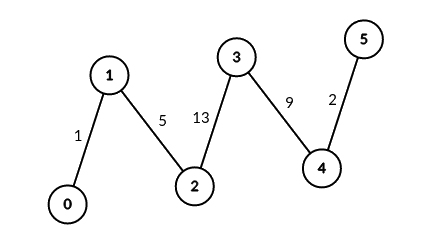
Input: edges = [[0,1,1],[1,2,5],[2,3,13],[3,4,9],[4,5,2]], signalSpeed = 1
Output: [0,4,6,6,4,0]
Explanation: Since signalSpeed is 1, count[c] is equal to the number of pairs of paths that start at c and do not share any edges.
In the case of the given path graph, count[c] is equal to the number of servers to the left of c multiplied by the servers to the right of c.
Example 2:
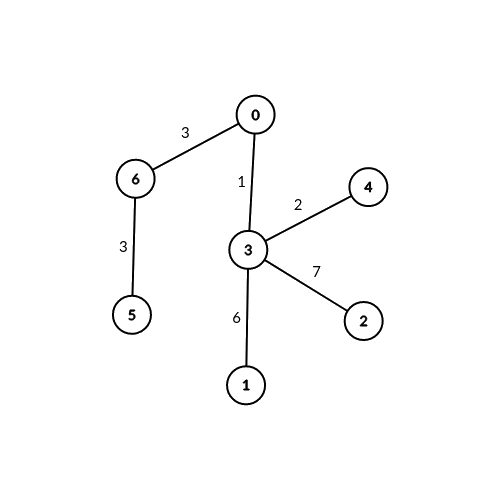
Input: edges = [[0,6,3],[6,5,3],[0,3,1],[3,2,7],[3,1,6],[3,4,2]], signalSpeed = 3
Output: [2,0,0,0,0,0,2]
Explanation: Through server 0, there are 2 pairs of connectable servers: (4, 5) and (4, 6).
Through server 6, there are 2 pairs of connectable servers: (4, 5) and (0, 5).
It can be shown that no two servers are connectable through servers other than 0 and 6.
Constraints:
2 <= n <= 1000edges.length == n - 1edges[i].length == 30 <= ai, bi < nedges[i] = [ai, bi, weighti]1 <= weighti <= 1061 <= signalSpeed <= 106- The input is generated such that
edgesrepresents a valid tree.
Approaches
2 approaches with complexity analysis and trade-offs.
This is a direct, brute-force approach. For each server in the network, we consider it as the central server c. Then, we examine every possible pair of other servers (a, b) to see if they are connectable through c.
Algorithm
- Build an adjacency list from the
edgesarray. - Initialize an answer array
resultof sizen. - For each server
cfrom0ton-1:- Perform a graph traversal (like BFS) starting from
cto calculate distances and the first neighbor on the path to every other node. Store these indistandfirstHoparrays. - Initialize
pairCount = 0. - Iterate
afrom0ton-1. - Iterate
bfroma + 1ton-1. - If
a == corb == c, skip this pair. - Check if
dist[a] % signalSpeed == 0,dist[b] % signalSpeed == 0, andfirstHop[a] != firstHop[b]. - If all true, increment
pairCount. - Set
result[c] = pairCount.
- Perform a graph traversal (like BFS) starting from
- Return
result.
Walkthrough
To check if a pair (a, b) is connectable through c, we must verify all four conditions given in the problem. The main computational tasks are finding the distances from c to a and b, and ensuring their paths from c are edge-disjoint.
A single traversal like Breadth-First Search (BFS) or Depth-First Search (DFS) starting from c can efficiently compute the distances to all other nodes in O(N) time. During this same traversal, we can also determine the "first hop" for each node, which is the neighbor of c on the unique path from c to that node. The path disjointness condition is met if and only if a and b have different first hops from c.
The overall algorithm is as follows:
- Build an adjacency list representation of the tree.
- For each server
cfrom0ton-1: a. Run a traversal (e.g., BFS) fromcto computedistances[i]andfirst_hops[i]for all other nodesi. b. Initialize a counter for connectable pairs to zero. c. Iterate through all pairs of servers(a, b)witha < b. d. Ifaorbis the same asc, skip. e. Check ifdistances[a]anddistances[b]are divisible bysignalSpeed, and iffirst_hops[a]is different fromfirst_hops[b]. f. If all conditions hold, increment the pair counter. g. After checking all pairs, store the result for serverc. - Return the final counts.
Complexity
Time
O(N^3). The main loop runs `N` times. Inside, the traversal takes O(N). The nested loops to check all pairs `(a, b)` take O(N^2). Thus, the total complexity is O(N * (N + N^2)) = O(N^3), which is too slow for the given constraints.
Space
O(N) to store the adjacency list, a distance array, and a first-hop array for each central server.
Trade-offs
Pros
Conceptually simple and directly follows the problem definition.
Cons
The O(N^3) time complexity makes it infeasible for the given constraints.
Solutions
Solution
class Solution {private int signalSpeed;private List<int[]>[] g;public int[] countPairsOfConnectableServers(int[][] edges, int signalSpeed) { int n = edges.length + 1; g = new List[n]; this.signalSpeed = signalSpeed; Arrays.setAll(g, k->new ArrayList<>()); for (var e : edges) { int a = e[0], b = e[1], w = e[2]; g[a].add(new int[]{b, w}); g[b].add(new int[]{a, w}); } int[] ans = new int[n]; for (int a = 0; a < n; ++a) { int s = 0; for (var e : g[a]) { int b = e[0], w = e[1]; int t = dfs(b, a, w); ans[a] += s * t; s += t; } } return ans; }private int dfs(int a, int fa, int ws) { int cnt = ws % signalSpeed == 0 ? 1 : 0; for (var e : g[a]) { int b = e[0], w = e[1]; if (b != fa) { cnt += dfs(b, a, ws + w); } } return cnt; }}Video walkthrough
Newsletter
One sharp idea, every week
System design and interview prep — short enough to finish.
No spam. Unsubscribe anytime.
Practice
Same difficulty — related problems to reinforce the pattern.