
Count Submatrices With All Ones
MedPrompt
Given an m x n binary matrix mat, return the number of submatrices that have all ones.
Example 1:
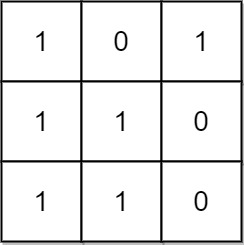
Input: mat = [[1,0,1],[1,1,0],[1,1,0]]
Output: 13
Explanation:
There are 6 rectangles of side 1x1.
There are 2 rectangles of side 1x2.
There are 3 rectangles of side 2x1.
There is 1 rectangle of side 2x2.
There is 1 rectangle of side 3x1.
Total number of rectangles = 6 + 2 + 3 + 1 + 1 = 13.
Example 2:
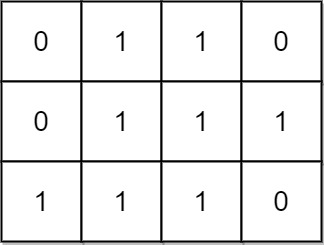
Input: mat = [[0,1,1,0],[0,1,1,1],[1,1,1,0]]
Output: 24
Explanation:
There are 8 rectangles of side 1x1.
There are 5 rectangles of side 1x2.
There are 2 rectangles of side 1x3.
There are 4 rectangles of side 2x1.
There are 2 rectangles of side 2x2.
There are 2 rectangles of side 3x1.
There is 1 rectangle of side 3x2.
Total number of rectangles = 8 + 5 + 2 + 4 + 2 + 2 + 1 = 24.
Constraints:
1 <= m, n <= 150mat[i][j]is either0or1.
Approaches
4 approaches with complexity analysis and trade-offs.
The most straightforward approach is to generate every possible submatrix and check if it contains all ones. A submatrix can be defined by its top-left corner (r1, c1) and its bottom-right corner (r2, c2). We can use four nested loops to iterate through all possible combinations of these corners. For each submatrix, we then perform another nested iteration to verify that all its elements are 1. If they are, we increment a counter.
Algorithm
- Initialize a counter
countto 0. - Use four nested loops to iterate through all possible top-left
(r1, c1)and bottom-right(r2, c2)corners of submatrices. - For each submatrix defined by these corners, create a helper function
isAllOnes. - The
isAllOnesfunction iterates through every cell from(r1, c1)to(r2, c2). - If it finds any cell with a value of
0, it immediately returnsfalse. - If the loops complete without finding any
0, it returnstrue. - If
isAllOnesreturnstrue, increment thecount. - After all possible submatrices are checked, return the final
count.
Walkthrough
This method exhaustively checks every single submatrix within the given matrix mat. The process is as follows:
- We iterate through each possible starting row
r1from0tom-1. - For each
r1, we iterate through each possible starting columnc1from0ton-1. - This pair
(r1, c1)defines the top-left corner of a potential submatrix. - Then, for each top-left corner, we iterate through all possible ending rows
r2fromr1tom-1. - And for each
r2, we iterate through all possible ending columnsc2fromc1ton-1. - This
(r2, c2)pair defines the bottom-right corner. - Once a submatrix is defined, we must verify if it's composed entirely of ones. A helper function can do this by iterating from row
r1tor2and columnc1toc2. If a0is found, the submatrix is invalid. If the entire submatrix is traversed without finding a0, it's a valid all-ones submatrix, and we increment our total count.
class Solution { public int numSubmat(int[][] mat) { int m = mat.length; int n = mat[0].length; int count = 0; for (int r1 = 0; r1 < m; r1++) { for (int c1 = 0; c1 < n; c1++) { for (int r2 = r1; r2 < m; r2++) { for (int c2 = c1; c2 < n; c2++) { if (isAllOnes(mat, r1, c1, r2, c2)) { count++; } } } } } return count; } private boolean isAllOnes(int[][] mat, int r1, int c1, int r2, int c2) { for (int i = r1; i <= r2; i++) { for (int j = c1; j <= c2; j++) { if (mat[i][j] == 0) { return false; } } } return true; }}Complexity
Time
O(m³ * n³)
Space
O(1)
Trade-offs
Pros
Simple to conceptualize and implement.
Requires no extra space.
Cons
Extremely inefficient due to six nested loops in total.
Will result in a 'Time Limit Exceeded' error for the given constraints.
Solutions
Solution
class Solution {public int numSubmat(int[][] mat) { int m = mat.length, n = mat[0].length; int[][] g = new int[m][n]; for (int i = 0; i < m; ++i) { for (int j = 0; j < n; ++j) { if (mat[i][j] == 1) { g[i][j] = j == 0 ? 1 : 1 + g[i][j - 1]; } } } int ans = 0; for (int i = 0; i < m; ++i) { for (int j = 0; j < n; ++j) { int col = 1 << 30; for (int k = i; k >= 0 && col > 0; --k) { col = Math.min(col, g[k][j]); ans += col; } } } return ans; }}Video walkthrough
Newsletter
One sharp idea, every week
System design and interview prep — short enough to finish.
No spam. Unsubscribe anytime.
Practice
Same difficulty — related problems to reinforce the pattern.