
Count the Number of Complete Components
MedPrompt
You are given an integer n. There is an undirected graph with n vertices, numbered from 0 to n - 1. You are given a 2D integer array edges where edges[i] = [ai, bi] denotes that there exists an undirected edge connecting vertices ai and bi.
Return the number of complete connected components of the graph.
A connected component is a subgraph of a graph in which there exists a path between any two vertices, and no vertex of the subgraph shares an edge with a vertex outside of the subgraph.
A connected component is said to be complete if there exists an edge between every pair of its vertices.
Example 1:
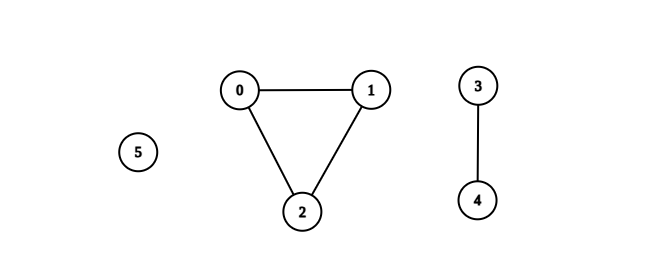
Input: n = 6, edges = [[0,1],[0,2],[1,2],[3,4]]
Output: 3
Explanation: From the picture above, one can see that all of the components of this graph are complete.
Example 2:
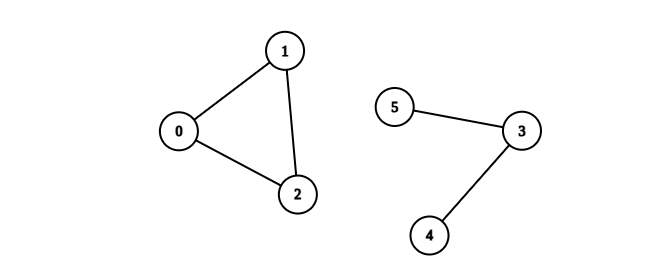
Input: n = 6, edges = [[0,1],[0,2],[1,2],[3,4],[3,5]]
Output: 1
Explanation: The component containing vertices 0, 1, and 2 is complete since there is an edge between every pair of two vertices. On the other hand, the component containing vertices 3, 4, and 5 is not complete since there is no edge between vertices 4 and 5. Thus, the number of complete components in this graph is 1.
Constraints:
1 <= n <= 500 <= edges.length <= n * (n - 1) / 2edges[i].length == 20 <= ai, bi <= n - 1ai != bi- There are no repeated edges.
Approaches
3 approaches with complexity analysis and trade-offs.
This approach first identifies the connected components of the graph using a standard traversal algorithm like Depth-First Search (DFS). For each component found, it then performs a brute-force check to see if it's complete. An adjacency matrix is used to represent the graph, which simplifies checking for an edge between two vertices but requires significant space.
Algorithm
- Graph Representation: Create an
n x nadjacency matrixadj. For each edge[u, v]in the input, setadj[u][v]andadj[v][u]totrue. - Component Identification: Use a
visitedarray to keep track of processed vertices. Iterate fromi = 0ton-1. Ifiis not visited, it marks the beginning of a new connected component. - Traversal: Start a Depth-First Search (DFS) or Breadth-First Search (BFS) from
i. During the traversal, collect all vertices of the component into a list and mark them as visited. - Completeness Check: Once a component is identified, iterate through every pair of distinct vertices
(u, v)within that component. Use the adjacency matrix to check if an edge exists between them (adj[u][v]). If any edge is found to be missing, the component is not complete. - Counting: If all pairs of vertices in a component are connected, increment a counter for complete components.
- Repeat: Continue this process until all vertices in the graph have been visited.
Walkthrough
The method involves three main steps:
-
Build Adjacency Matrix: An
n x nmatrixadjis initialized. We iterate through theedgesarray, and for each edge[u, v], we setadj[u][v] = trueandadj[v][u] = true. This providesO(1)lookup for the existence of an edge. -
Find Components and Check Completeness: We iterate through each vertex of the graph. If a vertex hasn't been visited, we start a traversal (like DFS) to find all nodes in its connected component. These nodes are stored in a temporary list. After the traversal for a component is complete, we check if it's a complete graph. This is done by iterating through all unique pairs of nodes in our list and verifying that an edge exists between them using the adjacency matrix.
-
Count: If a component is verified to be complete, we increment a counter. This process is repeated for all components in the graph.
class Solution { boolean[][] adj; boolean[] visited; public int countCompleteComponents(int n, int[][] edges) { adj = new boolean[n][n]; for (int[] edge : edges) { adj[edge[0]][edge[1]] = true; adj[edge[1]][edge[0]] = true; } visited = new boolean[n]; int completeComponents = 0; for (int i = 0; i < n; i++) { if (!visited[i]) { List<Integer> component = new ArrayList<>(); dfs(i, component, n); if (isComplete(component)) { completeComponents++; } } } return completeComponents; } private void dfs(int u, List<Integer> component, int n) { visited[u] = true; component.add(u); for (int v = 0; v < n; v++) { if (adj[u][v] && !visited[v]) { dfs(v, component, n); } } } private boolean isComplete(List<Integer> component) { int numNodes = component.size(); for (int i = 0; i < numNodes; i++) { for (int j = i + 1; j < numNodes; j++) { int u = component.get(i); int v = component.get(j); if (!adj[u][v]) { return false; } } } return true; }}Complexity
Time
O(n^2) - Building the adjacency matrix takes `O(n^2)`. The traversal over the entire graph takes `O(n^2)` with an adjacency matrix. The completeness check for a component of size `k` takes `O(k^2)`, leading to a total time complexity dominated by `O(n^2)` factors.
Space
O(n^2) - The primary space cost is the `n x n` adjacency matrix. The `visited` array and recursion stack take `O(n)` space.
Trade-offs
Pros
The logic is straightforward, especially the completeness check with an adjacency matrix.
Cons
Inefficient in both time and space, with complexities of
O(n^2).Particularly slow for sparse graphs where the number of edges
Eis much less thann^2.
Solutions
Solution
class Solution {private List<Integer>[] g;private boolean[] vis;public int countCompleteComponents(int n, int[][] edges) { g = new List[n]; vis = new boolean[n]; Arrays.setAll(g, k->new ArrayList<>()); for (int[] e : edges) { int a = e[0], b = e[1]; g[a].add(b); g[b].add(a); } int ans = 0; for (int i = 0; i < n; ++i) { if (!vis[i]) { int[] t = dfs(i); if (t[0] * (t[0] - 1) == t[1]) { ++ans; } } } return ans; }private int[] dfs(int i) { vis[i] = true; int x = 1, y = g[i].size(); for (int j : g[i]) { if (!vis[j]) { int[] t = dfs(j); x += t[0]; y += t[1]; } } return new int[]{x, y}; }}Video walkthrough
Newsletter
One sharp idea, every week
System design and interview prep — short enough to finish.
No spam. Unsubscribe anytime.
Practice
Same difficulty — related problems to reinforce the pattern.