
Count Unreachable Pairs of Nodes in an Undirected Graph
MedPrompt
You are given an integer n. There is an undirected graph with n nodes, numbered from 0 to n - 1. You are given a 2D integer array edges where edges[i] = [ai, bi] denotes that there exists an undirected edge connecting nodes ai and bi.
Return the number of pairs of different nodes that are unreachable from each other.
Example 1:
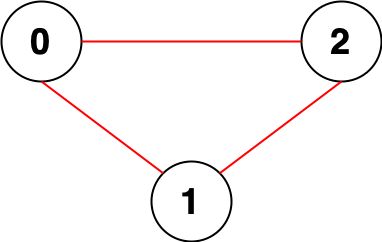
Input: n = 3, edges = [[0,1],[0,2],[1,2]]
Output: 0
Explanation: There are no pairs of nodes that are unreachable from each other. Therefore, we return 0.
Example 2:
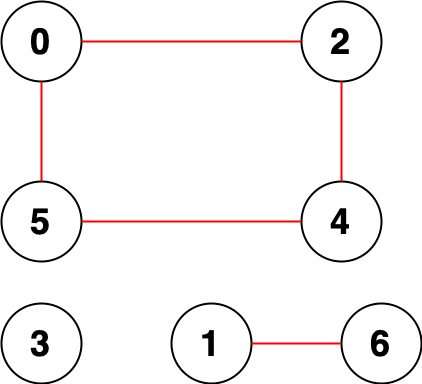
Input: n = 7, edges = [[0,2],[0,5],[2,4],[1,6],[5,4]]
Output: 14
Explanation: There are 14 pairs of nodes that are unreachable from each other:
[[0,1],[0,3],[0,6],[1,2],[1,3],[1,4],[1,5],[2,3],[2,6],[3,4],[3,5],[3,6],[4,6],[5,6]].
Therefore, we return 14.
Constraints:
1 <= n <= 1050 <= edges.length <= 2 * 105edges[i].length == 20 <= ai, bi < nai != bi- There are no repeated edges.
Approaches
3 approaches with complexity analysis and trade-offs.
This approach directly follows the problem definition by checking every possible pair of nodes. For each pair, it determines if they are connected by a path in the graph.
Algorithm
- Build an adjacency list representation of the graph.
- Initialize
unreachable_count = 0. - Loop for
ifrom0ton-1. - Inner loop for
jfromi+1ton-1. - Inside the inner loop, call a function
areConnected(i, j)which performs a BFS/DFS starting fromi. - If
areConnectedreturnsfalse, incrementunreachable_count. - Return
unreachable_count.
Walkthrough
The algorithm iterates through all unique pairs of nodes (i, j) where i < j. For each pair, a graph traversal like Breadth-First Search (BFS) or Depth-First Search (DFS) is initiated from node i. The traversal explores all nodes reachable from i. If node j is not visited by the end of the traversal, the pair (i, j) is considered unreachable, and a counter is incremented. This process is repeated for all n * (n - 1) / 2 pairs. First, an adjacency list representation of the graph is built from the edges array.
public long countUnreachablePairs(int n, int[][] edges) { if (edges.length == 0) { return (long)n * (n - 1) / 2; } List<Integer>[] adj = new ArrayList[n]; for (int i = 0; i < n; i++) { adj[i] = new ArrayList<>(); } for (int[] edge : edges) { adj[edge[0]].add(edge[1]); adj[edge[1]].add(edge[0]); } long unreachableCount = 0; for (int i = 0; i < n; i++) { for (int j = i + 1; j < n; j++) { if (!areConnected(i, j, n, adj)) { unreachableCount++; } } } return unreachableCount;} private boolean areConnected(int start, int end, int n, List<Integer>[] adj) { Queue<Integer> queue = new LinkedList<>(); boolean[] visited = new boolean[n]; queue.offer(start); visited[start] = true; while (!queue.isEmpty()) { int node = queue.poll(); if (node == end) { return true; } for (int neighbor : adj[node]) { if (!visited[neighbor]) { visited[neighbor] = true; queue.offer(neighbor); } } } return false;}Complexity
Time
O(N^2 * (N + E)). There are O(N^2) pairs. For each pair, we perform a graph traversal which takes O(N + E) time in the worst case. This is computationally prohibitive for the given constraints.
Space
O(N + E). O(N + E) for the adjacency list and O(N) for the `visited` array and queue/stack used in each traversal.
Trade-offs
Pros
Simple to understand and implement directly from the problem definition.
Cons
Extremely inefficient and will result in a 'Time Limit Exceeded' error on most platforms for the given constraints.
Performs a lot of redundant work by re-calculating reachability for nodes within the same component multiple times.
Solutions
Solution
class Solution {private List<Integer>[] g;private boolean[] vis;public long countPairs(int n, int[][] edges) { g = new List[n]; vis = new boolean[n]; Arrays.setAll(g, i->new ArrayList<>()); for (var e : edges) { int a = e[0], b = e[1]; g[a].add(b); g[b].add(a); } long ans = 0, s = 0; for (int i = 0; i < n; ++i) { int t = dfs(i); ans += s * t; s += t; } return ans; }private int dfs(int i) { if (vis[i]) { return 0; } vis[i] = true; int cnt = 1; for (int j : g[i]) { cnt += dfs(j); } return cnt; }}Video walkthrough
Newsletter
One sharp idea, every week
System design and interview prep — short enough to finish.
No spam. Unsubscribe anytime.
Practice
Same difficulty — related problems to reinforce the pattern.