
Count Valid Paths in a Tree
HardPrompt
There is an undirected tree with n nodes labeled from 1 to n. You are given the integer n and a 2D integer array edges of length n - 1, where edges[i] = [ui, vi] indicates that there is an edge between nodes ui and vi in the tree.
Return the number of valid paths in the tree.
A path (a, b) is valid if there exists exactly one prime number among the node labels in the path from a to b.
Note that:
- The path
(a, b)is a sequence of distinct nodes starting with nodeaand ending with nodebsuch that every two adjacent nodes in the sequence share an edge in the tree. - Path
(a, b)and path(b, a)are considered the same and counted only once.
Example 1:
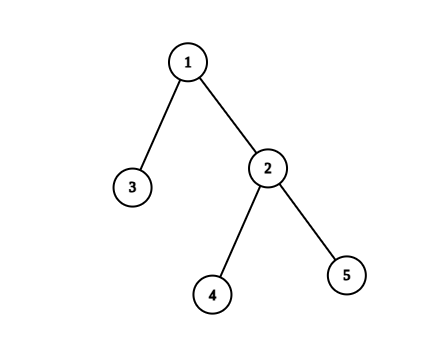
Input: n = 5, edges = [[1,2],[1,3],[2,4],[2,5]]
Output: 4
Explanation: The pairs with exactly one prime number on the path between them are:
- (1, 2) since the path from 1 to 2 contains prime number 2.
- (1, 3) since the path from 1 to 3 contains prime number 3.
- (1, 4) since the path from 1 to 4 contains prime number 2.
- (2, 4) since the path from 2 to 4 contains prime number 2.
It can be shown that there are only 4 valid paths.
Example 2:
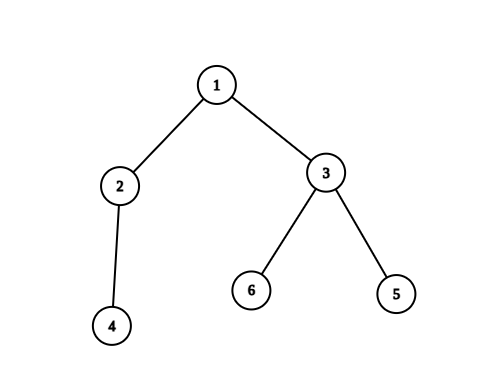
Input: n = 6, edges = [[1,2],[1,3],[2,4],[3,5],[3,6]]
Output: 6
Explanation: The pairs with exactly one prime number on the path between them are:
- (1, 2) since the path from 1 to 2 contains prime number 2.
- (1, 3) since the path from 1 to 3 contains prime number 3.
- (1, 4) since the path from 1 to 4 contains prime number 2.
- (1, 6) since the path from 1 to 6 contains prime number 3.
- (2, 4) since the path from 2 to 4 contains prime number 2.
- (3, 6) since the path from 3 to 6 contains prime number 3.
It can be shown that there are only 6 valid paths.
Constraints:
1 <= n <= 105edges.length == n - 1edges[i].length == 21 <= ui, vi <= n- The input is generated such that
edgesrepresent a valid tree.
Approaches
2 approaches with complexity analysis and trade-offs.
This approach iterates through every possible starting node in the tree. For each starting node, it performs a traversal (like Depth-First Search or Breadth-First Search) to find all possible paths originating from it. During the traversal, it keeps track of the number of prime nodes encountered on the current path. If a path to a destination node contains exactly one prime number, it's counted as a valid path.
Algorithm
- Create a boolean array
isPrimeof sizen+1and populate it using the Sieve of Eratosthenes. - Build an adjacency list for the tree from the
edgesarray. - Initialize a global counter
validPathsto 0. - Iterate through each node
ifrom 1 ton. - For each
i, start a DFS traversaldfs(u, parent, primeCount)fromu=i,parent=-1,primeCount=0. - In the
dfs(u, p, pc)function: a. Update the prime count:new_pc = pc + (isPrime[u] ? 1 : 0). b. Ifnew_pc > 1, stop exploring this path and return. c. Ifnew_pc == 1, it means the path from the start nodeitouis valid. IncrementvalidPaths. d. For each neighborvofu(wherev != p), recursively calldfs(v, u, new_pc). - After the outer loop finishes, return
validPaths / 2to correct for double counting.
Walkthrough
First, we need a way to quickly check if a number is prime. We can pre-compute primality for all numbers from 1 to n using the Sieve of Eratosthenes and store the results in a boolean array.
Next, we build an adjacency list representation of the tree from the given edges.
The main part of the algorithm involves a nested loop. The outer loop iterates through each node i from 1 to n, considering it as a potential starting point of a path.
From each starting node i, we initiate a Depth-First Search (DFS). The DFS function, say dfs(u, p, primeCount), will explore the tree, where u is the current node, p is its parent (to avoid going backward), and primeCount is the count of prime numbers on the path from the starting node i to u.
Inside the DFS, we first update primeCount based on whether the current node u is prime.
If the primeCount for the path from i to u is exactly 1, we've found a valid path (i, u). We've found a valid path (i, u). We increment our total count.
The DFS continues recursively to all neighbors of u (except its parent), but only if the primeCount does not exceed 1. If it's already 2 or more, any further extension of the path will also have at least 2 primes, so we can prune this search branch.
Since this process counts each path (a, b) twice (once when starting from a and once from b), the final result is the total count divided by 2.
class Solution { private List<List<Integer>> adj; private boolean[] isPrime; private long count = 0; private int n; public long countPaths(int n, int[][] edges) { this.n = n; sieve(n); adj = new ArrayList<>(); for (int i = 0; i <= n; i++) { adj.add(new ArrayList<>()); } for (int[] edge : edges) { adj.get(edge[0]).add(edge[1]); adj.get(edge[1]).add(edge[0]); } for (int i = 1; i <= n; i++) { // We only need to start from a prime or a node adjacent to a prime // to find all paths, but for simplicity of brute force, we start from all. dfs(i, -1, 0); } return count / 2; } private void dfs(int u, int p, int primeCount) { if (isPrime[u]) { primeCount++; } if (primeCount > 1) { return; } // If start node is not u, and path is valid, count it. if (primeCount == 1) { count++; } for (int v : adj.get(u)) { if (v != p) { dfs(v, u, primeCount); } } } private void sieve(int n) { isPrime = new boolean[n + 1]; if (n >= 2) { java.util.Arrays.fill(isPrime, true); } isPrime[0] = isPrime[1] = false; for (int i = 2; i * i <= n; i++) { if (isPrime[i]) { for (int j = i * i; j <= n; j += i) { isPrime[j] = false; } } } }}Complexity
Time
O(N^2). The outer loop runs N times. Inside, the DFS can traverse up to N nodes. This leads to N * O(N) = O(N^2) complexity. The initial Sieve takes O(N log log N), but it's dominated by the main loop.
Space
O(N). We need space for the adjacency list (O(N)), the `isPrime` array (O(N)), and the recursion stack for DFS (O(N) in the worst case for a skewed tree).
Trade-offs
Pros
Relatively simple to understand and implement compared to more optimized solutions.
Correctly solves the problem for small
n.
Cons
Highly inefficient due to redundant computations. The traversal from each node re-explores large parts of the tree.
Will result in a "Time Limit Exceeded" error for the given constraints (
nup to 10^5).
Solutions
Solution
class PrimeTable { private final boolean [] prime ; public PrimeTable ( int n ) { prime = new boolean [ n + 1 ]; Arrays . fill ( prime , true ); prime [ 0 ] = false ; prime [ 1 ] = false ; for ( int i = 2 ; i <= n ; ++ i ) { if ( prime [ i ]) { for ( int j = i + i ; j <= n ; j += i ) { prime [ j ] = false ; } } } } public boolean isPrime ( int x ) { return prime [ x ]; } } class UnionFind { private final int [] p ; private final int [] size ; public UnionFind ( int n ) { p = new int [ n ]; size = new int [ n ]; for ( int i = 0 ; i < n ; ++ i ) { p [ i ] = i ; size [ i ] = 1 ; } } public int find ( int x ) { if ( p [ x ] != x ) { p [ x ] = find ( p [ x ]); } return p [ x ]; } public boolean union ( int a , int b ) { int pa = find ( a ), pb = find ( b ); if ( pa == pb ) { return false ; } if ( size [ pa ] > size [ pb ]) { p [ pb ] = pa ; size [ pa ] += size [ pb ]; } else { p [ pa ] = pb ; size [ pb ] += size [ pa ]; } return true ; } public int size ( int x ) { return size [ find ( x )]; } } class Solution { private static final PrimeTable PT = new PrimeTable ( 100010 ); public long countPaths ( int n , int [][] edges ) { List < Integer >[] g = new List [ n + 1 ]; Arrays . setAll ( g , i -> new ArrayList <>()); UnionFind uf = new UnionFind ( n + 1 ); for ( int [] e : edges ) { int u = e [ 0 ], v = e [ 1 ]; g [ u ]. add ( v ); g [ v ]. add ( u ); if (! PT . isPrime ( u ) && ! PT . isPrime ( v )) { uf . union ( u , v ); } } long ans = 0 ; for ( int i = 1 ; i <= n ; ++ i ) { if ( PT . isPrime ( i )) { long t = 0 ; for ( int j : g [ i ]) { if (! PT . isPrime ( j )) { long cnt = uf . size ( j ); ans += cnt ; ans += cnt * t ; t += cnt ; } } } } return ans ; } }Video walkthrough
Newsletter
One sharp idea, every week
System design and interview prep — short enough to finish.
No spam. Unsubscribe anytime.
Practice
Same difficulty — related problems to reinforce the pattern.